EU leaders brace for tough talks on budget and Ukraine – Europe live
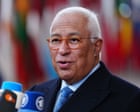
António Costa says the next long-term budget is ‘the most important’ item on the agenda The Danish prime minister, Mette Frederiksen, has acknowledged that leaders remain “very far apart,” agreeing with Germany’s Merz that the current proposal is not going to work. “The budget is too large and not sufficiently future-oriented,” she said, calling for more work on competitiveness, defence and security.
EU leaders are meeting in Brussels today and tomorrow for tricky talks on the next financial budget and Ukraine, with disagreements threatening to expose deep divisions within the bloc.
The European Council president, António Costa, told reporters this morning that the next long-term budget was “the most important” item on the agenda, as he acknowledged that getting an agreement at this summit may not be possible.
“My objective is to bring our leader closer to a deal,” he said, adding he is hoping that a compromise could be agreed “by the end of this year.”
Arrivals are now under way and I will bring you some reactions from the leaders coming in for the meeting.
Spain’s Pedro Sánchez is the only leader not present as he is fighting for his political survival ahead of this Sunday’s parliamentary election. France’s Emmanuel Macron will represent his views.
Elsewhere, I will keep an eye on the latest news coming from Ukraine and on Serbia, where we are expecting a date for the presidential election – also by the end of the year – to choose Aleksandar Vučić’s successor.
It’s Thursday, 26 November 2026, it’s Jakub Krupa here, and this is Europe Live.
The Danish prime minister, Mette Frederiksen, has acknowledged that leaders remain “very far apart,” agreeing with Germany’s Merz that the current proposal is not going to work.
“The budget is too large and not sufficiently future-oriented,” she said, calling for more work on competitiveness, defence and security.
Just like Martin earlier, she noted that 2027 will see “very important political elections across the member state” and openly acknowledged that “the situation within Europe could become even more challenging” as a result, making it important to get a deal this year.
Frederiksen also backed Merz’s call to link the funding for with the new budget, saying Ukraine serves as “Europe’s first line of defence.”
“If Ukraine falls, I believe there is a significant risk … that Russia might push further,” she warned.
She added that “in Europe, we have a tradition of collectively financing our shared expenses, and we must view the funding for Ukraine as part of that.”
Interestingly, she was also asked if the EU would be able to continue this support for Ukraine given several elections in the next 12 months, which could see rightwing and far-right parties come to power in France, Spain and Poland, among others.
She replied candidly that she didn’t know, but strongly “cautioned” against thinking that Europe could simply stop supporting Ukraine and spend the money elsewhere.
“Given everything we are seeing from the Russian side right now … if we let Ukraine fall, we essentially open the door for Russia to advance further,” she said.
Irish prime minister Micheál Martin also said he was confident the EU and the EU “will be in a position to resolve the outstanding issue” of tuition fees, as he hailed the deals on sanitary and phytosanitary rules, youth mobility, and energy.
Speaking at the beginning of the European Council meeting in Brussels, Martin said that “for the young people of Britain and the young people of Europe, this is a win-win.”
“I often felt with Brexit that the young people of Britain perhaps were not consulted as strongly in terms of the implications for youth mobility.”
“Young people love to travel, and we don’t need to be placing barriers in the way of young people accessing education, accessing work. In Europe, that should never be the case and I believe we can facilitate that.”
On SPS, he said that it’s “very good news for Ireland and the UK,” as it will “remove barriers” affecting small to medium size companies in particular.
The deal on the ETS also “makes sense,” as “there’s the potential of the UK and being part of the European energy market also offers up opportunities for both sides.”
Martin was perhaps the only leader offering any sort of detailed answer on the EU-UK relations when asked about the hold up caused by the lack of agreement on tuition fees, with most of them just delivering general platitudes.
Czech Republic’s Babiš chuckled and said he thought it was a mistake for Britain to leave, but welcomed its involvement in peace talks on Ukraine, while Latvia’s Kulbergs said he wasn’t across the detail on that issue.
Sweden’s Kristersson also said he was “not into details” on that point, but welcomed “a major step forward” in relations with Britain.
Irish prime minister Micheál Martin also wanted the EU to ensure there is enough money in the budget on agriculture.
He said he raised this issue in talks with the European Council’s António Costa this morning.
“I met with him to this morning, in a bilateral, particularly to press Irish issues and identified the Common Agricultural policies as key concern and that agriculture and agri-food industry is of paramount importance to us.”
But Martin sounded sympathetic towards Costa’s impossible job today, as he needs to “endeavour to reconcile the irreconcilable across the 27 member states.”
But he also makes the clearest reference yet to the worries that are clearly on the minds of many EU leaders, saying:
“But it is very important that we get a budget because if we don’t secure an agreement before the end of the year then I think the prospects of doing it in the first half of 2027 are very dim.”
Yes, that’s almost certainly a reference to the French presidential election early next year.
Germany’s chancellor Friedrich Merz is ready to push back against proposals already on the table, as he told reporters the current offer “does not provide a basis for reaching an agreement” and doubled down on calls to support Ukraine by the entire bloc.
“The overall volume remains too high,” he said, stressing that “Europe requires sound public finances.”
In terms of Germany’s priorities, he talked about the need to have a prosperous economy and strengthen defence capabilities, which he pointedly said “applies to all of Europe, and it applies to Ukraine.”
He said he was unwilling to opt out for a technical fudge on supporting Ukraine like last year, when three countries opted out from the loan. “I do not see any possibility of repeating that this year,” he said.
“When the European Union provides funding, it does so as the European Union – and that Union consists of 27 member states, not 23 or 24,” he said.
Merz stressed that “we must ensure that Ukraine continues to receive sufficient support in the coming years,” both on military and humanitarian spending.
“We must help [Ukraine] get through a very difficult winter, but we must also assist with its reconstruction,” he stressed.
He called for “constructive” talks with a view of reaching a compromise at some point before the end of the year.
“Yet, I want the overarching framework to be clear: it is in all of our interests that the European Union remains politically capable of action. We are operating in a global environment that requires a sovereign Europe. In my view, this is the most important guiding principle: Europe must remain capable of acting and must become sovereign,” he said.
Bulgaria will support a proposed new €45bn EU loan to Ukraine, but only for the part earmarked for non-military aid, prime minister Rumen Radev said.
In a compromise offer to a group of countries objecting to supporting Ukraine’s military financially, the European Commission president, Ursula von der Leyen, stressed last week that the new loan would consist of two parts, a military and civilian one.
It seems to have done the trick for Bulgaria, with Radev declaring he is willing to support the non-military part of the deal.
“Bulgaria is going to take part in the loan of €20bn (for) non-military support for Ukraine,” Radev told reporters as he arrived at an EU summit in Brussels, quoted by Reuters.
“We have a huge historic diaspora of Bulgarians living in Ukraine, our wish is to concentrate our support in that area. We are going to contribute, but no money from Bulgaria for weapons,” Radev said.
Latvia’s Andris Kulbergs offered a similar argument, saying that countries on the eastern flank had to ramp up their defence spending, often at the cost of other priorities, and so need to be supported with a strong EU budget with funds for cohesion and agriculture.
“We are putting the most money in security and defence, as we are getting attacked as an economy [because of] geographical punishment, but then we are seeing in our shops all these products from countries getting the most support of farmers. … That is not really the case of free trade, and that’s exactly where we need that support,” he said.
He urged leaders to “put aside our local mindsets and put on the hats of Europe.”
Estonia’s Kristen Michal argued against any cuts to the EU budget, “because if we look at what Russia is doing on the eastern border, [it] needs protecting; needs investments and money.”
He also warned that Ukraine “probably will face a winter like hell,” and so “they must know that Ukraine has its back, with money and everything we have.”
“They should not … be in a position [that they need] to take a bad deal.”
Michal said that there are “no signs that Putin wants peace,” with Russia trying “mind games” of pretending that the European security architecture poses any threat to Moscow.
“The European security architecture was fine until Putin attacked Ukraine,” he said.
He also disagreed with the Czech suggestion that the issues of EU budget and Ukraine should not be linked.
“Europe and Ukraine are linked, because Ukraine is fighting for us. We are only counting euros, and that is not a bad thing, … but they are shedding blood. So, whatever we can do, we must,” he said.
Sweden’s Ulf Kristersson suggested the talks could even go beyond December and into 2027, as with the budget kicking in only in 2028, “we aren’t in that hurry.”
He said the leaders should see December as “a target or a goal,” but not as “the deadline.”
“I think you can’t simply say that we are will accept a budget we don’t believe in simply because we have a deadline in December 2026.”
“But of course we need to finalise it sooner or later so I don’t mind finding a sound and reasonable compromise in December, but we are not there yet.”
But Kristersson pointedly backed Germany’s Merz against the four central eastern European countries, saying “it is not acceptable to simply kidnap [the issue of support for] Ukraine” by saying “we will accept the EU support for Ukraine, but we will not pay for it ourselves.”
“I don’t think that is a reasonable way of thinking, not in accordance with the basic rules for the European Council. We should not make opt out a new tradition, that’s my strong belief,” he said.
One thing to watch is what happens with four countries that do not particularly want to contribute to the EU’s next round of financing for Ukraine, and focus on keeping cohesion funds for their communities.
Bulgaria, Czech Republic, Hungary and Slovakia remain opposed, and German chancellor Friedrich Merz leads the group that wants to pressure them into agreement by linking the new budget with funds for Ukraine, threatening to veto the financial settlement if needed.
Czech PM Andrej Babiš argued this morning saying such solution was “not possible” under the treaties.
He said that maintaining high cohesion spending was a priority for his government, as “we don’t have a highway to Austria and we have to build our hospitals.”
“Financing of Ukraine should be negotiated separately, and the most important [thing] is the life of our citizens,” he said.
Asked if he’s expecting a deal by the end of the year, he noted that the positions are “so different, we will see.”
- budget
- leader
- ukraine
- europe
- talk
- antónio
- costa
- term