Protests in Iraqi Kurdistan at plans for government in Baghdad to take over oil, border crossings
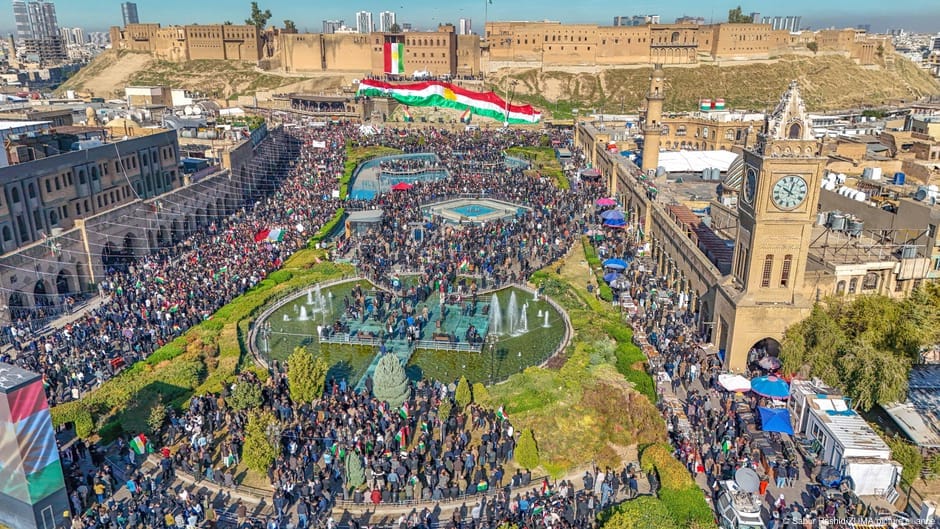
Thousands have gathered in the capital of northern Iraq's semiautonomous Kurdish region, waving flags and voicing opposition to plans for the federal government to take control of oil operations and border crossings.
Protesters took to the streets of Irbil, also often written Erbil, in Iraqi Kurdistan early on Thursday in large numbers, waving massive flags of the semiautonomous region in northern Iraq.
They were responding to federal government plans announced earlier in the week for Baghdad to take control of oil operations and border crossings previously run by Kurdish authorities.
Iraqi Prime Minister Ali al-Zaidi had said the measures were part of a bid to stop oil smuggling when announcing the changes.
The plans marked an escalation in the long-running power struggle between the central government and Kurdish authorities that have largely governed themselves since 1991, albeit with varying levels of recognition and authority.
Rival Kurdish parties joined forces for the large protests in the regional capital.
Protests were also reported to have spread to several other towns and cities beyond the capital.
Iraq's 2005 constitution, written following the US-led invasion that toppled Saddam Hussein, formally recognized the Kurdish region and its government. But authorities in Erbil and Baghdad have remained in a tug of war over the control of land, oil and money ever since.
Tuesday's decision, which received backing from Iraq's Federal Supreme Court a day later, brings border crossing in the Kurdish region under federal government management. It places approval for oil exports from the region under the authority of the federal oil ministry and transfers the management of oil fields in four contested provinces — Kirkuk, Diyala, Salahuddin and Nineveh.
The Kurdish regional government's Cabinet said on Wednesday that the decision from Baghdad "violates both the Constitution and the constitutional rights of the Kurdistan region," saying it represented "an attempt to return Iraq to a centralized regime."
Prime Minister al-Zaidi, who took office earlier this year with the backing of US President Donald Trump, also dismissed Kirkuk's operations commander and police chief and the head of the Border Ports Commission. He said the measures reflected Iraq's "independent national will."
Regional Prime Minister Masrour Barzani said his government was "surprised" by al-Zaidi's decisions and called them "completely unacceptable."
Iraq's Supreme Court ruled on Wednesday that the authority of the Kurdish Regional Government (KRG) only covered the land it administered on March 19, 2003, the day before the US-led invasion that unseated Saddam Hussein.
Kurdish peshmerga forces moved into many disputed areas after 2003, including the oil fields covered by this week's orders.
The 2005 constitution tried to solve the fate of some of the disputed territories in the lands between the borders to Syria and Iran that are home to a host of ethnicities and communities but with Kurds generally the majority group.
Article 140 called for reversing Saddam-era policies of expelling Kurds and moving Arabs in, and called for a census and a referendum on whether the disputed regions should join the Kurdistan region. Neither was held.
Kurdish forces then gained more of the disputed territory after Iraqi forces were forced out by the so-called "Islamic State," with Kurdish pershmerga for subsequently reclaiming some of the land with some international assistance.
The oil-rich region is highly important to both administrations, in a country that relies on oil revenues for the vast majority of its public sector budget.
Internal political tensions within Iraqi Kurdistan have further complicated the issue in recent months, with the Federal Supreme Court hearing an ongoing challenge against the current government's legitimacy after a party withdrew from the coalition cabinet. But rival Kurdish political factions seem to have found common ground on this issue at least.
- government
- oil
- border
- iraqi
- kurdistan
- plan
- baghdad
- crossing