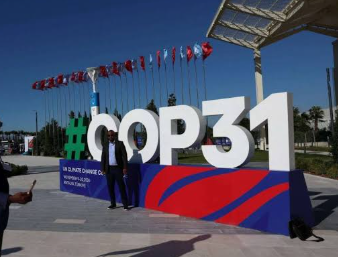
Climate negotiations: If COP31 cannot, what will?, By Samuel Stephen Wakdok

Given the outcome of COP31, countries like Nigeria that are prone to climate disruptions should take the events of COP31 as a strategic warning. Nigeria therefore cannot afford to build its climate strategy around anticipated international finance alone.
Given the outcome of COP31, countries like Nigeria that are prone to climate disruptions should take the events of COP31 as a strategic warning. Climate change affects productivity, credit risk, food prices, inflation, financial stability and the macroeconomy. Nigeria therefore cannot afford to build its climate strategy around anticipated international finance alone. The lesson from COP31 is that climate resilience can not be outsourced but must become a domestic development priority.
Football matches have been abandoned because of bad weather or that the officials lost control. This was the uncomfortable reality that emerged from the 31st Conference of the Parties (COP31) held in Antalya, Turkiye. Unlike previous COPs that at least produced communiques, declarations or compromise agreements, COP31 ended without a consensus outcome after negotiations collapsed over climate finance, fossil fuels and accountability. But the climate crisis is not a football match. The stakes are far higher. Floods do not understand disagreements and neither do droughts halt for lack of agreements. Rising sea levels or hotter temperatures care less about political decisions.
For many, COP31 exposed a deeper crisis within the global climate movement. Following years of criticism that previous agreements focused more on promises than delivery, Antalya was projected as the “Implementation COP.” The ambition was to translate existing climate pledges into measurable action, accelerate renewable energy deployment, increase adaptation financing, operationalise climate finance commitments, strengthen accountability mechanisms, and build momentum towards a low-carbon global economy. COP31 was supposed to be the second half of a football match. After negotiators had spent decades discussing tactics, Antalya was expected to deliver goals. Instead, the players left the field arguing about the rules.
To understand the expectations from COP31, we must appreciate the long history of climate negotiations. Climate change is a geography and history problem, as much as it is an environmental and economic one. The countries that industrialised first accumulated wealth by burning coal, oil and gas for more than two centuries. The resulting greenhouse gases were released into a shared atmosphere. Today, many of the developing countries suffering climate devastation contributed the least to the problem.
At the heart of climate negotiations is money, not because developing countries are seeking charity, but because they are demanding compensation for historic emissions. Imagine two neighbours sharing a compound. One neighbour accidentally sets fire to the entire compound. The second neighbour loses a house, crops and livestock. When compensation discussions begin, the first neighbour offers a loan that must be repaid with interest.
A farmer in Africa did not power the Industrial Revolution. A fisherwoman in South-East Asia did not build nineteenth-century factories. Yet both increasingly suffer from droughts, floods, coastal erosion and changing rainfall patterns. This is why the principle of Common but Differentiated Responsibilities became a foundation of global climate negotiations. It recognises that while climate change is everyone’s problem, responsibility for addressing it is not equal.
At the heart of climate negotiations is money, not because developing countries are seeking charity, but because they are demanding compensation for historic emissions. Imagine two neighbours sharing a compound. One neighbour accidentally sets fire to the entire compound. The second neighbour loses a house, crops and livestock. When compensation discussions begin, the first neighbour offers a loan that must be repaid with interest. Most people would immediately recognise the unfairness. Developing countries argue that climate finance should reflect historical responsibility and should therefore be delivered largely as grants rather than loans, but developed countries prefer structures that mobilise private capital, blended finance and debt instruments.
The second major fault line concerns fossil fuels. The science is clear, limiting climate change requires a significant reduction in fossil fuel dependence. The politics are less clear. Many developed economies built their prosperity on fossil fuel. Meanwhile, developing countries argue that they cannot be prevented from pursuing the same path to economic growth without viable alternatives and substantial financial support. This tension resembles a marathon in which some runners began the race two centuries earlier, reached the finish line, and then instructed those still running to slow down.
COP31 will be remembered for what it revealed, the gap between ambition and action, promises and delivery, historical responsibility and political reality. Every delay imposes costs and every missed opportunity worsens future risks. If the COP cannot deliver, who will?
Three factors explain the frustration with COP31. First, the costs are immediate. Climate change is not a future threat; it is already a present reality. Communities are experiencing more frequent floods, severe droughts, crop failures, rising sea levels, climate-related security risks and infrastructure damage, etc. While climate impacts accelerate, funding remains slow. Second, commitments continue to outpace delivery. Global climate negotiations increasingly resemble a bank account filled with promises but lacking cash withdrawals. Financial pledges have multiplied but actual disbursements remain substantially lower. Third, negotiating power remains unequal. Developing countries often arrive at climate negotiations with limited technical capacity and fewer resources than wealthier nations and private sector interests. The result is a negotiating landscape where influence remains unevenly distributed.
Given the outcome of COP31, countries like Nigeria that are prone to climate disruptions should take the events of COP31 as a strategic warning. Climate change affects productivity, credit risk, food prices, inflation, financial stability and the macroeconomy. Nigeria therefore cannot afford to build its climate strategy around anticipated international finance alone. The lesson from COP31 is that climate resilience cannot be outsourced but must become a domestic development priority. This requires integrating climate considerations into our national planning, monetary and fiscal policies, infrastructure investment, agricultural modernisation, energy policy and financial sector regulation. COP31 will be remembered for what it revealed, the gap between ambition and action, promises and delivery, historical responsibility and political reality. Every delay imposes costs and every missed opportunity worsens future risks. If the COP cannot deliver, who will?
Samuel Stephen Wakdok, an economist and climate and sustainability professional, wrote from Abuja.
- climate
- samuel
- stephen
- wakdok
- nigeria
- negotiation
- outcome
- country