On farewell trip, Steinmeier calls for more investment in Africa
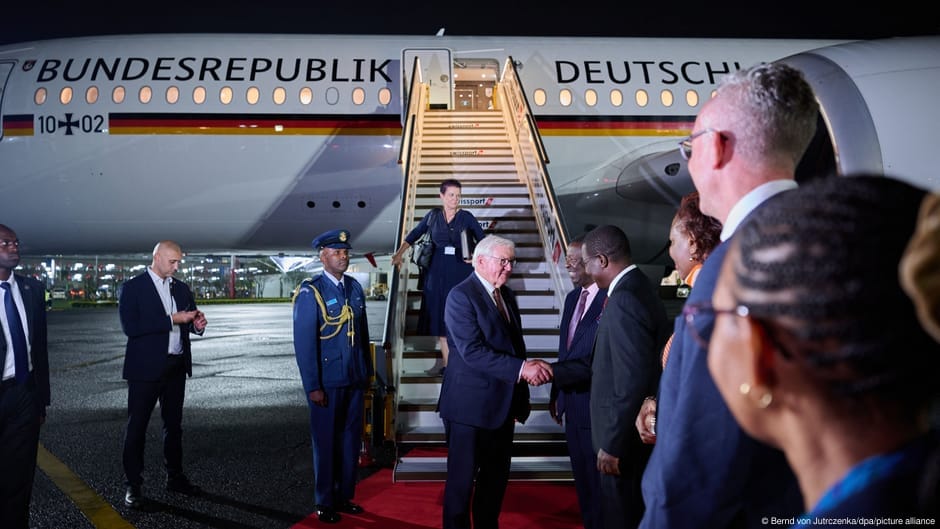
Cote d'Ivoire, Ghana, Kenya: On his last trip to Africa, outgoing German President Frank-Walter Steinmeier called on companies at home to be bolder and seize opportunities in Africa.
"My time as president is coming to an end, and that is why it was important to me to travel to Africa one more time — to the continent that is particularly close to my heart," said Frank-Walter Steinmeier during his final official trip to Africa. Over the course of 20 years, as president and before that as foreign minister, the veteran politician has made 30 trips to African countries.
"For me personally, things have come full circle today," the president added during his opening remarks at the German-African Business Summit in Ghana. He was alluding to the first German-African business summit in Berlin in 2015, which Steinmeier opened while he was still foreign minister in the administration of former Chancellor Angela Merkel.
This week, in addition to Ghana, he visited Cote d'Ivoire and Kenya with a business delegation from Germany.
A lot has happened since 2015, Steinmeier said. And yet: "We are still far from where we could be." Addressing Germany's business community, he said, "Be curious, take risks."
As the applause rang out after the speech, Jude Numfor, who works for the energy company REI in Cameroon, smiled. He too sees German companies as too risk-averse.
"When the Chinese come, they say 'let's do it,' and the Germans say 'let's prepare it'," he told DW.
Meanwhile, Africa's economy is growing rapidly. German-African foreign trade rose by 10.5% in 2025 to €63.4 billion ($69.4 billion). Africa's trade with the Asia-Pacific region is growing more slowly, but the absolute figures are also significantly higher.
This shows there is a great deal of potential in Africa's markets — especially in light of the emerging African Continental Free Trade Area (AfCFTA), which encompasses most of the continent.
When it comes to direct investment, German companies are more hesitant than others — a trend observed not only by Numfor: China, Turkey and the Gulf states are willing to take on more risk and are pushing into these markets.
The Chinese, in particular, are offering large loans to build key rail lines and ports, and they are buying up mines and raw materials in Africa. But since they usually bring their own low-wage labor force with them, China's investments often create few local jobs.
But such jobs would be the linchpin of Africa's future. In Kenya alone, 1 million young people enter the labor market each year; in Nigeria, the number is even higher, and some experts therefore anticipate even more irregular migration to Europe in the coming years.
Germany has said there is a need for action: It supports vocational training in Africa and, for several years now, has also been allowing skilled workers to emigrate to Germany from Africa.
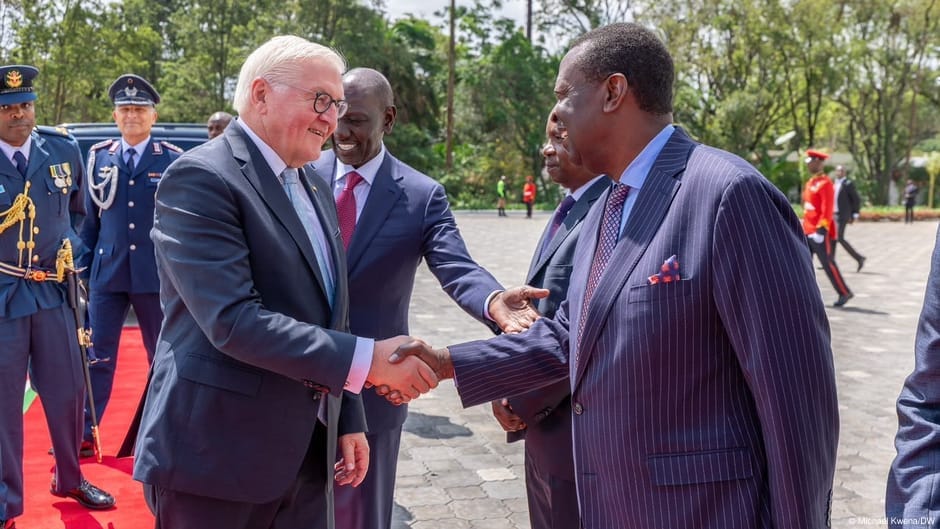
During his trip, Steinmeier also visited educational institutions such as the vocational school for mechanics and industrial maintenance in Abidjan, Cote d'Ivoire. In Kenya, he spoke with President William Ruto about the implications of the 2024 bilateral migration and mobility partnership and more opportunities for language and vocational training.
There are now around 9,500 Kenyans working in Germany, and nearly 1,300 in vocational training. "We want to open up opportunities for young people and create regular, fair and orderly pathways for labor and skilled worker migration," Steinmeier said in Nairobi.
Vocational training is said to be most effective where businesses and factories are being established.
"A very favorable window of opportunity for investment is currently opening up in Africa," said Fritz Audebert, CEO of ICUnet, a company that advises German firms on investment projects worldwide. "We've noticed a shift over the past two years or so, driven in part by geopolitical changes, the complicated situation in China, and most recently the war in Iran."
"More and more companies are beginning to understand this," Audebert added. "While there are reservations, we're seeing a similar sentiment to that regarding India." What's new is that small and medium-sized enterprises from Germany are also showing interest in Africa.
During the trip, Audebert was particularly impressed by Cote d'Ivoire, as he said, "because of the ministers' high level of expertise." The country is the world's largest cocoa exporter and possesses important raw materials. "You can work well with this potential," he said.
Members of the business delegation accompanying Steinmeier also agreed that the German automotive industry must focus more on the African market.
"The middle class is growing in cities, and with it, the demand for mobility," said Audebert.
Markus Thill, president of Bosch Africa, confirms there is a considerable market for simple, gas- and diesel-driven cars. "Based on the auto industry's experience, we know that households worldwide with an annual income of €10,000 or more can afford a new car," said Thill. This would mean that potentially 5-10 million new cars per year could be built and sold in Africa.
Instead, "we export millions of old used cars to Africa that would no longer be eligible for registration in Europe," he said.
Even though the focus of the trip was on the economy, "we shouldn't limit our view to that," Steinmeier said at the end of his trip. Germany maintains a reliable political partnership with Cote d'Ivoire, Ghana and Kenya.
"These are three countries with which we cooperate closely on the international stage, and in that sense, visiting them now was the right and deliberate choice," he said.
When asked to take stock of his 30 trips to African countries undertaken during his political career, Steinmeier said: "There is not one Africa, but many, and there are also very different, uneven developments there." This fact, he concluded, needs to be "communicated even more effectively" in Germany.
- africa
- trip
- steinmeier
- farewell
- investment
- cote
- ghana
- kenya