Remote Australian community becoming a battleground for space race
A new Australian rocket company, RangeOz, is developing a separate rocket launch site about 5 kilometres away from the pre-existing Koonibba Test Range.
A second rocket launch site is being prospected for South Australia's far west coast.
Indigenous elders and residents are divided over the expanding space sector.
Emerging rocket launch company RangeOz awaits a development decision from Plan SA and an assessment from Eyre Peninsula councils.
A remote Indigenous community in South Australia's outback is fast becoming the battleground for Australia's space race.
Rocket company RangeOz has put in a proposal to develop a launch facility near Koonibba, on the edge of the Nullarbor, about 5 kilometres from an existing test range.
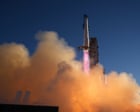
If it goes ahead, two rocket launch facilities will be on SA's far west coast: RangeOz's and Southern Launch's Koonibba Test Range.
The remote Aboriginal community of Koonibba is home to about 140 people, 96 per cent of whom identify as First Nations.
Aunty Sue Haseldine is a Googatha* elder, who was born in Koonibba and now lives in Ceduna, about a 30-minute drive away.
She has been a staunch opponent of the Southern Launch project, and is not looking forward to more infrastructure in the area.
The elder said it was making the west coast a "hit target" for global conflict and could impact the environment.
"The government and the space agency are all working together with people like Southern Launch and RangeOz to devastate more country, more people, more farmlands, the ocean," she said.
"And to have all the rest of this stuff around us, it's really quite dangerous.
"People just think about what you're leaving your children and your grandchildren.
RangeOz's development application was placed by chief executive officer Andrew Curran, who worked at Southern Launch from February 2020 to 2023, according to his LinkedIn profile.
He said the Ceduna region could become one of the world's leading suborbital launch locations and would bring "significant benefits" to the local community, particularly the local Aboriginal community, as well as SA and the country.
While the RangeOz website recognised the Far West Coast Aboriginal Peoples as the traditional owners and cultural custodians of the land, it did not confirm whether the Far West Coast Aboriginal Corporation (FWCAC) had involvement with the facility.
FWCAC did not respond to the ABC's request for comment.
The news comes after the Koonibba Community Aboriginal Corporation's (KCAC) recent partnership with Southern Launch to open an observatory.
KCAC board chair Geraldine Ware said the space industry had been good for her community.
"So far we have achieved a few rocket launches, amazing rocket launches, even with our capsule returns coming back to Koonibba and our test range," she said.
Ms Ware said she was looking forward to what the future would bring with the local expansion of the space industry, but did have some trepidation about the unknowns.
"I hope it does not interfere with our business," she said.
Southern Launch chief executive Lloyd Damp said RangeOz's application was market validation.
The District Council of Ceduna services about 3,500 residents.
Its mayor, Ken Maynard, has lived and worked in the region for 40 years.
Now semi-retired, he drives the local school bus, often ferrying students to and from Koonibba.
He said the federal government was responsible for environmental controls for the space industry in the region, and it was not up to local government to provide consultation.
"That to me is a bit like [me] trying to tell that truck it hasn't got the right tyres on it," he said.
"The federal government sets those standards and the requirements for the space industry to meet them.
"I think this is an example of the recognition that Ceduna is ideally placed for the space industry, given the vastness of the area and the availability of services.
The Minister for Defence and Space Industries Chris Picton said the "natural advantages" of SA's west coast made it a "world-leading destination for space launch and re-entry".
In a statement, he said he was "looking forward to the next steps" in RangeOz's development.
The South Australian Department for Environment and Water (DEW) said its role, with the Yumbarra Conservation Park Co-management Board, was to consider licensing any activities that RangeOz proposed to undertake in the parks, including returns and retrievals.
However, at this stage, DEW had not yet received any formal application for access to the parks.
SA currently has more than 100 companies in the sector, according to the state government.
Southern Launch has hosted commercial rocket launches from Koonibba since 2020 and began facilitating commercial spacecraft re-entry missions in 2025.
The nearby RangeOz launch facility is proposed to be developed on privately owned rural land and is currently undergoing planning assessment and approvals.
*While Kokatha is the spelling often associated with the traditional owners of a large area in the west of South Australia, Googatha is sometimes the preferred spelling.
- remote
- community
- battleground
- space
- race
- rocket
- company
- rangeoz