Hyderabad must make room for buses, rein in private vehicles, says Bogotá’s former mayor

Former Mayor of Bogota, Colombia, Enrique Peñalosa says Hyderabad must decide what kind of city it wants to become before investing further in transport infrastructure, with buses and pedestrians given priority.
Enrique Peñalosa, Former Mayor of Bogota, Colombia, speaking at a panel discussion titled ‘Global best practices in Urban Mobility: Lessons from Bogotá and London’ at Cyberabad Moves 2026.
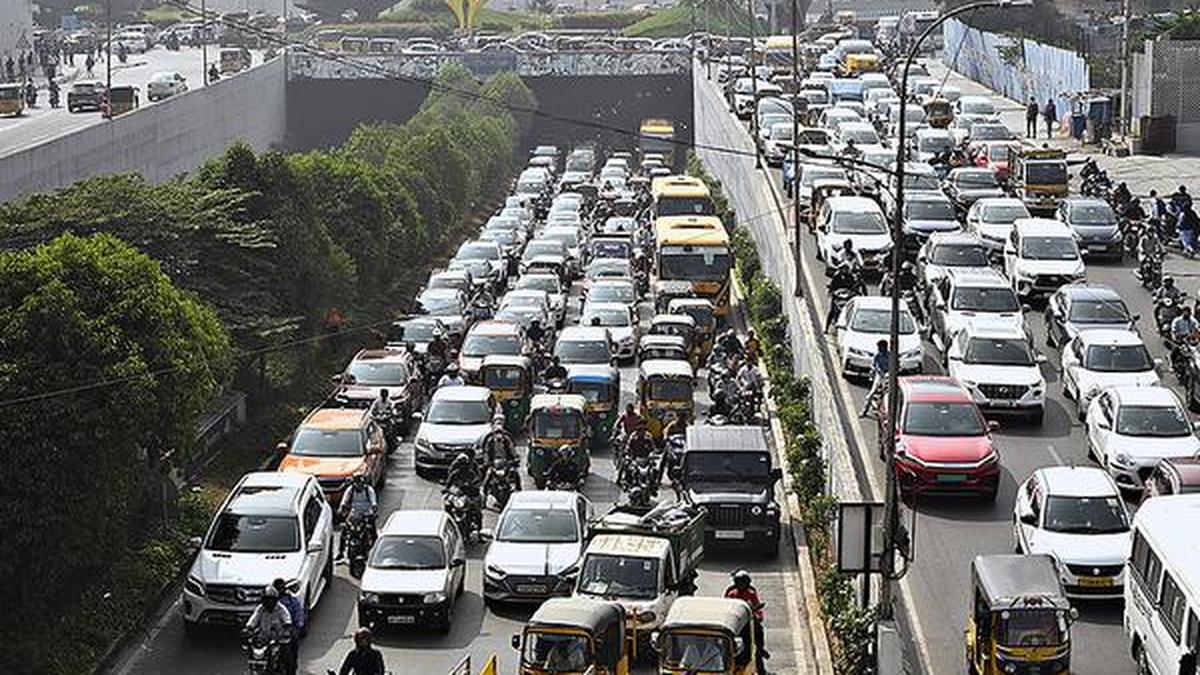
Hyderabad’s traffic problem cannot be solved simply by building more Metro lines, widening roads or constructing flyovers. The city must make difficult choices about how much space it gives to private vehicles, particularly two-wheelers, and whether it is willing to prioritise buses, cyclists and pedestrians, former Bogotá mayor Enrique Peñalosa said. The former mayor is credited with transforming Bogota’s transit infrastructure.
Speaking at a panel discussion titled ‘Global best practices in Urban Mobility: Lessons from Bogotá and London’ at Cyberabad Moves 2026, Peñalosa said Indian cities needed to distinguish between mobility and traffic. While public transport systems could improve people’s ability to travel, they would not necessarily reduce congestion unless private vehicle use was also regulated.
He identified motorcycles and scooters as a major challenge for Hyderabad, arguing that they were difficult to compete with in a tropical city where commuters could often reach their destinations faster on two-wheelers than by public transport.
“Most of the time, when people use public transport, it is because they have to, not because they like it. So there is always, I would say, a policy of carrot and stick. You have to make good public transport, but you also have to restrict car use,” he said.
The discussion was moderated by Jayesh Ranjan, Special Chief Secretary to the Telangana government, who presented figures highlighting the pressure on Cyberabad’s roads. A survey conducted near Cyber Towers during the morning peak had found 10,138 people travelling alone in cars, while another 3,584 people were travelling in cars with only one other occupant.
Ranjan asked Peñalosa what he would prioritise if he were tasked with addressing Hyderabad’s traffic problems, particularly given the city’s growing vehicle numbers and the pressure on public transport.
Peñalosa said Bogotá’s Bus Rapid Transit (BRT) system had succeeded because it was implemented on roads with the highest passenger demand rather than being shifted to less congested stretches to avoid affecting private vehicles.
“Many BRTs have failed because they say this is the highest-demand corridor, but we will not put it here because there are too many cars. So we put it three blocks away. Then it doesn’t work. And then they say BRT doesn’t work. Of course, you did not do it well,” he said.
He said dedicated bus lanes had to be protected from other traffic and located in the centre of roads to prevent vehicles entering or stopping along them. Stations and passing lanes were also important to increase the speed and capacity of the system.
Peñalosa said Bogotá’s BRT network carried a high volume of passengers and urged Indian officials to visit the city to understand how it operated. He said even cities with extensive Metro networks would continue to need high-capacity bus systems.
He also questioned the assumption that expanding Metro networks would automatically reduce traffic. Citing Delhi as an example, he said the city continued to experience severe congestion despite having an extensive Metro network.
“Metros or BRT solve mobility, but they will not solve traffic. Some of the cities with the most Metro in the world have the worst traffic jams,” he said.
Peñalosa argued that traffic congestion could be addressed only by regulating vehicle use, especially during peak hours. He suggested that technology could eventually be used to track vehicles and charge them according to when and where they were driven, with higher charges for using busy roads during peak periods.
He also urged Hyderabad to decide what kind of city it wanted to become before choosing its transport model. Comparing cities such as Amsterdam, Paris and Houston, he said they offered very different ways of living and organising urban space.
“Before deciding what is the way to solve transport, we have to decide what kind of city we want. How do we want to live?” he said.
Peñalosa said footpaths should be treated as public spaces comparable to parks and plazas, rather than extensions of roads that could be used for parking. He questioned why public space for cars was often protected while space meant for pedestrians was routinely compromised.
- hyderabad
- mayor
- room
- bus
- vehicle
- bogotá
- bogota
- colombia