THE PRICE OF NOISE: How Nigeria’s noisy cities are stealing our peace, sleep and productivity
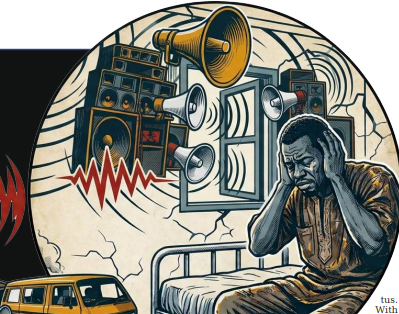
But recent figures from the Lagos State Environmental Protection Agency (LASEPA) suggest that the growing noise may be becoming harder to tolerate. From Port Harcourt to Calabar, Uyo, Yenagoa, Abuja, Ibadan and Ile-Ife, residents of Nigeria’s growing urban centres contend with varying combinations of traffic, generators, construction work, commercial activities and amplified sounds from religious and social gatherings.
By Josephine Agbonkhese In many Nigerian neighbourhoods, silence has become something of a luxury. Before the day properly begins, generators are already rumbling, religious houses are broadcasting their activities through loudspeakers, and commercial drivers are leaning impatiently on their horns. By afternoon, street hawkers have joined the chorus, while music from nearby bars, social gatherings and neighbours’ celebrations often continues late into the night.
For many residents, this is simply part of everyday life. But recent figures from the Lagos State Environmental Protection Agency (LASEPA) suggest that the growing noise may be becoming harder to tolerate. The agency reportedly received more than 3,000 noise pollution complaints within the first four months of 2026, leading to enforcement actions that resulted in the sealing of 500 facilities.
The figures are significant, particularly when compared with an earlier report showing that noise pollution accounted for 3,300 of the 8,437 environmental complaints recorded by the agency throughout 2025. Clearly, noise is no longer just an occasional neighbourhood nuisance. It has become a serious environmental concern. And Lagos is not alone. From Port Harcourt to Calabar, Uyo, Yenagoa, Abuja, Ibadan and Ile-Ife, residents of Nigeria’s growing urban centres contend with varying combinations of traffic, generators, construction work, commercial activities and amplified sounds from religious and social gatherings.
When noise becomes normal Nigeria’s relationship with noise is complicated. Much of it is woven into everyday culture, religion, commerce and social life. Religious houses use loudspeakers to reach worshippers, traders advertise their goods through megaphones, motorists honk to navigate congested roads, and celebrations often come with music loud enough for the entire neighbourhood to hear.
Then there is the generator, perhaps one of the most familiar sounds of Nigerian living. With unreliable electricity supply, households and businesses depend on generators to keep things running. Unfortunately, this convenience comes at a cost: hours of persistent engine noise. For Dr Princess Marylove A. Ifedoyin Olatubosun, a psychiatrist, counsellor and mental health advocate, the danger lies partly in how easily people have become accustomed to excessive noise.
She observes that many Nigerians have become desensitised to the sounds of generators, loudspeakers, traffic, markets and social activities. However, she cautions that becoming accustomed to noise does not mean the body is no longer affected. “Some people may stop noticing the disturbance consciously, while the body continues to experience its physiological effects,” she explains.
In densely populated communities, these sounds often overlap, leaving residents with little opportunity to enjoy a peaceful environment. What many dismiss as normal background noise may therefore be taking a toll on their health and daily lives. The hidden cost of living loudly According to Olatubosun, repeated exposure to excessive noise can contribute to hearing impairment, tinnitus (ringing in the ears), headaches, stress and increased blood pressure.
Prolonged exposure may also increase the risk of cardiovascular problems. Noise can equally disrupt sleep, reduce its quality and leave people fatigued during the day. Its effects extend to concentration, memory, learning and productivity, particularly among children and working adults. Emotionally, persistent noise can trigger irritability, anxiety, frustration and stress.
The World Health Organization (WHO) also warns that exposure to loud sounds can fatigue the ear’s sensory cells, resulting in temporary hearing loss or tinnitus. With repeated or prolonged exposure, these cells may become permanently damaged, leading to irreversible hearing loss. WHO identifies noise-induced hearing loss as the most common irreversible occupational hazard worldwide, while warning that recreational noise from concerts, clubs, bars and personal audio devices also poses significant risks.
For Lagos-based communications consultant and CEO of Clove Red Media, Wemimo Adewunmi Obiwale, these effects are far from theoretical. Living between two religious houses whose loudspeakers are clearly audible from her home, she has had to organise her professional life around their worship activities. “I cannot schedule interviews around that time or important meetings around that time,” she says.
Working from home makes the situation particularly frustrating. An important interview or virtual meeting can easily coincide with amplified religious activities. Sometimes, she has to close all her windows, move to the farthest room in the house and even relocate with her laptop in search of a quieter space. Sundays are especially challenging. Activities at one nearby worship centre can continue until about 3 p.m., only for another round of amplified sounds to follow from the second location.
For someone whose wo
- noise
- nigeria
- generator
- sound
- sleep
- productivity
- exposure
- neighbourhood