Country diary: Introducing Siccar Point, a true rock star of the geology world
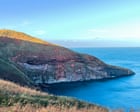
To the north-east, the 320m-year-old volcanic doorstop of Bass Rock contrasts with the edgy artifice of Torness nuclear power station, gleaming in low sun like a radioactive Lego brick. A series of interpretation stations on the path to Siccar Point encourages us to notice two distinct rock types, old red sandstone and greywacke, and to understand that each was formed in different ways at different times.
Berwickshire: Between the grey and the red formations, a staggering 65 million years passed. And the Scottish man who figured this out put science into a spin
“Who wants to see some reeeally important rocks?” The question sorts my holiday companions into two distinct types, and the self-selecting nerds set out on a blustery clifftop walk. To the north-east, the 320m-year-old volcanic doorstop of Bass Rock contrasts with the edgy artifice of Torness nuclear power station, gleaming in low sun like a radioactive Lego brick. We’re going in search of an even more consequential contrast, but one that is a little harder to see.
A series of interpretation stations on the path to Siccar Point encourages us to notice two distinct rock types, old red sandstone and greywacke, and to understand that each was formed in different ways at different times. The greywacke originated in a Silurian ocean 435m years ago, the sandstone in hot deserts of the late Devonian period, 370m years ago. It’s also important to understand that, given enough time, rock can be lifted, rotated, folded and weathered away. That’s what happened to the greywacke, long before the sandstone was laid down on top.
The vertically folded grey and slightly tilted red rocks at Siccar Point are the best known example of what James Hutton, Scotland’s father of modern geology, called an “unconformity”. The significance of this lies largely in what you don’t see: the vast swathe of “invisible” time that passed between each formation. Here on this otherwise unassuming toe of land, a rocky juncture that one can span with a hand marks a caesura of some 65m years – 220 times longer than our species has existed, or 13,000 times longer than recorded history.
It’s hard to overemphasise the impact that this insight had on 18th- and 19th-century science. Not only was Hutton’s theory a direct challenge to creationist thinking; it also implied Earth’s mind-bending antiquity, and paved the way for Darwin’s theory of evolution by natural selection.
Besides Hutton’s audacious discovery, I’m tantalised by what is missing between the ghost ocean of vertical greywacke and the ghost desert of ruddy sandstone. Mineral grains that were once embedded beside those lodged here but – freed by ancient winds and waters – could now be anywhere, or part of anything, on the planet.
- rock
- siccar
- point
- sandstone
- greywacke
- country
- diary
- star