A bakery, a playground, a speaker’s corner … how a former Brussels car garage tore up the art gallery rulebook
Repurposing a space previously used for selling Citroëns, the Belgian capital now has its first ever dedicated space for contemporary art. Consequently, after a €230m decade-long transformation in collaboration with the Pompidou Centre, this gargantuan garage has been reborn as a palace of performance, dance, music, film, architecture and visual art.
Repurposing a space previously used for selling Citroëns, the Belgian capital now has its first ever dedicated space for contemporary art. It’s certainly ambitious – but will they be able to fill it?
‘A cathedral of cars” is how the colossal Citroën garage in Brussels was described when it opened in 1934, conceived as a startling glass temple to showcase the streamlined wonders of the automobile age. It greeted the street with an immense curtain wall of glass that wrapped a monumental nave-like showroom, culminating in a curved art deco prow, which glowed like a crystal lantern by night.
Almost a century later, arts and culture have replaced cars as the great urban consumables of our age. Consequently, after a €230m decade-long transformation in collaboration with the Pompidou Centre, this gargantuan garage has been reborn as a palace of performance, dance, music, film, architecture and visual art. The original Parisian Pompidou was designed as a transformable cultural machine for the city; this place takes those urban ambitions to an even greater extreme.
“It’s a true city within a city,” declares Yves Goldstein, director-general of the Kanal-Center Pompidou, as he stands beneath the building’s soaring industrial roof, at the crossroads of two indoor streets where cars were once shuttled to and fro between the mechanics’ workshops. “We have a bookshop, library, restaurants, workshops, an indoor playground – and what other museum has at its heart a place where you can come to buy your daily bread?” He gestures at the bakery, which occupies a prime position at the crossing of the indoor streets. Visitors can watch bakers kneading dough through big picture windows, a spectacle that might be just as entertaining as the performance art in the black box studio next door.
Brussels may be the de facto capital of Europe, but it has shockingly never had a dedicated museum of modern and contemporary art, until now. With the momentous opening of Kanal, there is a slight sense of overcompensation. It occupies a 1.7-hectare city block on the banks of the Charleroi canal, in the northern fringes of the city centre, and contains 40,000 sq metres (half of which is freely accessible), making it larger than the original Tate Modern. As if the existing garage wasn’t big enough, three new buildings have been inserted into the complex, rising above the pitched industrial roofscape like supersized concrete sugar cubes, clad in veils of ribbed glass. One contains the five-storey art museum; another is the new home of Kanal Architecture, formerly CIVA, the city’s architecture centre; while the third houses an auditorium and offices. These cubic volumes plunge down into the factory floor, their walls of raw terracotta blocks mingling with the steel trusses, concrete beams and brick panels of the rambling Citroën pile.
“Our work is merely adding another layer,” says Stephen Bates, co-founder of London architects Sergison Bates, which teamed up with Belgian practice noAarchitecten and Swiss firm EM2N to form Atelier Kanal, winning the 2017 competition. “You’re never sure if you’re looking at something new or repaired.” In an unusual step, the collaborative team moved their office into the building, so their engagement with the existing fabric could be as hands-on as possible throughout.
Much of it was a process of invisible mending. The building’s 470-metre-long glass curtain wall facade has been meticulously replaced with thermally-efficient, slender laminated vacuum glass panels, set within the original (and pleasingly wonky) 1930s steel frames, avoiding clumsy new-look double glazing. “Re-use should be about drawing attention to the existing characteristics of the architecture,” says Bates, not “fixing” every detail. A lively colour palette, developed with artist Sarah Smolders, picks out particular features and helps to humanise what might otherwise be an intimidating scale. Patina is celebrated: the floor is painted with three coats, each a different colour, with the idea that these layers will be revealed with use.A pre-existing first-floor mezzanine threads its way through the entire complex, providing elevated views down on to the expansive shop floor, accessed by processional vehicular ramps. It’s a “wandering space”, says Bates, that the museum hopes people will appropriate as they see fit. There’s an informal stepped stage, where Goldstein imagines the citizens of Brussels might spontaneously perform, as part of his quest to “abolish the boundary between the public space outside and inside”. With its endless ranks of steps, ramps and rails, it is a skater’s dream – if they’re allowed.
Quite how permissive the radical art garage will be in practice remains to be seen. One corner of carefully curated anarchy comes in the form of an intriguing indoor adventure playground by the British Turner prize-winning collective Assemble, developed with local school groups. Dark mounds of resin-bound rubber hint at the piles of coal once transported along the canal, as well as volcanoes and lunar landscapes, while soft boulders and movable ramps await a fleet of miniature wheelbarrows. “It’s a framework for children to create their own worlds,” says Assemble’s Emily Wickham. Her colleague Mark Gavigan adds: “We hope that how the children play might influence the institution as a whole.”
The theme of bottom-up, participatory city-making is central to the ethos of Kanal Architecture, too, a place that Goldstein describes as “a laboratory to dream and conceive the city of tomorrow”. Its opening exhibition, Right to the City – Right to the Future, takes a rather wordy look at Brussels’ role as an incubator of radical architectural activism. “The city has a traumatic history of modernisation, seeing major demolitions in peacetime,” says the centre’s cerebral director, Nikolaus Hirsch. “But this has made it a fertile ground for new spatial practices.” Exhibits range from fragments of Victor Horta’s art nouveau Maison du Peuple, senselessly demolished in the 1960s, to a “Fugitive Cartography” project mapping Black experience in Brussels, to the Right to Housing campaign, as well as lengthy manifestos printed out and stuck on the wall. It’s worthy stuff, but you’ll need patience.
There is a bit of a studenty feel to the whole enterprise, familiar from biennales, particularly in spaces like the “Salon”. This flexible room features a big silver tent and a hydraulic concrete table-cum-stage, another element that the museum imagines will become an impromptu speaker’s corner. Sockets in the floor “allow visitors to plug in a lamp”, says one of the designers. Others might camp out with laptops. Like any self-respecting 1960s squat, Kanal also has its own printing studio, where posters will be continually produced and pinned up around the building to advertise exhibitions and events.
“We won’t have any screens in the public spaces,” declares Goldstein. “We want it to be a refuge, where people can spend the day without looking at their phones. No QR codes either!” The quiet reading room is a delight, lined floor to ceiling with books and equipped with bespoke modular furniture, designed to be compatible with the OpenStructures system. “It’s a place to study, do your homework, or just hang out,” says Bates.
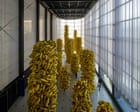
It’s impossible to take it all in on a single visit. Drop-in visitors can delight in the magnificent former car showroom, a 24-metre high glass vitrine, currently bursting with bouquets of gold letter-shaped helium balloons, an installation by Banu Cennetoğlu. Or head straight to the rooftop, where a free public terrace and bar give the feeling of floating on the deck of an ocean liner amid the city. Or splurge in the fine-dining restaurant, where you can enjoy a €95 six-course tasting menu on an 11-metre long pewter table, welded in situ, while looking down on the showroom with the feeling of a well-fed Citroën exec.
It hasn’t happened without a fight. Kanal has long been a subject of political scrutiny, and has come under fire locally for what its critics see as a costly and colonial partnership with the Pompidou Centre in Paris. Kanal is paying €2m a year for a five-year partnership – funded, like the building cost, by the Brussels capital region. Perhaps in response to the controversy, there is very little sign of the P-word in the building. Only one of the opening 10 exhibitions features works from the French institution’s collection, Goldstein is proud to note. The 350 items on loan include the likes of Giacometti, Picasso and Matisse, intermingled with works from Kanal’s growing Brussels-focused collection. Other opening exhibits touch on themes ranging from Belgium’s bloody history in the Congo, to collaborative weaving on a series of long open looms. An atmospheric seven-metre-high underground gallery plays host to a polyphonic soundscape – although this isn’t an industrial leftover, but a vast concrete basement dug out at considerable carbon cost. It would have been a serendipitous “found space” to uncover, a la Tate Modern’s Tanks, but excavating it from scratch, and fortifying it against the canal, seems perverse when there was so much space to play with upstairs.
This great surfeit of space, pregnant with potential, is Kanal’s defining feature. But it might also prove to be its weakness. It’s a lot to fill in uncertain times. Goldstein abruptly announced his resignation in May, after a decade leading the project, after government cuts to the institution’s promised annual budget. From 2028, the Kanal will need to find private donors, said a government spokesperson, “and, in time, become financially self-sustaining”. Museums can be too big. Just look at the twisted brick albatross of Tate Modern’s £260m Blavatnik extension, completed in 2016, much of which is now closed off to the public.
Public or privately funded, Kanal deserves to thrive. The architects have given this automotive temple a wonderfully imaginative second life, in equal parts radical and sensitive, crafting a dazzling fun palace of endless possibility.
Opens 28 November. Free + ticketed exhibitions.
- art
- car
- garage
- brussels
- bakery
- playground
- speaker
- corner