Zelensky criticises ‘strange’ Trump-Putin friendship in BBC interview

Volodymyr Zelensky has voiced deep frustration with the US, criticising Donald Trump for calling Vladimir Putin “my friend” and saying delays in delivering vital anti-ballistic missiles were costing Ukrainian lives. On Thursday, Donald Trump posted on his Truth Social platform that at his own summit with Putin in China last week he had urged Russia to “pull back all military aggression against territories throughout Europe” and said he believed a peace deal with Ukraine was “a strong possibility”.
Volodymyr Zelensky has voiced deep frustration with the US, criticising Donald Trump for calling Vladimir Putin "my friend" and saying delays in delivering vital anti-ballistic missiles were costing Ukrainian lives.
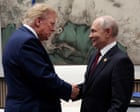
In an interview with the BBC at his central Kyiv office, Ukraine's president complained the US was not pushing Russia hard enough in peace talks, and called it "strange" that Trump posted a photo of himself embracing Putin.
"Of course it's up to the President of the United States, but... it's strange," Zelensky said, speaking in English.
"He's an aggressor, and a killer…He can't be a friend. Just cannot be," he said, adding it was like saying you were friends with Adolf Hitler during World War Two.
Since a bruising encounter with Trump in the Oval Office in 2025, Zelensky has been careful how he handles relations with the United States.
Trump's two envoys have been trying to negotiate a peace deal between Russia and Ukraine - to end the huge loss of life. But they often seem more in tune with Moscow's position, than that of Kyiv.
The latest round of peace talks, mediated in Abu Dhabi earlier this month, made no obvious progress: "The more we know, the more problems", is how Zelensky described it.
He said talks were expected to resume in December.
On Thursday, Donald Trump posted on his Truth Social platform that at his own summit with Putin in China last week he had urged Russia to "pull back all military aggression against territories throughout Europe" and said he believed a peace deal with Ukraine was "a strong possibility".
But from its public statements, Russia appears to have regressed to its initial, hardline negotiating positions – on everything.
And Zelensky revealed that it was not clear whether European negotiators would be at the table, as the US envoys had announced.
Ukraine urgently needs the talks to move forward and bring five exhausting years of Russia's full-scale invasion to an end.
Russian strikes across the country have been growing more frequent and more deadly: the number of civilians being killed is at an all-time high.
So Zelensky called for "real helpful allies, who can push Russia" to achieve results and urged the US to live up to its reputation as a strong country with "power and respect".
"When you try to be very neutral with the aggressor... it means you support victims and you support also aggressor. It's not right," he said.
The US argues that it is neutral: in the complex search for a peace deal between the two sides that can hold.
Questioned again on Thursday about calling Putin a friend, Trump told reporters: "We want to stop killing. I could say he's not a friend... I want to make a deal."
He added: "I could walk in and say, I don't like you, and then we have the same problem that we have with Zelensky and Putin.
"You know... the biggest problem to that settlement is the fact that you have two leaders that really hate each other."
In the meantime, Kyiv is struggling to defend its skies.
The air alerts, day and night, are now a draining feature of everyday life. As Russian ballistic missiles target power stations and bridges, jet-powered drones are launched daily at central Kyiv and other big cities.
Ukraine launches hundreds of drones at targets in Russia in response.
Zelensky said the military here are now able to destroy about 70% of Russia's fastest drones, a statistic he said was improving.
But there is a "very, very big" deficit of interceptors to stop ballistic missiles and he said the Americans were delaying deliveries of its Patriot systems.
"It's a pity they made a focus on Middle East and they help them more… It's a pity. We have huge questions with this," Zelensky said.
"The deficit of these missiles - that is people's lives."
He also confirmed that the US satellite communications system, Starlink – and its military version, Starshield – were still being restricted in occupied areas of Ukraine.
Ukrainian drone units have described their problems to the BBC, as their interceptor drones can no longer catch up with Russian Shaheds. It means those weapons then fly deeper into Ukraine, unhindered.
"Technically SpaceX, politically - I don't know, I really don't know," Zelensky replied. "It's like... ping pong. We are asking one side, they say it's the other."
Ukraine's own long-range strikes against Russian targets have increased in recent weeks, including oil refineries and ships carrying weapons or fuel.
On Thursday, Italy's Prime Minister Giorgia Meloni said an attack that sank a Russian warship docked in eastern Libya this week risked spreading war to the Mediterranean, which was unacceptable.
Zelensky defended the move, calling the warship Merkury an "absolutely fair goal".
He accepted that such strikes were "very dangerous" but said Ukraine's forces "never attack" without co-ordinating with its partners.
But he acknowledged that Ukraine was bracing for a difficult and dangerous winter.
Recent attacks on Kyiv have targeted bridges over the vast river Dnipro, apparently trying to cut the city in two.
Some residents have already left town for the winter and businesses closed, as power cuts and strikes on logistics networks have pushed operating costs unmanageably high.
They have also plunged much of the city into darkness.
"[Russia] wants us to run away, of course," Zelensky said.
"People can go, but we will try to defend our capital in any way. We need our capital. Without a capital, you don't have a country."
- zelensky
- russia
- trump
- putin
- friend
- ukraine
- peace
- bbc