How Chinese support is keeping vulnerable Mathare children in school
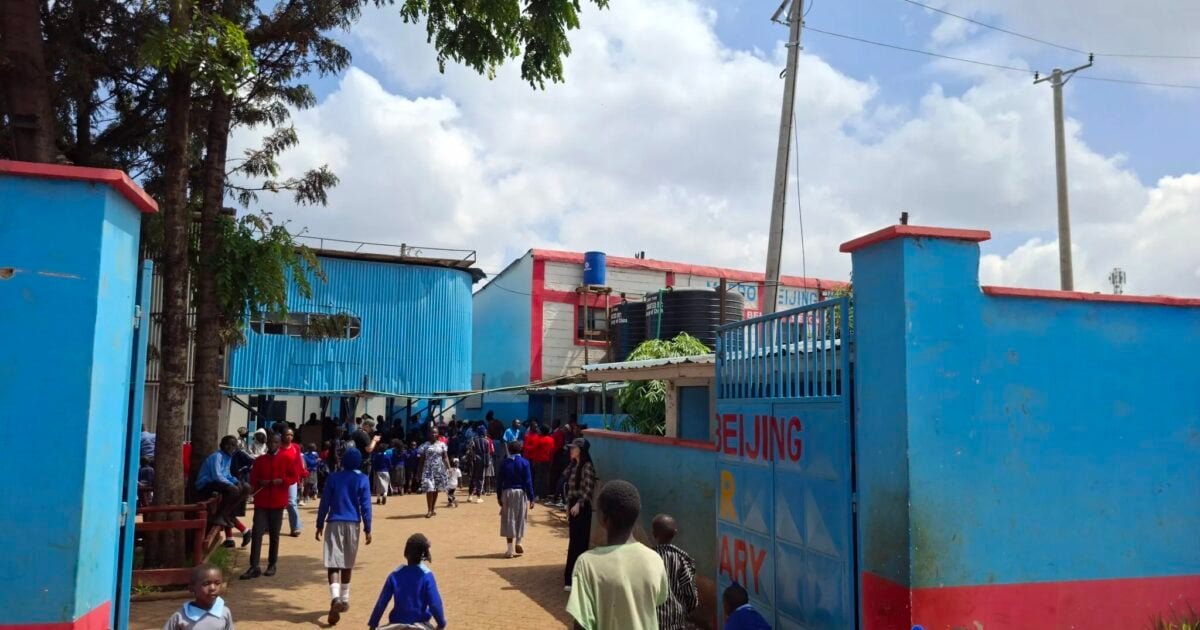
NAIROBI, Kenya, Nov 27 – For some children at MCEDO Beijing School in Mathare, the food they receive at school is not just a meal to get them through the day. MCEDO Beijing School Director Benedict Kiage/CFM For school director Benedict Kiage
NAIROBI, Kenya, Nov 27 – For some children at MCEDO Beijing School in Mathare, the food they receive at school is not just a meal to get them through the day.
It is sometimes the only food they will have for that day.
Their families struggle to make ends meet, and paying school fees, however small, can be difficult.
For some parents, keeping a child in school means making sacrifices elsewhere at home.
It is against this background that the support MCEDO Beijing School has received from the Chinese Embassy in Kenya and Chinese enterprises over the past 18 years has made a difference to children growing up in the informal settlement.
What started as a partnership to support a struggling school has grown into a long-term commitment that has brought better classrooms, learning materials, school meals, scholarships, reliable lighting and clean water to hundreds of children.
The change is evident in the school’s growth.
From an enrolment of about 200 learners when the partnership with Chinese organisations began in 2007, the institution now has more than 550 pupils.
For school director Benedict Kiage, the difference is particularly clear when he looks back at the conditions the institution operated under before the partnership.
“When we partnered with the Chinese people, the school was scattered all over. Through the Chinese people, through the Embassy and companies, they came, consolidated the school in one place and constructed, giving the students a humble and conducive place for learning,” he said.
The school previously struggled with inadequate facilities and learning resources.
Over the years, the Chinese Embassy and enterprises have helped bring the institution together, supported construction and renovations, and provided textbooks, teaching materials, food and other essential supplies.
The support has also addressed challenges that go beyond the classroom, particularly the difficulties faced by children from families living in poverty.
Kiage estimates that about 90 per cent of the school’s learners come from vulnerable households, with many living below the poverty line.
The school charges less than Sh2,000 in fees, while some children attend without paying anything.
Even then, the cost of keeping children in school remains a burden for some families.
One of the most important interventions has been the feeding programme, which has helped children who would otherwise struggle to get a proper meal at home.
The head of the primary section said some pupils arrive at school without eating.
The food they receive during the day is therefore important not only for their well-being but also for their ability to concentrate in class.
In some cases, the children share what they receive with family members when they return home.
“Sometimes you find that most of these learners come from home without eating anything. Sometimes the food that they serve here is what they carry home. They just take a little and carry something to go and feed their siblings at home,” she said.
It is a reflection of the circumstances in which some of the school’s pupils are growing up, where the struggle to put food on the table extends beyond one child to an entire household.
The Ministry of Education’s Director of Primary Education, Steven Barango, said the feeding programme had helped address a basic but often overlooked barrier to learning.
“As we all know, a child whose stomach is empty may not learn well. So introducing food means the child will be satisfied and will learn and understand in the classroom,” he said.
For the school, providing meals has become as important as ensuring that children have books and teachers to guide them.
The changes are also visible in the school’s facilities.
An upgraded solar power system has improved the reliability of electricity, while new water storage tanks have helped ensure a more consistent supply of clean water.
The school has also received uniforms and sports equipment.
During her visit on Friday, Chinese Ambassador Guo Haiyan said she was encouraged by the improvements made since her previous visit.
“The solar system has been upgraded, ensuring a more reliable electricity supply; new water storage tanks have been installed; and the students are wearing new school uniforms,” she said.
The solar installation has improved lighting at the school, making the learning environment more conducive, particularly during darker hours.
For the pupils, these improvements are part of their everyday school experience.
Student representative Latifa, speaking during the ceremony, thanked the Embassy and Chinese enterprises for the support.
“Your generosity has provided us with reliable lighting for uninterrupted study, two daily nutritious meals, and a continuous supply of clean water from our new tank,” she said.
She also acknowledged the new uniforms and the equipment provided to the school’s football team.
While these may appear to be basic provisions, they make a considerable difference in a community where many families cannot afford to provide such necessities consistently.
For some parents, the biggest worry is not simply enrolling their children but finding the money to keep them in school throughout the year.
The head of the primary section said the school depends on donors, well-wishers and the small contributions parents can afford because it does not receive government capitation.
She said scholarships supported by the Chinese Embassy and associated companies have helped ease the burden for families who might otherwise struggle to meet school expenses.
“Sometimes keeping their children in school is very difficult. So when some of the learners are given scholarships, they are sure of being in school the entire year,” she said.
The Chinese Embassy provides about 20 scholarships annually, according to the school, helping learners from disadvantaged backgrounds continue with their education.
For some former pupils, the opportunities have extended beyond Kenya.
Kiage said between four and five former learners were currently studying in China on full scholarships facilitated by the Embassy.
He also pointed to more than 700 learners who have passed through the school’s senior school wing and proceeded to universities, tertiary colleges and vocational training institutions as evidence of the opportunities created over the years.
The Ministry of Education’s Barango said the school had played an important role in extending education to children who might otherwise have been left behind because of their economic circumstances.
He urged parents in Mathare to take their children to school, while encouraging learners to work hard and remain disciplined.
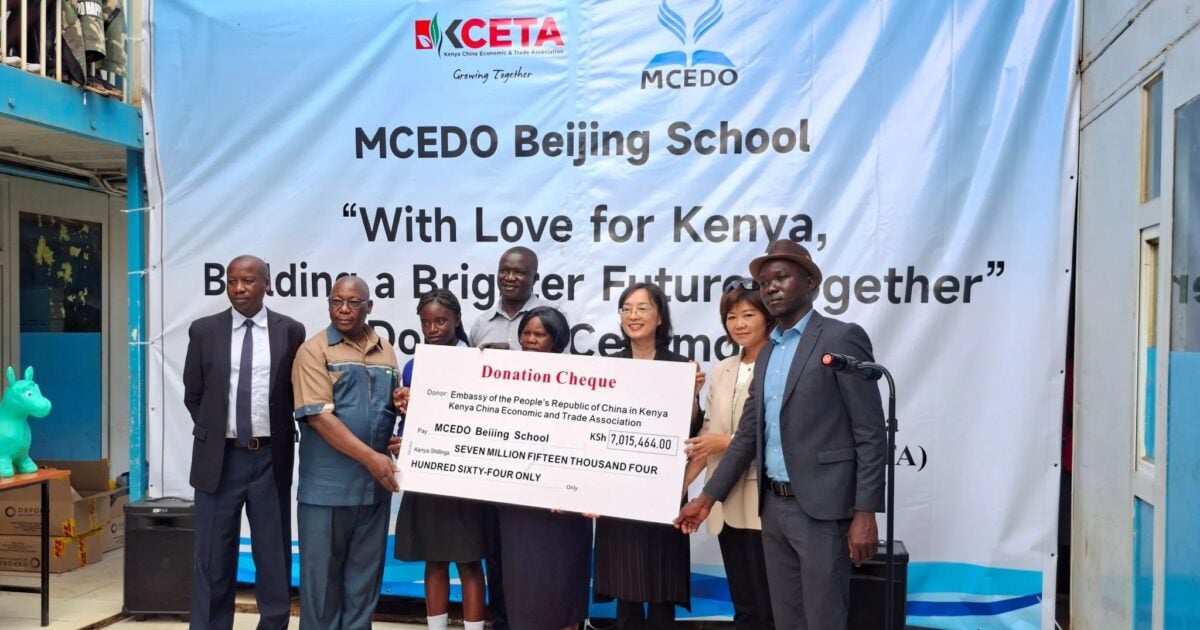
The Chinese Embassy began supporting MCEDO Beijing School in 2007, with Chinese enterprises later strengthening the partnership through the Kenya China Economic and Trade Association (KCETA).
KCETA representative Du Shan said the association had remained involved in the school’s development, including through a Sh55 million contribution made in November 2012 with the support of the Embassy.
She said the school’s growth from about 200 learners to more than 550 demonstrated the value of the sustained partnership.
On Friday, the Embassy and KCETA announced an additional Sh7.01 million contribution to support food supplies, sports equipment, teaching and learning materials, medical supplies and other essential needs.
The latest contribution adds to previous support for school infrastructure, solar power, water storage, uniforms and the feeding programme.
“KCETA will keep standing by your side. We will help the school wherever we can,” Du said.
Ambassador Guo said the Embassy and Chinese enterprises would continue supporting the institution, describing it as an important example of the friendship between Kenya and China.
“MCEDO Beijing School is not only the oasis of growth for the children of Mathare, but also the vivid example of China-Kenya friendly cooperation and the bridge of friendship between our two peoples,” she said.
She also thanked Chinese enterprises operating in Kenya for their contribution to the school’s development.
For Kiage, the support remains important because the needs of the community have not disappeared.
The school still requires assistance to renovate its facilities and sustain programmes that enable children from poor households to access education.
He believes the feeding programme and improved learning conditions have also played a role in attracting more children to the institution.
“One thing which attracts them is food. One thing which attracts them is the good learning condition. So those are the things which I think attract the number of students who come,” he said.
The Ministry of Education has pledged continued cooperation, particularly in quality assurance and support with teaching and learning materials.
Meals, scholarships and hope: China’s lasting impact on vulnerable Mathare children
Bruhan Makong is a Senior News Reporter for Capital FM in Nairobi, covering diplomacy, foreign policy, national security, climate, and human rights across East Africa and the wider region.
- school
- child
- food
- support
- meal
- mathare
- family
- home