Walking the Wirral Way: winter birdwatching and coastal history on the Dee estuary
Once a hive of maritime activity, the estuary is now a haven for wildlife – but you don’t have to be a birder to appreciate its tousled beauty Cheshire’s Hadlow Road is a fine railway station. The trackbed, long since greened over, is now the Wirral Way, a tree-lined path for walkers and cyclists that stretches along the remarkable Dee estuary.
Once a hive of maritime activity, the estuary is now a haven for wildlife – but you don’t have to be a birder to appreciate its tousled beauty
Cheshire’s Hadlow Road is a fine railway station. A redbrick building with a cream signal box and a spick-and-span platform, it has neat benches, potted flowers, and a cafe that serves a restorative flat white. But the metal billboards fixed to the brickwork – advertising, among other things, Lever’s Cattle Cakes and Hudson’s Super Soap – are evidence of what really makes the station notable: the last train came through in 1962. “Nearly 65 years ago,” confirms the man repainting the signal box. I sip my coffee and stare along the line.
Plenty has changed in this corner of the country since Hadlow Road’s heyday. The rural station is now a preserved heritage attraction, but for almost 100 years it was a stop on a branch line of the Birkenhead Railway. From its westbound platform, passengers and cargo would rumble out towards the coastal town of West Kirby. The trackbed, long since greened over, is now the Wirral Way, a tree-lined path for walkers and cyclists that stretches along the remarkable Dee estuary.
Why remarkable? Because the estuary, too, has evolved beyond recognition over the centuries. Forming a long inland channel between north Wales and the Wirral peninsula, it was once a hive of maritime activity, with packet boats crisscrossing the Irish Sea to Dublin and pleasure resorts dotted along its length. Then the waters silted up, seeing trade move to the nearby Mersey and forcing its seaside bathing areas to close. In the late 1920s, a type of cordgrass (Spartina anglica) was planted to stabilise the mud. It spread fast, and the estuary is now largely saltmarsh – which is good news if you happen to be a bird.
“Marsh harrier! No, wait, there’s two of them!” I’m on the seafront – or, more accurately, the marshfront – at Parkgate, a handsome old resort town overlooking the estuary. The spot where I’m standing is known as the Donkey Stand, a hark-back to the children’s rides once offered here. Today there’s not a heehaw to be heard. On this late October morning, dachshund-walkers stroll the prom as a cluster of birders train their binoculars on the view. The soft hills and smoking chimneys of the Welsh coast dominate the backdrop, but the main interest is closer at hand.
The Dee estuary is a site of special scientific interest, which in this case essentially translates as an avian all-you-can-eat buffet. It has a raw, tousled beauty of its own, with its long grasses waving in the breeze and its waters mirroring the skies, but it’s also absolutely stuffed with life. The mudflats and saltmarshes here hold unfathomable quantities of nutrient-rich invertebrates, making it an internationally important wetland for waders and wildfowl, which settle here in their tens of thousands and pile on the winter calories.
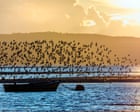
When you stop and gaze, the whole scene becomes an epic one. Most of the birds are seasonal arrivals from Scandinavia and other northern shores. I watch as a cloud of about 80 black-tailed godwits billows up from the marsh and resettles. Skeins of pink-footed geese flap overhead in honking, dusky-headed squadrons. Little egrets curl their snow-white heads above the sea asters, teal dabble in the shallows and shovellers swim across pond-like clearings, swishing jumbo bills. Best of all, two marsh harriers patrol the air on languorous wingbeats, occasionally plummeting to snare unseen bounty.
A handful of times a year, when the tide tops 10 metres, Parkgate is the site of a gory if gripping spectacle as voles, mice and shrews are forced by the rising water to flee their marshland homes, drawing hungry raptors from far and wide to profit from the mammalian exodus. There’s no such drama due today, but the weather’s set fair so I resolve to make the eight-mile walk along the estuary to West Kirby.
Parkgate was once visited by the likes of Lady Hamilton and George Frideric Handel (not together, I don’t think) and the seafront still has several eye-catching buildings, not least the vast timber-framed bulk of what was once the well-to-do Mostyn House School. Nearby is the art deco frontage of Nicholls, an ice-cream parlour that has been here since the 1930s. I can’t quite rouse myself to order a mint choc chip this late in the year, but there are rows of traditional sweet jars so I stock up on aniseed humbugs and get on my way.
It’s a gloriously relaxed and almost entirely flat walk, partly along the coastal path and partly following the Wirral Way. The sections along the latter are generally quiet, save for a steady flow of cyclists, joggers and squirrels: leaves are falling from the sycamores and glossy tresses of ivy flank the path. The sections that hug the coast, however, bring widescreen joys. I trace endless gangs of pink-footed geese speeding above the marshes as black-headed gulls – already in pale winter plumage, making their name a misnomer – wheel and squawk.
Towns and villages come and go. At Heswall foreshore, the mudflats are full and the air is filled with high-pitched bird calls. A woolly-hatted man passing the other way with a long-lens camera stops me. “About 100 knot just up there,” he says, clearly chuffed. “They’ve just come in this week – 40 golden plover too.”
Our wintering birds often have names that make them sound like accountants (“This is Gadwall, Knot and Dunlin – please leave a message after the peep”), but seeing them en masse is a thrill. The last few miles of the walk are easy, with Hilbre Island now crowning the horizon. The tide’s in when I reach West Kirby, and the shoreline is sheltering hordes of oystercatchers and hefty waddles of shelducks, with curlews standing tall in the crowd. After watching them, I follow local advice and refuel on deruny pancakes at the Ukrainian-run Sweet Pea cafe – a top tip, it transpires – then catch the bus back to Parkgate.
My room at the Ship inn overlooks the estuary, with a framed picture of a marsh harrier above the bed and a pair of binoculars next to the TV. I’m up at first light the next day, watching the saltmarsh come to life, with Wales forming a green backdrop.
My destination on this last morning is yet another example of local evolution. At the estuary’s head, the Burton Mere Wetlands were mainly arable farmland until they were purchased piecemeal by the RSPB between 1986 and 2008, and planted with thousands of reed seedlings. Now a dedicated reserve with various walking trails and four linger-long wildlife hides, it’s another nexus for resident and overwintering birds.
The hours here pass in a kind of hushed majesty. Among the wooded lakes and wetlands there are grebes and whooper swans, herons and Egyptian geese, teal and lapwings. I spot a bittern emerging from the reedbeds, camouflaged to the point of near-invisibility, and join others in gawping at a green woodpecker in the treetops. Finally, I follow one of the reserve trails that leads up to Burton Point, a hilltop with a booming northward view across the entire estuary. The headlands appear hazy and the saltmarsh is agleam as the sun goes down. If I were a bird, I’d be happy to settle here too.
Accommodation was provided by the Ship in Parkgate (doubles from £80 B&B, four-poster rooms overlooking the estuary from £115 B&B)
- estuary
- wirral
- way
- dee
- station
- winter
- birdwatching
- history