Can Adeleke’s Tinubu campaign role resolve Osun’s political disputes amid APC resentment at home?

With the forging of political alliance between Osun State Governor Ademola Adeleke and President Bola Tinubu for the president's re-election, questions are emerging about whether the political partnership could help resolve Osun’s longstanding political disputes.
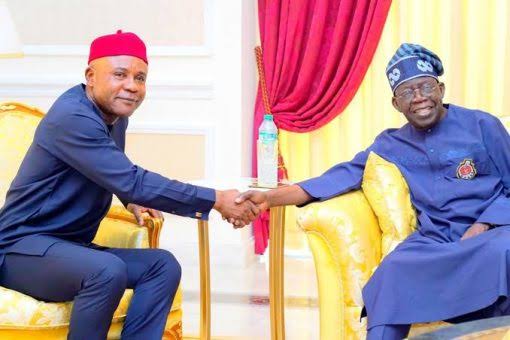
Former governor Gboyega Oyetola, Governor Adeleke, President Tinubu, Bisi Akande and former APC governorship candidate in Osun Oyebamiji.
Osun State Governor Ademola Adeleke’s emergence as coordinator of President Bola Tinubu’s re-election campaign in the state has stirred controversy within the All Progressives Congress (APC), with some party members in the state questioning the arrangement and its implications for their political interests ahead of the 2027 general elections.
The appointment has also raised questions about what the alliance could mean for the Accord Party, on which platform Mr Adeleke won re-election in August. The governor was inaugurated for second term on Friday.
While the governor is expected to mobilise support for Mr Tinubu’s presidential bid, candidates of the Accord Party will be competing against APC candidates for seats in the Senate and the House of Representatives in the elections to be held simultaneously with the presidential poll in January 2027. The Accord Party currently holds zero Senate seat and six seats in the House of Representatives from Osun State, while APC holds two and three seats, respectively.
However, beyond the political implications for both parties, the alliance has raised a bigger question about whether Mr Adeleke’s relationship with the president could help resolve some of Osun’s longstanding political and institutional disputes in the state.
These include the protracted crisis over control of local governments and the withholding of local government allocations, as well as violent disputes over control of transport unions and motor parks in the state.
The soft spots the two leaders – Mr Tinubu and Mr Adeleke – have for each other became increasingly visible in the run-up to the Osun’s August governorship election, when Mr Tinubu’s intervention helped to reverse the restriction the Economic and Financial Crimes Commission (EFCC) placed on the state government’s bank accounts.
On 5 August, PREMIUM TIMES reported that the EFCC had obtained a court order restricting bank accounts of the Osun State government, about 10 days before the governorship election in which Mr Adeleke was seeking re-election on the Accord platform against the APC candidate, Bola Oyebamiji.
President Tinubu subsequently directed the EFCC to approach the court to vacate the order and discontinue the action against the state government. The president described the timing of the restriction as “embarrassing,” saying it could create the impression that a federal institution was being used to interfere with the electoral process. The account was subsequently unfrozen on 22 August.
Following Mr Adeleke’s victory in the election, defeating APC’s Mr Oyebamiji, the governor publicly reaffirmed his support for Mr Tinubu’s second-term bid, describing the president as a son of Osun State. He said he wanted the president to complete his development projects and reforms, particularly in the South-west in his second term.
The political significance of the alliance is underscored by Osun’s voting pattern in the 2023 presidential election where Mr Tinubu lost Osun to Atiku Abubakar, then of the People Democratic Party (PDP). Mr Adeleke belonged to the PDP as of the time of the 2023 elections. Atiku, a former Nigerian vice president, polled 354,366 votes against Mr Tinubu’s 343,945 to win Osun, the only state in the South-west region that fell into PDP’s electoral column in the 2023 poll.
Although Mr Adeleke said his support for Mr Tinubu was not based on any agreement with the president, he maintained that he was willing to work with APC members, including Mr Oyebamiji and former governor Gboyega Oyetola, the minister of Marine and Blue Economy, to secure the president’s re-election.
But his appointment as Osun coordinator of the APC presidential campaign council on 13 October took the relationship beyond public endorsements and into a formal campaign structure.
The appointment was followed by consultations and the inauguration of a 344-member campaign council in Osogbo on 22 October. The council comprised leaders and members of the APC including Mr Oyetola, Mr Oyebamiji, and party’s state chairman, Tajudeen Lawal, as well as members of Accord Party and PDP.
However, some prominent APC figures, including Mr Oyetola, Mr Oyebamiji and Mr Lawal, were absent from the inauguration.
The APC leadership said its members were not adequately consulted nor invited, alleging that Mr Adeleke had sidelined some of its party leaders. The development fuelled concerns among party members about their place in a campaign structure headed by a governor from another political party.
Ayodele Fanibe, an APC top figure in Osun, attributed the absence of some prominent party leaders from the inauguration to what he described as Mr Adeleke’s failure to consult the party’s state leadership.
“His failure to do the right thing must have resulted in what happened at the inauguration. The party chairman said he was not informed, and that is the duty of the DG to do,” he said.
However, Olawale Rasheed, spokesperson for Mr Adeleke, disputed claims that APC leaders were not invited. He said the governor had reached out to Mr Oyetola and Mr Oyebamiji by himself via phone, but they did not answer his calls.
He added that the governor also contacted other prominent party figures and mobilised their supporters, including the APC National Secretary, Ajibola Basiru, former Osun governor Adebisi Akande and his former deputy, Iyiola Omisore, who were listed as advisers to the campaign council.
“What has the governor done wrong? We are the outsiders, the governor is an outsider. Who owns the project? APC owns the project. The instruction to inaugurate the council came from Abuja. The governor complied, and this is why the short-notice arrangement went ahead,” Mr Rasheed said.
The arrangement has therefore created an unusual political situation in Osun where Accord is leading the presidential campaign for APC.
However, beyond the electoral calculations, the alliance is also being tested by the state’s unresolved political disputes. There have been questions whether Mr Adeleke alliance with APC can help resolve the wider disputes over political and institutional control in the state.
One of the biggest tests of the relationship between Mr Adeleke and Mr Tinubu is the lingering dispute over control of Osun’s 30 local governments, which has resulted in prolonged withholding of council allocations and repeated confrontations over access to council secretariats.
The crisis dates back to the local government election conducted on 15 October 2022, during the administration of Mr Oyetola of the APC.
In November 2022, the Federal High Court nullified the election in a suit marked FHC/CS/OS/103/2022, which challenged the legality of the exercise. The decision was subsequently upheld by the Court of Appeal, according to court records cited in subsequent proceedings.
The dispute intensified after Mr Adeleke defeated Mr Oyetola in the November 2022 governorship election and the new administration removed the APC-elected council officials, who were already embroiled in legal challenges over the validity of their election.
On 21 February 2025, the Osun State High Court sitting in Ilesa ordered the Osun State Independent Electoral Commission (OSIEC) to proceed with a fresh election to fill the vacant positions across the 30 local government areas. The election had initially been scheduled for 22 February.
Following the re-run election, OSIEC declared PDP candidates winners of all the chairmanship and councillorship seats. Mr Adeleke, who was then a member of the PDP, subsequently swore in the elected officials.
The APC, however, maintained that its officials elected in October 2022 were entitled to remain in office, citing a separate Court of Appeal decision which it argued had reinstated them. The disagreement over the competing claims to the council positions further complicated the legal status of the two sets of officials.
The dispute subsequently escalated into a security crisis, with rival groups laying claim to council secretariats across the state.
In February 2025, attempts by APC members to take over some council secretariats triggered violent confrontations with supporters of the PDP-backed chairpersons.
PREMIUM TIMES reported that at least five people were reportedly killed in the clashes, prompting Mr Adeleke to direct the newly elected chairpersons to stay away from the secretariats to prevent further violence.
The disagreement over which officials were entitled to control the councils also affected access to their statutory allocations from the Federation Account.
Between March 2025 and June 2026, about N216 billion earmarked for Osun’s 30 local government councils was withheld by the federal government, according to a review of Federation Account revenue-sharing data reported by The Guardian.
The figure comprised N131.5 billion for March to December 2025 and another N85.3 billion between January and June 2026.
The dispute over the withheld funds later reached the Supreme Court after the Osun State Attorney General and Commissioner for Justice, Oluwole Jimi-Bada, on behalf of the state government sued the federal government over the withheld funds.
In December 2025, PREMIUM TIMES reported that the Supreme Court struck out the suit, ruling that the Osun State Attorney General lacked the legal standing to institute the case on behalf of the local governments.
Judge Mohammed Baba-Idris who delivered the lead majority judgement of the Supreme Court held that only duly elected and inaugurated local government officials were autonomous entities with the capacity to sue and be sued.
However, while declining to entertain the suit, the court faulted the federal government’s withholding of the councils’ allocations, describing the action as a “misuse of power,” and urged the government to ensure that the funds were paid directly into the local government accounts.
“Refusal to release the funds is a clear misuse of power by the defendant, and it is a clear disobedience to the court’s order that funds should be paid only to a democratically elected government,” the justice declared.
The legal contest over control of the councils continued into 2026. In June, the Federal High Court in Osogbo dismissed a suit filed by APC elected chairpersons and councillors seeking an extension of their tenure beyond October 2025.
The court held that the claim for tenure extension lacked legal foundation. The affected officials subsequently appealed the judgement.
Following the ruling, chairpersons and councillors elected in February 2025 resumed at some council secretariats, including those in Ede North, Ede South, Iwo, Boripe and Ila, despite resistance from APC members.
The struggle over the secretariats persisted after Mr Adeleke’s re-election in August 2026, with PDP-backed chairpersons making further attempts to occupy council offices and facing resistance from APC members.
The recurring confrontations further exposed the absence of a lasting settlement over the administration of the councils.
The prolonged dispute has also affected local government workers, whose welfare and salaries have become entangled in the disagreement over access to statutory allocations.
On 9 November, the Osun State chapter of the Nigeria Labour Congress (NLC) began a three-day sympathy strike in solidarity with local government workers over the continued withholding of council allocations.
The action, which followed the expiration of a seven-day ultimatum to the federal and Osun State governments, disrupted activities in government offices and public schools across the state.
The crisis has therefore evolved beyond a contest between the APC and the Adeleke-led administration. It has become a prolonged institutional and financial dispute, with implications for grassroots governance, workers’ welfare and the delivery of public services across the state.
A PREMIUM TIMES report documented the impacts of lack of local government governance and withheld funds.
With the political relationship between Mr Adeleke and Mr Tinubu strengthening after the governor’s re-election, negotiations to resolve the local government crisis and address the withheld allocations have reportedly gathered momentum.
PUNCH reported in October that Mr Tinubu had initiated a peace process shortly after Mr Adeleke visited the Presidential Villa following his re-election. The president subsequently constituted a committee led by his Chief of Staff, Femi Gbajabiamila, to develop a framework for resolving the dispute.
Confirming the resolution, Mr Adeleke’s spokesperson, Olawale Rasheed, said the presidency and the state government are working towards a total resolution of the local government control crisis.
Mr Rasheed said the discussions involved the interests of the APC-backed council officials and the PDP chairpersons elected in February 2025, as well as questions surrounding the management of local government funds. He expressed optimism that the negotiations would produce a resolution before the 2027 general elections.
“What the governor and the Presidency are doing is to set up a negotiation team to iron out how best we can resolve it. In fact, the negotiation is almost reaching the final stage, and the negotiation continues to resolve the matter. All this will be over before the election,” he added.
Although Kola Olabisi, the Osun State APC spokesperson, said he was unaware of any committee set up to resolve the local government crisis.
“I am unaware of such an arrangement. The fellow who spoke about it is in a better position to explain. I don’t know anything about it,” he said.
However, experts said a political relationship between Mr Tinubu and Mr Adeleke would not, by itself, settle the legal questions surrounding the council leadership or secure the release of the outstanding allocations.
Adebola Bakare, a doctor of Political Science and director of the Institute of Legislative Studies at the University of Ilorin, described the Osun State local government control crisis as a complex issue requiring a careful review of the previous legal proceedings involving the contending parties.
He noted that the political alliance between Mr Adeleke and Mr Tinubu could provide an opportunity to resolve the crisis, but stressed that this would depend on the parties reaching a common ground and agreeing to settle the dispute out of court. Otherwise, he said, the protracted legal battle could continue to complicate efforts to restore local government administration in the state.
“If there is a resolution committee, as you mentioned, and it is able to settle the matter out of court with its framework, that would be the best approach. The case before the court arose from the crisis, so if both parties can find common ground and agree to an out-of-court settlement, the court has no option but to strike out the case,” he said.
The struggle for control of motor parks has also exposed the limits of political influence in resolving Osun’s institutional disputes.
For months, rival factions within the National Union of Road Transport Workers (NURTW) have been embroiled in disputes over leadership and control of motor parks across the state, with the crisis also fuelling allegations of political favouritism.
The disputes have escalated into violent confrontations, shootings and deaths as rival factions battle for control of the parks.
In July 2026, the state government suspended NURTW activities in motor parks following a violent clash between rival factions.
The government maintained that the recognised state executive was the one led by Nurudeen Alowonle, while accusing a faction led by Kazeem Oyewale, popularly known as Asiri Eniba, of attempting to take control of parks and garages.
The NURTW national leadership rejected the suspension, arguing that the governor lacked the authority to halt the union’s activities. It subsequently inaugurated a seven-member caretaker committee for the Osun chapter, a move also rejected by the state government.
However, despite the interventions, violence continued. In August, two people were shot dead during a confrontation in the Naira and Kobo area of Ikire, in Irewole Local Government Area, reportedly amid an attempt by a faction to take control of a motor park following Mr Adeleke’s re-election.
The crisis escalated further in September when Olalekan Oyeyemi, popularly known as Emir Ajagungbade, an Accord Party top figure and associate of the governor, was shot dead at Mayfair motor park in Ile-Ife.
Mr Oyeyemi was also involved in the transport sector and had served on a government-appointed transport committee. Police later recovered another corpse from the park.
Reports linked the killing to the struggle over motor park leadership. The police said they were investigating the incident to establish the motive for the killing and identify those responsible.
Following the incident, Mr Adeleke again banned NURTW activities in the state, directed rival groups to vacate motor parks and garages, and ordered security agencies to arrest those allegedly involved in the killing.
He also announced plans to reintroduce a Park Management System, which he said would restore order and discipline to the transport sector.
The government subsequently pursued a legislative solution. The Osun State House of Assembly passed the Integrated Transport, Traffic and Park Management System Bill in September, which Mr Adeleke signed into law on 5 October.
The legislation, however, sparked another political dispute, with the state APC challenging the House of Assembly over the authority the legislation granted the state government to regulate and manage public motor parks.
The APC argued that the state government lacked the constitutional authority to take over the functions relating to public motor parks, citing Section 7(1) and the Fourth Schedule of the Nigerian constitution assigning responsibilities over motor parks to local government councils.
However, the assembly rejected the APC’s interpretation, arguing that the Nigerian constitution also recognises the role of state legislatures in providing the legal framework for local government administration. It challenged the party to approach the courts if it considered the legislation unconstitutional.
The disagreement is significant because the existing local government crisis has put the local governments and their finances under an unclear control.
Although the new law provides a framework for regulating parks, ticketing and revenue collection.
Mr Adeleke’s Tinubu campaign role has also exposed divisions within the Osun APC.
The appointment was particularly sensitive because the governor belongs to the Accord Party, while the APC has its own political structure and leaders in the state.
Former governor Mr Oyetola has long been regarded as the party’s prominent figure in Osun and was not included in the list of campaign council members published by the APC.
The development unsettled some party members who had expected an APC chieftain to coordinate the president’s campaign in the state, claiming Mr Adeleke appointment to lead APC’s presidential campaign council could give the Accord party momentum in the political landscape of the state and could give it a potential to emerge victorious in legislative seats it is contesting against APC’s candidates.
The disagreement became more visible after Mr Adeleke announced a 344-member campaign council and invited members of the APC, PDP and Accord to participate in the presidential campaign, where Mr Oyetola and Mr Oyebamiji were absent.
The resentment within the APC soon resulted in the emergence of a rival presidential campaign structure by the state’s party.
On 2 November, the Osun APC unveiled a 168-member campaign council to mobilise support for Mr Tinubu’s re-election and other APC candidates in the 2027 elections. The party appointed Mr Oyebamiji as its director-general.
- osun
- adeleke
- tinubu
- campaign
- role
- dispute
- apc
- resentment