AI-generated lawsuits flood German courts
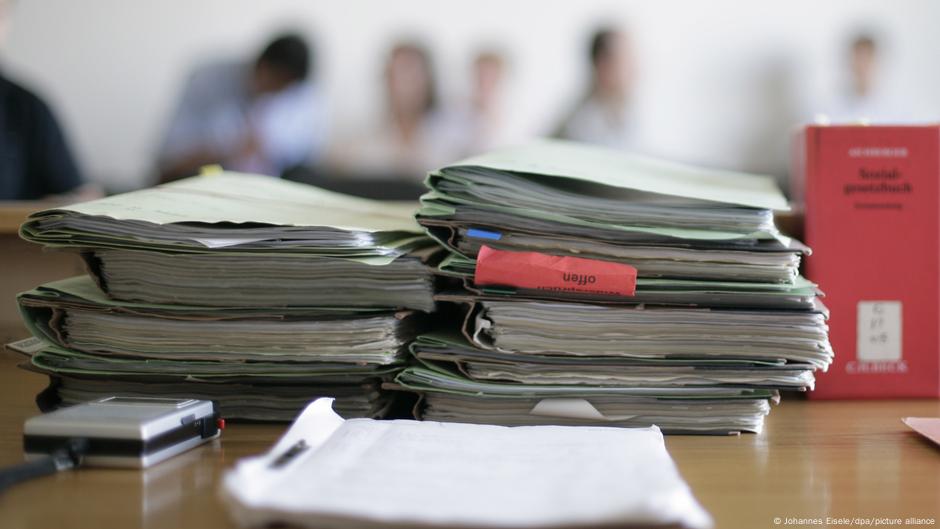
German courts are being overwhelmed by AI-generated lawsuits, many riddled with errors and running to huge lengths. Some state justice ministers want to introduce a fee to stem the flow, but that brings its own problems.
German courts are reporting a huge rise in lawsuits and complaints, and are blaming the use of artificial intelligence models.
The German media has been filled with reports about the problem, which particularly affects social courts, where citizens can file complaints themselves without legal representation. In most such cases, people appeal against sanctions or cuts to their unemployment benefits, or demands from authorities that benefits be returned, but the complaints can also pertain to other benefits or sudden rises in health insurance contributions.
Marcus Howe, spokesperson for Berlin's state social court, where he is himself a judge, said his court was dealing with 28% more cases this year than in 2025.
"That is of course an enormous increase, which is surely in part because of artificial intelligence," he told DW, though he added that it could also be partly down to the tightening of sanctions on unemployment benefits, introduced by the federal government this year.
Other states have reported similar increases. The Legal Tribune Online news portal reported that the number of urgent proceedings at the eight social courts in North Rhine-Westphalia, Germany's most populous state, rose from around 1,400 in the first quarter of 2025 to 3,600 in the same period of 2026.
Howe said that in most cases it's still easy for judges to see when a complaint has been generated by AI.
"You can usually tell at first glance," he said. "The font and the layout are different. In the worst cases, they're much too long and bloated, stuffed with content that has very little to do with the case."
Howe has also noticed that the AI-generated lawsuits are more impersonal, which makes his job more difficult.
"You don't really get an impression of what kind of people are behind these cases," he said. "And it becomes difficult to recognize what the actual problem is. The human factor is important because a lot of this computer-generated German can mislead you. It makes arguments that the computer has thought up, but which aren't actually important for the people in question."
This can go to extremes: Friedrich-Johannes Graf von Pfeil, president of the social court in Potsdam, Brandenburg, has received one complaint that stretched to 800 pages.
"You can tell very quickly when one is AI-generated, just because they use specialist legal formulations that no ordinary citizen would use," he told DW. "There's often very little on the facts of the case, and a lot of legal interpretation that no non-specialist could provide. But you still have to respond to all of it."
The problem for judges is that they are obliged to wade through all this material, which often includes references to other legal rulings that either have little bearing on the case — or have been hallucinated by the AI tool.
Nor can the courts simply use their own AI tools to summarize these documents, von Pfeil said. "If we wanted to use AI to assess a legal document, we'd have security and data protection problems, because the AI isn't in-house," he said. "Also, we receive a lot of sensitive medical documents that would end up on a server that doesn't belong to the judiciary. And that's not allowed."
At a regular conference this month, Germany's state and federal justice ministers agreed to set up a working group to look into the problem, with some conservative ministers calling for a fee to file urgent complaints.
Christian Heinz, Christian Democrat justice minister in the state of Hesse, said that a fee of €15 ($16.40) should be considered. Another proposal was for people to pay court costs for lawsuits that are deemed to have little chance of success or which abuse the system.
The VdK, a social welfare association that offers legal advice to people dealing with German welfare authorities, is vehemently against those ideas. Holger Lange, head of the VdK's federal legal department, thinks it's vital that people — particularly the most vulnerable — have access to social courts without fearing the costs.
The solution, as far as Lange is concerned, is not to "build walls around the courts," but to streamline their digital access and make it easier to submit clear, concise complaints — in other words, online portals with easy-to-understand questions and word limits on legal documents. "They could steer the procedure a little," he told DW.
Howe is also skeptical of fees, an idea that, he said, has been discussed for decades. But social courts are supposed to have low thresholds to entry, he added: "This isn't a situation that suddenly justifies fees — yet. We want to keep access to justice open."
Judge von Pfeil thinks a fee would be "worth a try," though he acknowledges that a lot of people might apply for legal aid, which means the state would end up with more bureaucracy and costs anyway.
Though there has been a recent increase in social court complaints, a broader look at the statistics shows that this is nothing that the social courts haven't seen before.
In the years leading up to the advent of wide availability of AI chatbots, the courts actually saw a big drop in the number of pending cases: from over 445,000 at the end of 2017 to 325,000 at the end of 2024. Analysts suggest that such long-term developments are tied to economic conditions and legal changes in unemployment benefits.
And Lange doesn't think that this new rise in complaints — AI-generated or not — is necessarily a bad sign. "The key thing is enabling people," he said. "We need to ask whether the recent rise isn't also in part the expression of a demand for legal protection that has been hidden so far, because people just haven't dared to claim their rights."
Lange acknowledged that AI-generated complaints can't always be trusted, because of errors and hallucinations. But he stressed that the use of AI doesn't make an appeal invalid.
"It could be a seriously ill person whose pension claim has just been refused," he said. "Or a care-dependent person who desperately needs support. We always need to look at who is behind the complaint."
- lawsuit
- flood
- court
- error
- length
- state
- justice
- minister