‘There was a lot of negativity’: Barrow-in-Furness continues years-long struggle to find twin town
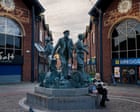
The Cumbrian town’s twinning committee has been searching since it was formed in 2023, but have had no success so far When it was revealed this week that Barrow-in-Furness had spent two years trying to find a town to twin with and there were no takers, the much-maligned Cumbrian town faced ridicule. “There was a lot of negativity,” said the mayor, Kay Hyland.
The Cumbrian town’s twinning committee has been searching since it was formed in 2023, but have had no success so far
When it was revealed this week that Barrow-in-Furness had spent two years trying to find a town to twin with and there were no takers, the much-maligned Cumbrian town faced ridicule.
“There was a lot of negativity,” said the mayor, Kay Hyland. In fact, she says she was approached by a national newspaper and asked to contribute to an article about why it was such an awful place. She declined.
“Maybe I’ve got rose-tinted spectacles on and I see our town in a different light, but it has so much to offer.”
The twinning committee, with volunteers from the council and the public, has considered at least half a dozen options since it was formed in 2023.
Early in the process, at her own expense, Hyland visited the town of Karlskrona in Sweden. “They were very polite, very courteous, very welcoming, but unfortunately, like a lot of other towns, they already had twins throughout Europe,” she said.
The previous mayor also visited the town of Osborne in Australia and discussed the possibility of twinning, but nothing came of that. Ideally, however, it would be somewhere closer to home to make it possible for Barrovians to visit.
“I wouldn’t want to think some of the poorer children couldn’t join in the programme because they couldn’t afford it. That would be terrible,” said Hyland.
But they are otherwise very open-minded. They are happy to be matchmade with a similar town – perhaps with a similar maritime industry – or one that is entirely different.
Hyland’s husband, Kevin, who moved from London in the 80s to work and stayed, said: “Barrow is an up-and-coming place. Come and join us.”
While “up-and-coming” might have described Barrow at various points in its history, “declining” would also fit at other times.
“It’s a bit of a boom and bust, this town,” Hyland said.
Barrow was a hamlet until the mid-1800s when, after the discovery of Britain’s two biggest deposits of iron ore, the town’s mining industry sprang up. By 1863 it was exporting 400,000 tonnes of ore, said Peter Laird, a local historian and retired BT engineer, who has lived in Barrow all his life.
It was not long before Barrow’s own iron and steel industry was created, bringing hundreds more workers. Only in 1870 did the shipbuilding industry for which Barrow is famous arrive. While the shipyard has weathered various economic storms, where the steelworks once was sits a retail park home to an Aldi, a TK Maxx and a Dunelm. It is where construction of the town’s first Nando’s is under way. “My grandchildren are excited,” says Laird.
The 1980s and 90s dealt Barrow’s heaviest blow, which it still has not fully recovered from. As the iron curtain collapsed, the government ceased the manufacture of submarines and warships, leading to thousands of redundancies.
“But now, Barrow is rising,” says Hyland. “We cannot get enough people to come and work in our town.”
This is as a direct result of £6bn of military investment shared between Barrow and Raynesway in Derby.
On a grey Wednesday afternoon, Michaelson Road is a scene akin to a Lowry painting, as workers leave a gargantuan Victorian warehouse building and set off home for the day. Except, instead of the dark angular figures depicted by the Lancashire painter, the street is crowded with dozens of people in large yellow hi-vis jackets with BAE Systems branding over their heart.
The aerospace engineering company is already the biggest employer in Barrow, operating the UK’s largest shipyard and the only facility in the UK with the infrastructure, site licence and resources to build nuclear submarines.
And demand is strong. Earlier in November, it was announced Barrow would manufacture the first submarines as part of the Aukus defence deal between the UK, US and Australia.
Well-paid jobs are increasing, but the town does not yet seem to be catching up. Hyland does not deny Barrow has pockets of deprivation and the town centre has seen similar decline to others across the UK, while facing its own additional challenges. The indoor market, which was a focal point, closed in February after falling into disrepair, with leaks and asbestos. The Forum theatre was also shuttered for the same reasons, leaving Barrow without its main events venue. Traders are fighting a compensation battle with the council, some saying the alternative site they were offered was not suitable, forcing them to make staff redundant.
Hyland is optimistic that a government investment of £200m over 10 years will change Barrow’s fortunes, and local people will a chance to say what the money should be used for.
There are plenty of options. Local people react with skepticism whenever the Marina Village waterfront development is mentioned. The area of former industrial brownfield land near Cavendish Dock, where BAE Systems is based, has been earmarked for housing for two decades. The site has only been cleared in recent years and money is still not in place to build anything. Patience is running thin.
“You hear a lot of things about investment but nothing seems to happen,” said Noah Harrison, 16.
Harrison and his friend Tilly McLaughlin, 17, were benefiting from welding apprenticeships run by BAE Systems, which meant paid work and a guaranteed job at the end, something many young people could only dream of amid a Neets crisis. “It’s good, we’re lucky,” says McLaughlin, from nearby Whitehaven.
The pair were unsurprised Barrow has struggled to find a twin. Harrison, who grew up here, said: “It’s in the middle of nowhere.”
“They should make everything look presentable – I mean, look around,” he said, gesturing to the condemned market building and others boarded up nearby.
It might take some proof of progress for the pessimism to begin to dissolve but Barrow does have boast-worthy attributes.
“People knock Barrow all the time, mainly people who have never been. But lots of people come here for work and stay. It’s a friendly place,” Laird said.
And there are other reasons why it does not reflect badly on Barrow that it has struggled to find a twin.
Dr Holly Eva Ryan, a town-twinning expert from Queen Mary university of London, said some of these formal relationships have waned, while lots of towns simply have enough twins.
Only days earlier, it was revealed Aberystwyth turned down the Polish town of Sochaczew because it already had five twins.
Plus, it can also be difficult for less-connected towns to strike up those relationships in the first place, she said. Barrow is on the Furness peninsula, which its mayor reluctantly describes as a “cul-de-sac”, a 35-mile drive to a motorway. In the 2021 census, 95.3% of its 67,000 population identified as white British, though it is becoming more diverse.
“A lot of the words that come up over and over again are empathy, transformation, intercultural understanding, friendship,” says Dr Ryan, whose book Between Friends: The Everyday Politics of Town Twinning, Sister Cities and International Linking will be published next year.
“[It is] really striking … that those sorts of words grate up against and counteract the surge of ethnonationalism and chauvinism that we’re seeing rise on the global stage. And so I think what’s really important is maintaining models of local politics that can foster that sort of deep empathy, because I think we need it now more than ever.”
She is positive about Barrow’s chances: “It sounds as if they’ve got a clear idea of some of the things that they would like to gain from a twinning. So I hope that they’ll find their partner and I suspect that they will.”
- town
- lot
- negativity
- furness
- struggle
- twinning
- committee
- success