Germany news: Leftist BSW rules out limiting ties with far-right AfD
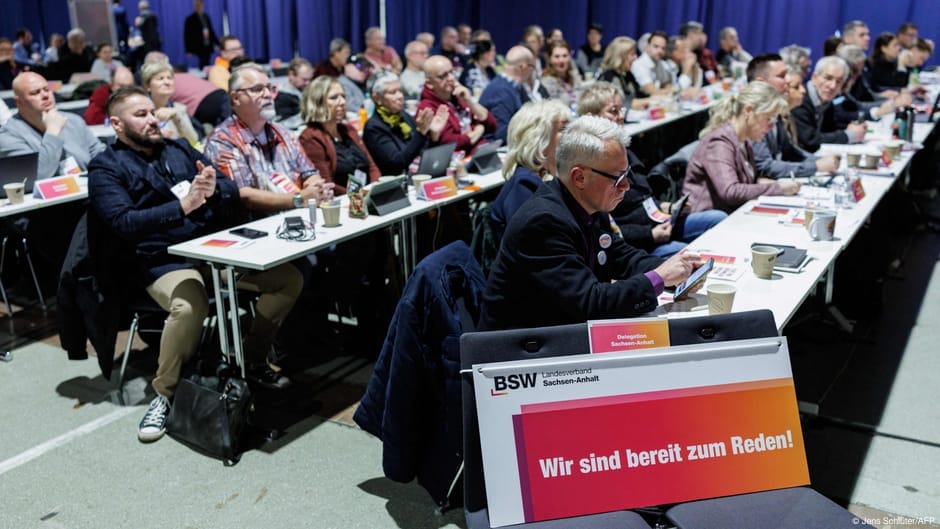
A motion had been filed by senior BSW leaders to reject any "de facto" support of a far-right government. Party founder Sahra Wagenknecht has said limited cooperation could provide a "window of opportunity."
Follow along for the top headlines and analysis from Germany on the Saturday, November 28 and Sunday, November 29:
The left-wing populist party Alliance for Social Justice and Economic Reason (BSW), formerly the Sahra Wagenknecht Alliance (also BSW) voted against a measure that would have limited cooperation with the far-right Alternative for Germany party (AfD) on the federal level.
During the party conference in the eastern city of Dresden, a majority of the approximately 600 delegates voted against a motion put forth by several founding BSW members calling for a clearer distinction from the far right.
The basis for the vote came after the AfD came out on top in September's state election in the eastern state of Saxony-Anhalt with 39 seats. The victory is being seen as a major win for Germany's far right. In October, the AfD's Tobias Rausch in Saxony-Anhalt became Germany's first far-right state parliament speaker since World War II.
With the BSW's five seats, the two parties on the opposite extremes of the political spectrum would combine for a majority of the 83 seats.
BSW Party founder Sahra Wagenknecht and party leader Fabio De Masi have advocated for the-called "Magdeburg Model," named after the capital of Saxony-Anhalt.
This approach rejects a formal coalition with the AfD, offers no support for AfD candidate in the election of a state premiere, and calls for no official tolerance for far-fight platforms. However, the approach envisions joint motions, joint voting, and possibly also written agreements with the AfD.
On Saturday, Wagenknecht made clear she does not see the AfD as a long-term strategic partner.
"None of us wants to cozy up to the AfD," Wagenknecht said. But the BSW will decide how to proceed if there is "the possibility of reasonable majorities for peace, social improvement, and a reform of public broadcasting."
The AfD and BSW see some overlap in Germany's approach to the Ukraine war, with both taking pro-Russia views critical of military support for Kyiv, while opposing or questioning sanctions on Russia, arguing that they harm the German economy.
BSW executive board members such as Christian Leye, Amid Rabieh and Klaus Ernst had sought to pass the amendment to both rule out coalitions with the AfD, and also "any formal or de facto tolerance, support for an AfD-led government, and long-term agreements on cooperation."
"Since when have we been partners with the AfD?" Leye said after the vote. "This party can only be an opponent."
"In my view, it is a racist party, a nationalist party that also has its issues with democracy. That is why it cannot be a partner," he said.
Germany's Office for the Protection of the Constitution, the domestic intelligence agency, has classified the AfD as right-wing extremist.
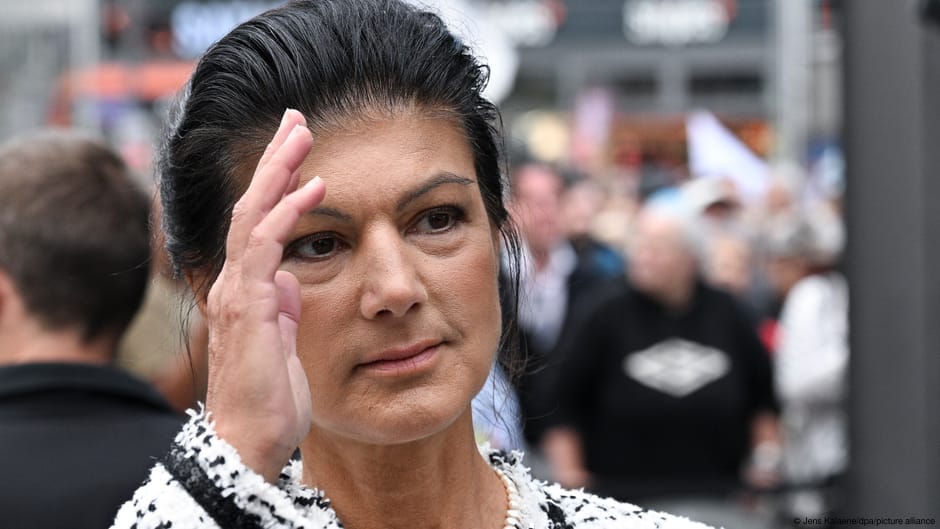
Sahra Wagenknecht, the leader of the left-wing populist Alliance for Social Justice and Economic Reason (BSW), formerly the Sahra Wagenknecht Alliance (also BSW), has spoken at her party's conference.
She defended the party's decision to work with the far-right Alternative for Germany (AfD), saying they needed to take advantage of the opportunity.
"The AfD is a contradictory party," she said, adding: "But as long as there is a window of opportunity for concrete changes and improvements, we must make use of it."
The BSW's ambiguous relationship with the AfD has sparked debate within the party. The BSW has left-wing economic policies but takes a hard approach to migration.
At the conference on Saturday, BSW co-founder Klaus Ernst threatened to leave the party if it didn't draw a clear line between itself and the far right.
Wagenknecht said it was not necessary for party members to "lecture each other about what unsavory characters can sometimes be found in the AfD and just how far this party is from us in terms of its platform."
Germany has paid around €16.5 million ($18 million) to victims of terrorist and extremist attacks since the 2016 attack on the Berlin Christmas market, Federal Victim Commissioner Roland Weber has said.
"The number of people affected by these attacks is almost 3,000," Weber said.
Following the Berlin attacks alone, almost €4 million was paid out in hardship funds, according to the commissioner.
The Berlin attack was a turning point in such hardship funds, according to Weber, who said structures have been built up to respond to such situations since then.
The attack took place on December 19, 2016, when Tunisian man Anis Amri drove a truck into the middle of a busy Christmas market in the capital. Some 13 people were killed and another 109 were injured. Another 43 people, bereaved relatives, also received support.
Weber said that letters were quickly sent out to those impacted by a similar attack on a Christmas market in Magdeburg on December 20, 2024, letting them know that support was available.
The German Motor Trade Association (ZDK) predicts that more than 1 million electric vehicles will be sold in Germany in 2027.
The prediction was based on its estimate of 840,000 sales in 2026.
From January to October 2026, the Federal Motor Transport Authority recorded around 698,000 new all-electric cars.
The forecast also included a total of around 3.05 million passenger cars sold, up by 2.5%.
ZDK President Thomas Peckruhn said the electric car market would gain "further momentum" in 2027. "The range of models is growing, and government subsidies for electric cars can provide additional incentives to buy."
Andrea Nahles, the head of the Federal Employment Agency (BfA), has warned that it could take months to see any noticeable recovery in the German job market.
She told the Funke media group that there would be little change between spring and early summer. Even if there's continued economic growth, its impact on the job market would be delayed.
"We've reached a tipping point," Nahles said. "For the first time, we're not seeing any growth in the number of employees subject to social insurance contributions, which currently stands at around 34 million."
She predicted that "demographics and the resulting worsening shortage of skilled workers will be the biggest problem facing the German labor market."
At the same time, there is no lack of unskilled workers. "There are currently 13 unemployed people for every open position for unskilled workers," she added.
At the same time, there are two jobs for every skilled worker.
The employment agency chief said it was necessary to attract more skilled immigrants.
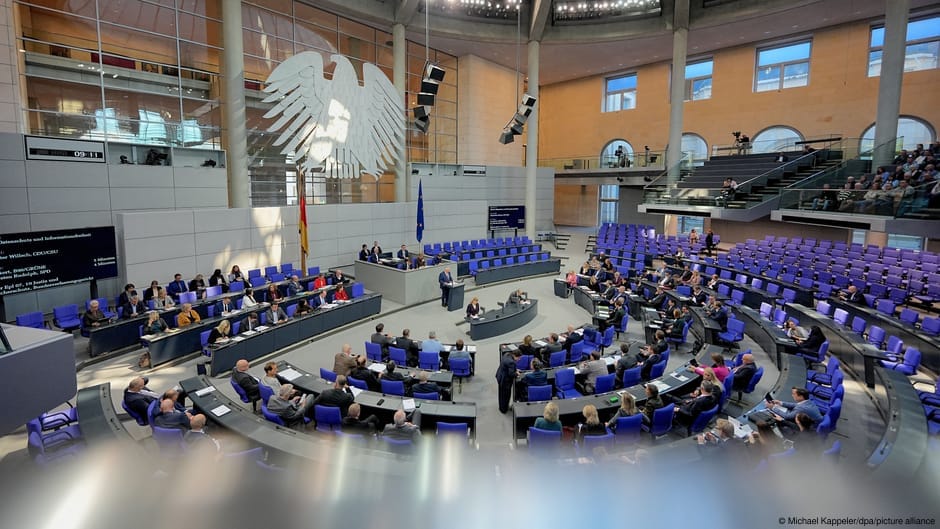
You join us the day after the German Bundestag passed the government budget for 2027, even as EU budget talks in Brussels have been faltering.
Saturday is also the party convention for the left-wing populist BSW party.
For the latest on this and more, keep reading.
- bsw
- germany
- news
- leftist
- tie
- right
- motion
- leader