How making documentaries is changing the lives of Nigeria’s teenage brides
In northern Kaduna state, where many girls are taken out of school to be married, making films is offering students – and their families – a brighter future Last year, Ruqqaya Muhammad was gripped by a sense of purpose that had been lost since she was 13 and her parents, at her grandfather’s insistence, had married her off. Muhammad was among a group of married teenagers recruited by a small organisation from the capital, Abuja, headed by a former national radio journalist, Ummi Bukar.
In northern Kaduna state, where many girls are taken out of school to be married, making films is offering students – and their families – a brighter future
Last year, Ruqqaya Muhammad was gripped by a sense of purpose that had been lost since she was 13 and her parents, at her grandfather’s insistence, had married her off. After two years as a wife, handling household chores and catering for her husband and then their son had become her life, as routine as homework had once been.
But then the Nigerian teenager had the chance to become a film-maker. Muhammad was among a group of married teenagers recruited by a small organisation from the capital, Abuja, headed by a former national radio journalist, Ummi Bukar.
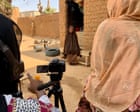
Paged (Participatory Communication for Gender Development) Initiative came to her home town, the northern city of Zaria, with a plan to persuade local girls to produce short films about the long list of issues impeding their education.
The girls first had to get permission from the local authorities and then convince shy friends and neighbours to be interviewed. The outcome was two films: a six-minute documentary Gobe Ma Fi Kyau (Hausa for “Tomorrow will be Better”) and a 17-minute documentary Cikas (Challenges).
The films caused quite a stir during screenings in makeshift cinemas in the girls’ communities. One of those featured was close to being forcibly married but after her father, seated in the audience, watched her talk on screen about the sadness of it all, he called off the marriage and kept her in school.
“Ina jin daɗi sosai,” says a beaming Muhammad, now 17, using the Hausa expression for intense happiness.
Approximately one in every five children out of school globally live in Nigeria.
The north of the country is also largely responsible for Nigeria’s status as third in the world for child brides: 44% of all girls in Nigeria are married before they turn 18. Many face gender-based violence and never finish secondary school, including in Zaria, despite it being the site of one of Nigeria’s most prestigious universities
Even though primary and secondary education are free nationwide, multiple barriers to education remain for Nigerian children. Infrastructure is sparse: in some schools, a shortage of desks mean pupils sit on the floor and, at break-times, queue up with dozens of their peers to use what is often the only school toilet.
In the deeply conservative society of northern Nigeria, parents feel uncomfortable sending their children to local schools, which often have few female teachers and no help for menstruating girls.
In rural areas, those who do enrol often have to trek for several kilometres to catch transport to the school. On their return, they may be required to work, such as hawking food or other basic goods on the streets until early evening.
The region has the largest average household sizes in the country and with many mouths to feed, any extra money a family can raise is needed.
Bukar, the founder and head of Paged, says: “Little children in the north, particularly in Kaduna state, indirectly are breadwinners of their families as street vendors because the fathers, a lot of times, do not provide [and] the mothers are not allowed to go out and earn.”
Selling goods on the street can open them up to violence, which in turn leads to their families marrying them off quickly. Some have a “very limited understanding of the world” because they are “children made into women abruptly”, says Bukar.
A former journalist at the state-owned Radio Nigeria, Bukar’s workshops teach girls basic film-making skills and an understanding of gender-based violence. Alongside them are volunteers such as Safiyya Tanko, 29, who has a statistics degree from Ahmadu Bello University in Zaria. Tanko almost left school at the age of seven after her father’s death as his family wanted her to marry young, but her mother fled with the children.
Now, when Tanko sits with cousins who dropped out, they listen admiringly as she talks of her career. “They tell me when we are chatting that they want to be like me. Some still want to go back to school,” she says.
Another volunteer, Sa’adatu Saidu Idris, became a fellow at the Malala Fund, a girls’ education charity set up by the Nobel laureate Malala Yousafzai. The fund trains girls and young brides in her community to make sustainable products, such as reusable sanitary pads.
“That gave me that respect in my community because they saw me as someone that came and opened doors for them and to help them support themselves in whatever they are doing,” she says.
Nabila Aguele heads the Malala Fund in Nigeria, which has given a grant to Paged. She wants to see more girls having an input in decisions about their education and marriage.
Bukar agrees. She believes in dialogue within boardrooms and policy forums rather than just public debates. “Nobody knows their stories better than the people that it affects,” she says.
In July, the fund hosted a screening in Abuja for policy leaders and development professionals, who subsequently offered to mentor the girls, as well as showcasing the films on larger platforms.
Aguele wants such commitments to become real opportunities for the film-makers, and ultimately lead to policies that will help keep girls in school nationwide. “We want to see a future where girls don’t have to fight so hard for the opportunity to learn,” she says. “Their advocacy is powerful, but it must be met with political will, investment and action.”
Some of the girls, including Muhammad, were able to travel to Abuja to take part in the post-production process of the films. Bukar remembers their excitement throughout.
“By the time we started showing them examples of what other women are doing and how, they were really excited about what they could be capable of,” Bukar says. “So building their ability to make the film is actually secondary to understanding the gender dynamics around education.”
The girls began the work on the films as camera-shy as their subjects, but since the excitement of seeing their name in the credits, they now joke about a future as directors in Kannywood, the Hausa-language segment of the larger Nigerian cinema industry, known as Nollywood. At school, words such as “screening” and “teaser” now appear in their conversations.
When a few of the girls recently met Nigeria’s junior education minister, Suwaiba Sa’idu Ahmad, in Abuja, their newfound confidence came to the fore. As the minister attempted to leave after the first film ended, citing time constraints, one girl courteously but firmly insisted the minister watch the second one, too.
In Zaria, Muhammad, who wants to become a broadcaster and women’s rights advocate, is back in school. “I feel like a shugaban, a leader,” she says.
- life
- nigeria
- film
- muhammad
- teenager
- documentary
- bride
- kaduna