My daughter was saved by strangers, institutions must do same – Chidoka
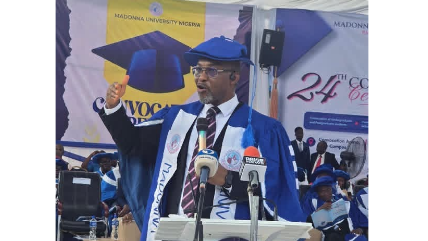
Former Minister of Aviation, Osita Chidoka, has called for the building of strong and reliable public institutions that serve Nigerians equally, irrespective of their social status, ethnic background or connections to people in authority. Chidoka made the call on Friday while delivering the 24th Convocation Lecture of Madonna University, Elele, Rivers State, titled, “Rebuilding Public Institutions, Advancing National Development in Nigeria.”
Former Minister of Aviation, Osita Chidoka, has called for the building of strong and reliable public institutions that serve Nigerians equally, irrespective of their social status, ethnic background or connections to people in authority. Chidoka made the call on Friday while delivering the 24th Convocation Lecture of Madonna University, Elele, Rivers State, titled, “Rebuilding Public Institutions, Advancing National Development in Nigeria.” He recounted how his daughter was involved in a head-on road crash a day before the lecture, saying two strangers who came across the accident scene rescued her and took her to a hospital.
According to him, a female police inspector from Plateau State, who accompanied his daughter from the accident scene to the hospital, told him that the two men were Northern Muslims on their way to an event when they stopped to help. “One of them carried her when she cried in pain at touch, not knowing that her arm was broken, and his clothes were soaked with her blood.
“They handed her over to the hospital and left. They would not give their names or their telephone numbers. They did not ask who she was, where she came from or how she worshipped. They saw a person in trouble and they acted,” he said. The former FRSC Corps Marshal said the incident reminded him of the Nigerian national anthem’s message of unity and brotherhood across ethnic and religious divides.
“Our national anthem says, ‘Though tribe and tongue may differ, in brotherhood we stand.’ Two strangers whose names I will never know showed me what that line means,” he added. However, Chidoka expressed disappointment that the hospital initially declined to admit his daughter, citing a lack of space for another emergency patient. He said it took his intervention through telephone calls before the hospital agreed to stabilise her.
He, however, acknowledged the efforts of the medical personnel, explaining that they were courteous and willing to help but faced limitations arising from inadequate facilities. “But when I got there, I found doctors who were courteous and willing to help. They simply had no bed. A patient they had already stabilised had to give up a bed before my daughter could be admitted.
That is not a failure of the doctors. It is a failure of the system they work in,” he said. Chidoka, who disclosed that his daughter was subsequently moved to a private hospital, said the experience exposed the challenges confronting Nigeria’s public healthcare system, particularly inadequate facilities and poor funding for existing infrastructure.
He recalled that during his tenure as FRSC Corps Marshal, he consistently advocated against the rejection of road crash victims by hospitals, expressing concern that his daughter encountered the same challenge years later. “We keep building and commissioning new facilities without funding the day-to-day running of the ones we already have. And no Nigerian should need a former minister’s telephone call to get a bed in an emergency ward.
“The institutions we need are the ones that work on their rules, not on who you know,” he said. Despite the experience, the former minister said he remained optimistic about Nigeria’s future, noting that he had continued to encourage his children to pursue their education in the country. “My daughter is studying in a Nigerian university. I brought my son and my last daughter back from the United States to attend secondary school here.
I am a Nigerian optimist. But that optimism comes with a duty: to keep calling our institutions out, and to keep pushing them towards global standards,” he said. Restating the central message of his lecture, Chidoka said Africa needed committed citizens who would build institutions capable of functioning beyond the influence of individuals. “Africa needs good people willing to build institutions that do not depend on good people,” he said.
Addressing the graduating students, he warned that public institutions were often weakened not only by major acts of corruption but also by seemingly minor compromises and preferential treatment. He cited practices such as backdating official documents, giving preferential attention to the files of relatives and signing attendance registers for absent colleagues as examples of conduct that gradually undermined institutional integrity.
Chidoka urged the graduates to imagine a situation in which a Nigerian woman approaches a government office in 30 years to claim an entitlement without a recommendation or intervention from an influential person. He said the treatment she receives would depend on whether the officials she encounters uphold the rules guiding their institution. According to him, some members of the graduating class would eventually occupy positions where their decisions would determine whether public institutions served citizens fairly.
Referencing the national anthem’s pledge to hand over to future generations “a banner without stain,” he urged the graduates to resist practi
- daughter
- chidoka
- hospital
- institution
- stranger
- minister
- people
- lecture


