Kurds in the Middle East: Does 2026 mark the end of all political hopes?
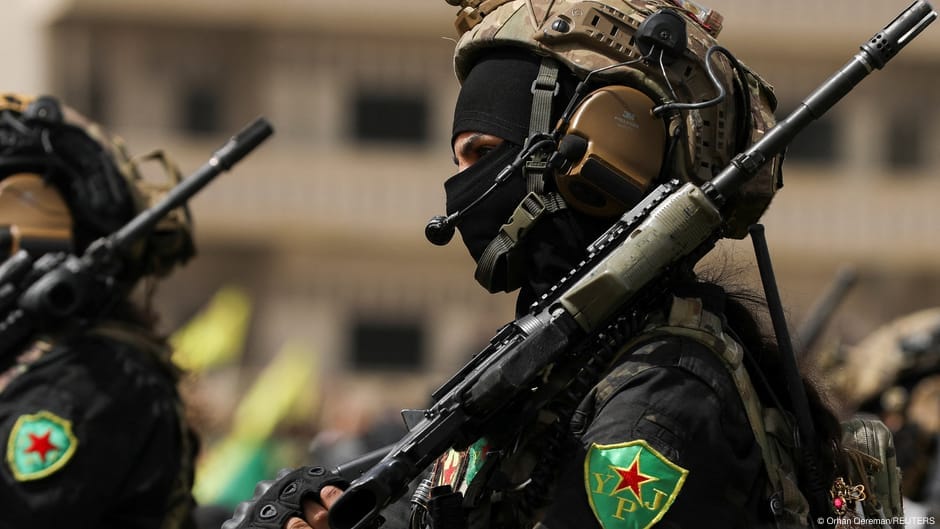
2026 has been a year of political setbacks for the Kurds in their traditional areas of residence. Even in Iraq, they are now facing increasing pressure.
The year 2026 has been a difficult one for Kurds. In Syria, the de facto Kurdish system of self-rule which had emerged in 2012 during the Syrian civil war came to an end.
In Iraq, infighting among the leading Kurdish parties continues as the central government in Baghdad increases pressure on the semi-autonomous region.
In Turkey, efforts are underway to end the decades-long conflict with the Kurdistan Workers' Party (PKK), which announced its decision to dissolve last year. However, the disarmament process remains incomplete and the group is still classified as a terrorist organization by Turkey, the United States and the European Union, among others.
Other aspects such as greater cultural recognition and political rights as a minority remain unresolved.
For the Kurds in Syria in particular, this year brought a major setback. In January, the new leadership in Damascus brought large parts of the northeast under its control. An agreement dated January 18 stipulated that the Kurdish-dominated Syrian Democratic Forces (SDF) would hand over territories and key infrastructure to the central government. Their fighters were to be integrated into the Syrian armed forces. This marked the end of self-governance as an independent political and military project.
The US, which had supported the SDF for years as an ally in the fight against the so-called Islamic State group, began aligning itself with the new central government in Damascus.
Dastan Jasim of the German Institute for Global and Area Studies (GIGA) in Hamburg said this was a textbook example of the limits of Kurdish alliance politics.
"The bitter truth is that western alliances with the Kurds are always alliances of convenience and very rarely have political consequences," she told DW.
However, there was no alternative to the fight against ISIS, she said. "It was a matter of survival," Jasim recalled, adding that cooperation with the superpower, the US, by no means brought the Kurds the lasting political guarantees they had hoped for.
According to political scientist Thomas Schmidinger of the University of Vienna, Austria, Kurdish self-governance in Syria might still have an impact due to experiences and learnings in the fields of education, women's organizations and local structures.
Schmidinger believes the knowledge in these areas could remain relevant "at the grassroots level," even if it remains to be seen which specific aspects will endure.
"The Kurds will certainly continue to play a role, though no longer as an autonomous region, but rather within the framework of the state as a whole," he told DW.
But for an entire generation that grew up and was socialized in a de facto autonomous self-governing region, the end of Kurdish autonomy as a quasi-state region with its own armed forces was an enormous rupture and a great disappointment. Many had seen it as the starting point for a future Kurdish state.
Kurds in northern Iraq, or Kurdistan, where they enjoy constitutionally guaranteed autonomy, are also going through tough times. In addition to mounting pressure from the central government in Baghdad, the traditional rivalry between the two major parties — the Kurdistan Democratic Party (KDP, also known as PDK) and the Patriotic Union of Kurdistan (PUK) — is a major problem, as it weakens the institutions of autonomy at a critical juncture: Two years after regional elections, there is still no established regional government. Both parties are essentially securing their spheres of influence and seeking different regional allies.
"The situation is very unstable," says GIGA's Dastan Jasim.
Although autonomy is enshrined in the constitution, there is a lack of well-functioning institutions to enforce decisions. Schmidinger also says there's instability among the Iraqi Kurds, "and that is primarily due to the political elites of the PUK and the PDK."
According to an October 2026 analysis by the British think tank Chatham House, the consequences could be significant.
"The ongoing stalemate between the KDP and the PUK threatens to trigger an irreversible decline in the very structures that have made Kurdish self-governance possible over the past two decades," the analysis reads.
Baghdad and neighboring countries could benefit from this. And the move away from Kurdish autonomy may already have begun: On Tuesday, November 24, Iraq's central government ordered the border crossings of the Kurdish autonomous region, as well as several oil fields previously controlled by the Kurds, to be placed under central government control without prior notice.
The prime minister of the Kurdistan Regional Government, Masrour Barzani, called this "in no way acceptable."
The development is likely to intensify the dispute between Baghdad and Kurdistan over oil exports and jurisdictional responsibilities — though to what extent remains to be seen. Many Iraqi Kurds are likely to view the developments in Syria as a cautionary tale, especially since the US has now also ended its military presence in Iraq.
The country that stands to gain the most from developments in Syria and Iraq could be Turkey, which for decades has gone to great lengths to prevent the emergence of a Kurdish state, primarily on its own territory but also in neighboring countries.
The decades-long conflict between the Turkish state and the PKK could potentially come to an end, given that the PKK had already announced its dissolution and the end of armed struggle in May 2025.
Nevertheless, expert Jasim believes that lasting peace appears to be just as uncertain as greater rights for the Kurdish minority. She criticizes the fact that the process focuses on disarmament and amnesty, while the political causes of the conflict are barely addressed. As long as Turkish remains the only official language under the constitution and Kurdish education is not available on an equal footing, she argues, recognition of the language depends on the will of the respective government.
Political scientist Berfin Coskun, a visiting scholar in the Middle East program at the British think tank Chatham House, agrees that PKK disarmament alone is not enough. In an analysis for Chatham House's Kalam platform, she writes that the process gained support faster than it could build trust. Without legal guarantees and political reforms, she argues, it will not lead to lasting peace.
Therefore, the year 2026 did not bring any hopes for greater political or even cultural rights to the Kurds in Turkey; quite the contrary. Nor did it bring such hopes to Iran, where some Kurds are suspected of collaborating with foreign powers and where, under the current circumstances, political autonomy also seems virtually inconceivable for the time being.
- middle
- east
- end
- kurds
- kurd
- hope
- setback
- area