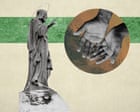
I couldn’t reconcile the idea of an all-powerful God with one who allows suffering. The mystics showed me a different path
I couldn’t reconcile the idea of an all-powerful God with one who allows suffering. Jackie Bailey is the award-winning author of The Outrageous Good Fortune of Living, a guide to finding the sublime in everyday life.
I left institutional religion for a number of reasons but, after reading a 13th-century book, I am inspired to revise the notion of the divine I had as a child
For anyone who has taken an introductory philosophy class, this question will be familiar: If there is a God, why is there suffering? It’s a question that has kept theologians up at night for thousands of years and has been identified as one of the key reasons people are leaving religion.
It’s one of the reasons I left my childhood faith. When my sister was diagnosed with an inoperable brain tumour, seven-year-old me asked: If God can do anything, why would he choose to do this to my family?
But what if, all these years, I have been asking the wrong question?
In her book The Flowing Light of the Godhead, the 13th-century mystic and beguine Mechthild of Magdeburg asks God: “Who made this book?” God replies: “I made it in my powerlessness, for I cannot restrain myself as to my gifts.”
The idea of God as powerless radically challenges my Sunday school notions of God as the all-powerful creator of the world. If God is all things then this means, according to the mystics, that God is also the experience of the absence of all things.
Mechthild understood God as infinite in all directions, infinitely powerful and powerless. In her conception of the godhead, the divine chose to be powerless and unable to stop themself from giving love and life.
About 250 years after Mechthild’s death, the Jewish mystic Isaac Luria described a similar concept of God as choosing to limit the divine presence for the possibility of existence. His mystic concept, the Lurianic Kabbalah, explains that God had to withdraw part of themselves to create a space known as the tzimtzum in which reality and humans could exist.
Centuries later, in the early days of the second world war, the French philosopher and mystic Simone Weil wrote something similar: “God could create only by hiding himself. Otherwise there would be nothing but himself.”
Mechthild wrote her book over the course of a long life. In old age, she lost her eyesight and was unable to feed herself. She also wrote of losing all sense of God’s presence yet still being at peace.
The former Trappist monk James Finley explains how Mechthild found acceptance by understanding that “God is the infinity of the experience that God is missing”. Mechthild understood that love “permeates all the moments we are not aware of it at all. I don’t feel it [God’s presence]”, Finley explains, “but I don’t need to”.
Mother Teresa of Kolkata reportedly experienced one of the longest dark nights of the soul, spanning more than 50 years, almost the entire period of her mission in India. In letters to her confessors, Mother Teresa mourned the loss of her sense of God’s presence. She seems to have eventually found some comfort in the idea that this experience might be a way of sharing more deeply in Christ’s suffering. “If I ever become a Saint – I will surely be one of ‘darkness’,” she wrote in 1962. “I will continually be absent from Heaven – to [light] the light of those in darkness on earth.”
Reading the mystics, I am inspired to revise the notion of God I had as a child. I left institutional religion for a number of reasons, not just the question about suffering. Issues including gender equality and cultural disconnection keep me away from temples and churches.
Mechthild, Mother Teresa, Weil are women from a tradition of mystical engagement and questioning to which I can belong, even if I don’t belong in a formal faith tradition. Each of them reminds me that I can still engage with the deep mystery of creation as love. My longing for meaning may represent its own divine answer.
Jackie Bailey is the award-winning author of The Outrageous Good Fortune of Living, a guide to finding the sublime in everyday life. She is an ordained interfaith minister, funeral celebrant and pastoral care practitioner with a master’s of theology
- god
- reason
- idea
- path
- religion
- question
- mystic
- number