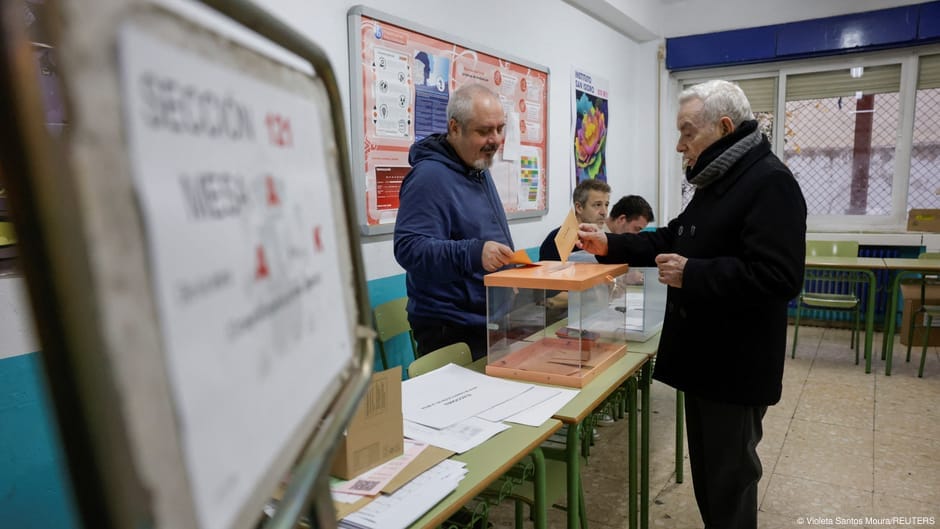
Polls close in Spain's snap election, as voters turn out in numbers
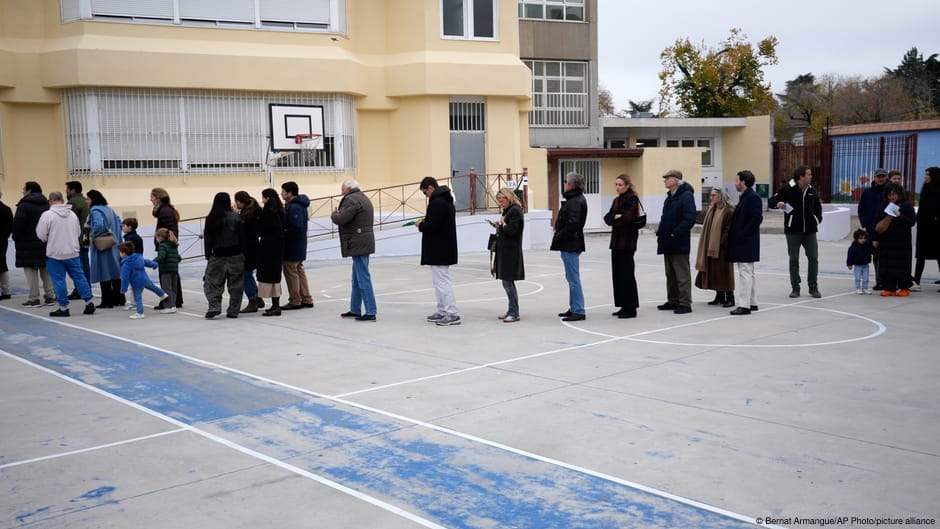
Voter turnout shortly before polls closed reached 68%, surpassing the total turnout of the last election. The results could bring an end to Pedro Sanchez's center-left leadership.
Follow along for the latest news regarding Spain's snap election on November 29, 2026:
The Sigma Dos survey for Spanish public broadcaster RTVE released its last pre-election survey, based on 19,500 interviews conducted between November 13 and 28.
According to the survey, Spain's conservative opposition People's Party (PP) and the far-right Vox appeared likely to secure a parliamentary majority.
The survey has projected the PP to win between 131 and 136 seats and Vox 44-48, for a combined range of 175 to 184 seats. The bloc needs 176 seats for a majority in the 350-seat lower house.
Meanwhile, Prime Minister Pedro Sanchez's Socialist Party was forecast to win 119-124 seats, while the hard-left Broad Front could secure 10-11 seats.
Polls closed in Spain's parliamentary election, with the first official results not expected for about hour later.
Voting still continued in the Canary Islands, which lie in a different timezone, one hour behind mainland Spain. Polls close there at 20:00 UTC/GMT.
Spain's election is taking place as the country's economy has grown during the eight years leftist Prime Minister Pedro Sanchez has been in power.
Economic figures have painted a positive picture, as Spain has topped growth among advanced economies globally for three straight years, having created around 41% of all jobs added across the EU last year and narrowed its deficit from 3.3% in 2023 to an expected 2.6% in 2026, according to government figures and the IMF.
And yet, Spaniards across the country say they do not feel those economic gains in their everyday lives.
The success has been offset by rising prices for housing, energy and consumer goods. The cost of living increases have been partly caused by external shocks, including from the COVID-19 pandemic and the US-Iran war, which have similarly squeezed households and triggered discontent across Europe.
Meanwhile, reforms that lifted salaries for millions of workers have also raised costs for small businesses, which make up 95% of Spain's companies and are already battling higher costs elsewhere.
According to Eurostat data, per capita income growth has not kept pace, with Spaniards still lagging behind the EU average on purchasing power.
As such, the share of Spaniards at risk of poverty and social exclusion has barely changed in the past decade, in part because of inflation, which stood at 4.9% in October, the highest since February 2023, according to the National Statistics Institute.
Pedro Sanchez' Socialists have acknowledged the hurt that still exists, despite the economic successes the country has achieved.
"Spain is generating prosperity. The economy is working in macroeconomic terms, much better than those around us. But that prosperity is not being shared adequately in terms of reaching certain layers of society or territories," Salvador Illa, a leading Socialist politician and president of Catalonia, told Reuters.
The conservative PP has promised to increase Spain's average salary to €50,000 ($54,700) from its current level of around €29,500, but has not provided specific plans for how it will do so.
Meanwhile, its potential partner, the right-wing, populist Vox has proposed wide-ranging tax cuts it says will boost the economy, saying it will be paid for by stripping unions and parties of funding and also restricting welfare payments to Spanish citizens only.
Vox has campaigned on blaming high levels of immigration for Spaniards' economic woes, something that may be resonating with voters.
PP has also called for a stricter immigration policy, while also promising financial aid for young families buying homes, hoping to tap into growing frustration over Spain's housing crisis.
According to preliminary Interior Ministry data, turnout in Spain's Sunday parliamentary election was the highest in 40 years.
Turnout reached 68.1% by 6 p.m. (17:00 UTC/GMT) on Sunday, up from 53.1% recorded at the same time in the last parliamentary election in July 2023.
The final turnout rate in that election was 66.6%, where conservative Partido Popular won the most votes but failed to secure enough parliamentary support to form a government.
There is a steady stream of people coming in to cast their ballots at this polling station in Madrid’s Chamberí district.
Voters also include those who have obtained Spanish citizenship. Many are arriving with family members, saying they plan to go about their Sunday as usual until the polls close.
But the clear divide among voters is hard to miss.
"The people who deserve to win the most will win. In my personal opinion, that won't be Pedro Sanchez. I don't like the way he governs," one woman tells DW when asked who should form a government in Spain.
Another voter takes the completely opposite view.
"I want the current government to continue because I don't want us to go backward on rights or resources. And I don't want a fascist country."
In Andalusia, queues have been forming outside some polling stations as citizens cast their ballots.
With nearly 9 million inhabitants and 60 seats in the Spanish Congress, the southern Spanish region holds particular importance in the election.
It was traditionally a stronghold for the Spanish Socialist Workers' Party (PSOE,) but in recent years, the Conservatives and the far-right party VOX have made significant gains there.
Regional President Juan Manuel Moreno, of the conservative People’s Party (PP), urged Andalusians to cast their votes, reminding them of their "special responsibility."
Voter turnout in the Sunday election has already reached 45.7% by 2:00 p.m. (1300 GMT), according to Interior Ministry figures.
That is 5 percentage points higher than in the previous election in 2023.
The leader of the far-right Vox party, Santiago Abascal, has now also voted, meaning the leaders of the four main contestants in the election have now all cast their votes.
Abascal called on voters to turn out in "massive numbers so that they don't have any regrets tomorrow."
Vox is hoping to beat the 33 seats it won in the last election, a result that put them shy of preventing another term for Sanchez.
Polls have forecast a better result this time around, putting the far-right party in line with other such parties across the continent. Although with less than 20% support in pre-election polls, they remain below the likes of Alternative for Germany, who have closer to 30%.
A coalition with the center-right Partido Popular would bring the far-right to power for the first time since the end of Spain's fascist dictatorship.
A loss for Pedro Sanchez and a shift to the right in Madrid could affect how one of the EU's largest countries approaches migration, defense and the war in Gaza, writes DW's Tessa Clara Walther.
Read the full report on what a right-wing victory in Spain could mean for Europe.
Ada Colau, the leader of the left-wing Broad Front and former mayor of Barcelona, has cast her vote in the Catalan city.
"Today we have to vote for the social working majority," she said, according to Catalan public TV 3Cat.
She also said that "women will have the final word in these elections."
The Broad Front is the main party that would likely back Sanchez's PSOE to stay in power, alongside several smaller regional parties. However, according to the polls, the Broad Front isn't forecast to get enough votes to hold up another Sanchez government.
Alberto Nunez Feijoo, the leader of the center-right Partido Popular and possible new prime minister, has also voted in Madrid.
Feijoo urged voters not to cast their ballots "with fear," in reference to the accusations that Sanchez had campaigned on fears of the far right coming to power for the first time since the death of ultranationalist dictator Francisco Franco in 1975.
He also said Sunday's election would "decide the future of Spain for the next decade."
The center-right leader also confirmed that he would accept the result of the vote
The Spanish prime minister has cast his vote in the capital Madrid.
Speaking to the press, he said: "Today is the day when Spain will decide what future it wants for the next four years," adding that in democracy "there are many powers" but the biggest is voting.
Urging as many people to come out to vote as possible, Sanchez said that a higher turnout would mean a greater reflection of the public sentiment in the next parliament.
"I see a historic mobilization and I have a good feeling," he said, expressing optimism that polling may be proven wrong.
Sanchez wife Begona Gomez did not accompany the prime minister, amid her own corruption scandal, instead voting by post.
The Spanish electorate are voting for both the Congress of Deputies and the Senate, with the former being the more important chamber.
Congressional seats are awarded based on the D'Hondt system, which is somewhat complicated.
Votes are cast across 52 constituencies which coincide with the 50 Spanish provinces plus the autonomous cities of Ceuta and Melilla in North Africa.
Each constituency sends a minimum of two deputees to the congress, although Melilla and Ceuta send one each. However, this doesn't bring us to the total 350 seats in congress.
The remaining seats are spread across the constituencies based on population, meaning Madrid sends 38 deputees and Barcelona sends 32. For this election, Madrid gained an extra seat at the expense of Cadiz.
Voters vote for a party list rather than specific candidates. The D'Hondt system shares out seats by first giving one seat to the party with the most votes. That party's votes are then divided by two and whichever party now has the most votes gets a seat and in turn that party's vote is divided by two, or however many seats it has already won, plus one. This process continues until all of a constituency's seats have been awarded.
While this process is largely representative, because of the minimum two seats per constituency, the number of votes needed per province can vary. For example, in some of the smallest constituencies, each seat needs an average of around 30,000 votes, whereas in Madrid, this is closer to 130,000.
Once all the votes have been counted, it is up to the largest parties to try to put together a government, with their leader becoming prime minister. In the last election, Sanchez's center-left PSOE was able to form a government despite the center-right PP winning more seats because the latter was unable to put together a coalition with a majority of 176 seats or more.
It is 9 a.m. (0800 GMT) in Spain, meaning polls have opened and voters can begin casting their votes to decide on whether Pedro Sanchez will extend his eight years in power, or whether a coalition of right and far-right parties takes control.
Polls will remain open until 8 p.m., with almost 36 million people eligible to vote across almost 22,500 polling stations.
The first results will start coming in shortly after and it is expected that we will have a good idea of the outcome before midnight.
- election
- poll
- voter
- turnout
- spain
- number
- result
- end