A leaderless revolution has swept Serbia. The world should be watching

A leaderless revolution has swept Serbia. Aleksandar Matković is a postdoctoral researcher at the Institute of Environmental Science and Technology in Barcelona and a fellow at the Transnational Institute in Amsterdam.
I saw a remarkable experiment take shape in Belgrade. Its lessons should be studied by other European countries struggling with unrest
More than a decade ago, the WikiLeaks founder Julian Assange told an interviewer in Belgrade that Serbia was “a country where the future happens first”. The phrase circulated widely on Serbian social media in the weeks before Sunday’s election, but in a way that could not have seemed possible 10 years ago. Who would then have imagined that Serbia today could be at the forefront of global democratic change?
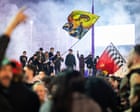
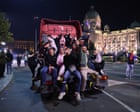
The images from Belgrade on Sunday night – people dancing and crying in the streets, while in Novi Sad, the city that sparked the student movement, a flag bearing the image of the convicted war criminal Vojislav Šešelj, which had hung from a building since the 1990s, was torn down – reinforced the feeling that the future had truly arrived.
Watching my home country from abroad, I found it hard not to share in the excitement and emotion. I became involved with the student movement behind this electoral earthquake and was an election candidate for it, for about six months before moving abroad. My involvement began while lecturing in Belgrade at the university’s blockaded faculties in 2024 and 2025. During these extraordinary blockades, something happened that was not widely discussed in the western media: the emergence of a collective sharing of intelligence and a process of shaping opinion that would become key to Sunday’s outcome.
For almost two years, students debated almost every aspect of Serbia’s economy and society – from lithium mining and resource exploitation to the economic power of local oligarchs, as well as issues such as healthcare and education. Sometimes discussions lasted six hours. All of this happened before the students developed any joint programme or formed an organisation capable of outmatching the traditional liberal parties. In a sense, knowledge came first, and organisation followed.
Sunday’s election victory for what became the Student List, therefore, emerged from a novel political culture: a leaderless movement based on collective self-governance and political education, unseen in the Serbian political arena since the collapse of Yugoslavia.
Given Serbia’s recent history, how was this remarkable democratic experiment even possible? One answer lies in the movement’s ability to rally a wide range of people who, despite different political convictions, wanted to counter the perceived corruption of Aleksandar Vučić, the authoritarian president. With the economy dependent on foreign direct investment after the destruction of Yugoslavia, the political leadership formed close ties with foreign-owned corporations. Vučić’s name was often intertwined with the activities of multinationals such as Rio Tinto, the Anglo-Australian mining giant that sought to extract the country’s lithium.
In this context I received death threats following the publication of a critical scientific paper on the contested lithium issue; many of my colleagues faced similar intimidation. But the mistreatment of Serbian citizens who challenged large-scale investment projects also began to shape public consciousness in Serbia. Vučić’s party was accused of standing by and even participating, while opposition parties offered only lacklustre responses.
From the students’ standpoint, party leaders were seen as easy to corrupt when confronted with the financial power of international projects. And so, to change the system, you had to start by changing the political structures that enabled it.
In this sense, this was not just another election; it was a monumental struggle between the old, which was dying, and the new, which was struggling to be born – to paraphrase Antonio Gramsci. In Serbia, the new movement has arisen out of the old: it began with faculty occupations, blockades and plenary assemblies, before evolving today into the largest political force in the country.
By winning the parliamentary election, the Student List has broken the monopoly of political parties. It has become more popular than both the rightwing government and virtually all the opposition parties across the spectrum, most of which did not even win enough votes to meet the electoral threshold. Thus, the “old”, in Serbia’s case, at least, is confirmed as dead.
And what the Serbian people chose was not another party but a list of 250 candidates, 134 of whom hold PhDs, 44% of whom are women, and 135–140 of whom are now projected to enter parliament. Behind them stood an organisation unlike anything seen in traditional, leader-based political parties. In this way, “a bunch of students”, as the Economist described them, has created something that should be studied as it goes beyond the traditional ways of doing politics.
Will a leaderless movement be able to govern? This is where things get tricky. In the context of what the historian Adam Tooze calls the world’s “polycrisis”, a collective intelligence based on self-organisation may be a tempting answer. After all, the student protests in France, Italy and Belgium, along with protests in Spain and Albania, have emerged in response to interlocking crises of housing, education and environmental destruction. For these crises elsewhere in Europe, so evidently mismanaged by governments, the lessons of the Serbian experiment may become crucial.
On the other hand, one should not idealise the situation. The list comprises ideologically opposed blocs, from rightwing adherents to leftwingers and liberals. Most of those elected have never before held political office, and the parliamentary system will require them to nominate a prime minister and, in future presidential elections, a presidential candidate. Will the Student List bring the same energy to the national assembly without jeopardising the very method that made it so strong? Moreover, for Vučić, losing the election does not necessarily mean losing the system. On the contrary, his concession of defeat may also have been a strategic move, allowing him to keep the party apparatus intact for a comeback.
Whatever happens, one question has been put on the table: to what extent are self-organisation and decentralised decision-making a basis for government? For the time being, people are celebrating on the streets of Belgrade, Novi Sad and many other cities and towns across Serbia. But the real fight has only just begun. The world should be watching closely: it may be witnessing the start of a very different kind of politics.
Aleksandar Matković is a postdoctoral researcher at the Institute of Environmental Science and Technology in Barcelona and a fellow at the Transnational Institute in Amsterdam. He works on environmental history, political economy and the history of Yugoslavia
- serbia
- belgrade
- leaderless
- revolution
- world
- country
- future
- image