Agric ministry puts post-harvest loss at $10bn yearly
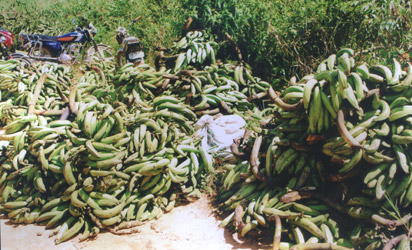
•As 14 of 17 federal silos fail •20% of grains, 70% of fruits, vegetables lost By Gabriel Ewepu ABUJA — THE Minister of Agriculture and Food Security, Senator Abubakar Kyari, Tuesday, disclosed that Nigeria loses an estimated $10 billion annually to post-harvest losses. Kyari made this known as one of the panelists focusing on the topic ‘Productivity Revolution for Growth’ at the ongoing 32nd Nigerian Economic Summit (NES#32) organised by the Nigerian Economic Summit Group, NESG, in Abuja.
•As 14 of 17 federal silos fail •20% of grains, 70% of fruits, vegetables lost By Gabriel Ewepu ABUJA — THE Minister of Agriculture and Food Security, Senator Abubakar Kyari, Tuesday, disclosed that Nigeria loses an estimated $10 billion annually to post-harvest losses. Kyari made this known as one of the panelists focusing on the topic ‘Productivity Revolution for Growth’ at the ongoing 32nd Nigerian Economic Summit (NES#32) organised by the Nigerian Economic Summit Group, NESG, in Abuja.
He also said Nigeria loses between 15 and 20 per cent of its grains, including rice, maize and millet, while losses involving tomatoes, pepper, onions, fruits and vegetables could reach 60 to 70 per cent, depending on the season. He described the reduction of post-harvest losses as a low-hanging fruit in Nigeria’s food security drive, said the country could significantly improve food availability and farmers’ earnings by addressing weaknesses in storage, processing, transportation and market infrastructure.
He stated: “We lose almost about $10 billion annually on post-harvest losses. “About 15 to 20 per cent on grains, and you can see grains that are hard, and you probably think we will not lose much of that, but we lose on grains, on cereal, rice, maize, and so on and so forth, millet. On fruits and vegetables, the minister warned that the scale of waste was considerably higher.
“Tomato, pepper, onion, and other fruits and vegetables, we lose some of that as high as 60 to 70 per cent depending on the season”, Kyari said, attributing the vulnerability of tomatoes, in particular, to their short shelf life and the effects of hot weather. The Minister also lamented that 17 of the 33 silo complexes built by the Federal Government had been concessioned to private operators, but only three were performing.
“The government had concessioned 17 out of the 33 silos that it had built over a period of time, but I’ll tell you that out of the 17, only three have performed. All the 14 are almost comatose for the past, I believe, since when it was concessioned”, he said. The minister attributed the problem partly to a disconnect between agricultural production centres and the location of storage facilities.
According to him, some farming communities are situated more than 100 kilometres from major storage facilities, making it difficult and costly for farmers to transport their produce to the silos. He argued that the country’s storage strategy must be redesigned to reflect the geographical distribution of agricultural production rather than depend exclusively on large-scale facilities located far from farming communities.
The minister’s position suggests that the challenge extends beyond the physical availability of silos to questions of accessibility, operational efficiency, commercial viability and the suitability of infrastructure to the needs of farmers. To address the shortcomings, he (Kyari) said the Federal Government was considering smaller, modern community silo systems that could be deployed closer to farming communities.
He explained that the proposed facilities would draw inspiration from traditional grain-storage practices, while incorporating modern technology, ventilation and renewable energy. The facilities, he said, could be designed to accommodate capacities of 2,000, 3,000, 5,000 or 10,000 tonnes, depending on the productive capacity of the communities they serve.
He said: “We need not only the huge silo systems, but we need community silo systems.” He noted that traditional grain-storage structures, known in Hausa as grumbu, offered a useful starting point for developing storage systems adapted to local conditions. He said the government was exploring modernised versions of such systems, equipped with appropriate ventilation and solar-powered infrastructure.
“We have renewable energy that we must take advantage of because we have to have that in our budget”, he said. The proposed approach could reduce the distance farmers travel to store produce, improve access to preservation facilities and help prevent avoidable losses caused by inadequate storage. However, the effectiveness of the initiative will depend on implementation, maintenance, affordability and the ability of farmers and cooperatives to access the facilities when they need them.
Beyond post-harvest losses, the Minister said the government’s approach to food security had evolved from its traditional emphasis on the availability, accessibility and affordability of food to include consumption of nutritious and diverse diets. He asserted that food security must be assessed not only by the volume of food produced or available in markets, but also by whether households can consume nutritious food capable of supporting healthy growth, particularly among children.
The minister also disclosed that agriculture had assumed a higher level of national coordination, with the Presidential Food Systems Coordinating Unit bringing together relevant sectors, including agricu
- loss
- silo
- grain
- storage
- community
- fruit
- minister
- facility