The Devils review – Ken Russell’s 1971 possessed-nuns tale is a frenzied aria of confrontation and hysteria
The speaker is Father Urbain Grandier, the 17th-century French priest accused of witchcraft, stylishly played by Oliver Reed, in Ken Russell’s scabrous 1971 classic; it is now restored and rereleased in its complete form after years of censorship. The Devils is based on a true story of politically directed mass hysteria, adapted by Russell from two literary works: Aldous Huxley’s The Devils of Loudun and John Whiting’s stage play The Devils.
Oliver Reed and Vanessa Redgrave put in the performances of their lives in this film originally banned for obscenity that highlights the violence of power
‘I could never be Satan’s boy. I haven’t the humility.” The speaker is Father Urbain Grandier, the 17th-century French priest accused of witchcraft, stylishly played by Oliver Reed, in Ken Russell’s scabrous 1971 classic; it is now restored and rereleased in its complete form after years of censorship. It comes from an era when movies, playing in high-street cinemas, still had the power to shock, to position that shock in the polite cultural mainstream and to compel serious discussion about whether that shock – or, conversely, a ban – was justified.
The Devils is based on a true story of politically directed mass hysteria, adapted by Russell from two literary works: Aldous Huxley’s The Devils of Loudun and John Whiting’s stage play The Devils. Of course it is obscene; obscenity is the glowing sulphurous paint which Russell is applying to the canvas. It is about obscenity – but the obscenity does not reside in the sexualised images of the crucified Christ or naked nuns disporting themselves; it is the violence of authority that is shown to be obscene. The idea of martyrs or heretics being burned at the stake has long been an accepted fact recounted in U-certificate history lessons, and a punishment which survived well into the European enlightenment. Russell shows you what it might actually look like and that is to involve a confrontational assault on good taste.
Reed is a revelation with his intelligent, focused, charismatic and dignified performance as the sensualist cleric who submits to injustice like a dissolute version of Thomas Becket. Grandier is a magnetically handsome man and de facto municipal leader of the town of Loudun in western France, bullishly promoting its independence, its walls and fortifications; this is to the rage of Cardinal Richelieu (Christopher Logue) and the Catholic church, who suspect that it will become a sanctuary and power-base for Huguenots and Protestants.
Grandier is blandly tolerated by the equally decadent and vain Louis XIII (Graham Armitage); the king’s bizarre court masque is shown in the film’s stunning opening scene, with superb music by Peter Maxwell Davies, whose compositions do so much to give this film its crazed, dissonant fervour. Loudun’s Ursuline abbess Sister Jeanne Des Anges, played with radioactive certainty by Vanessa Redgrave, is sexually frustrated like more or less every authority figure here – the displacement of sexuality into tyranny is, after all, part of the point – and tormented by her spinal-curvature disability; she is infatuated by Grandier and enraged by him marrying another woman, Madeline De Brou (played by Gemma Jones), and moreover declining her offer to be the order’s father confessor.
So Sister Jeanne spitefully invents stories about his demonic hold over everyone, a tale cynically seized upon by cynical agents of the state, who then fan the flames of hysteria – although Russell does not entirely endorse the theory that the nuns were themselves cynically putting on a show to incriminate Grandier. The priest’s persecutors are Baron de Laubardemont (Dudley Sutton) and the order’s Father-Canon Jean Mignon (Murray Melvin), a thin-faced disapproving ascetic who is to become this story’s contrite and despairing Judas to Grandier’s Jesus.
Russell allows us now to register what was perhaps not registered fully in 1971: the misogyny behind the publicising of her deformity over the centuries, turning it into a mark of villainy like that of Shakespeare’s Richard III, exaggerated or even invented by posterity’s myth-making. It is part of a tradition of monstrosity – perhaps even inaugurated by the self-flagellating abbess herself – that dramatised the penitent view that a woman’s sexuality was an ugly disorderly phenomenon.
As well as everything else, The Devils is also about fascism; like upmarket psycho-sexual shockers of the same era such as Visconti’s The Damned in 1969, Cavani’s The Night Porter from 1974, or Pasolini’s Salò from 1975, it sees power licensing and permitting sexual decadence as a safety valve for discontented, frustrated energies that might otherwise be directed against the state. Yet it also uses that decadence as a pretext for moral panic and cracking down, and even rechannelling the mad sexual excitement into power worship.
What comes across in the film is the cynicism of the religious authorities whose officers are quite well aware of more modern concepts of frustration and hysteria. Simply and importantly, the possessions and the “devils” are not real, or not real in the sense they are held to be by the church. How intriguing that just two years later, in Friedkin’s The Exorcist, we were offered a story of authentic possession, a plausibly conceived possession whose metaphorical properties can only be absorbed at one remove.
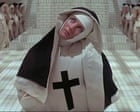
The amazing, anachronistic set designs of the young Derek Jarman present to us the white-tiled nunnery, whose low arched ceilings mean everyone has to duck down in imitation of the abbess; it looks like a Victorian or Edwardian prison or public lavatory, while the giant, multi-storied library looks like the jailhouse in which Elvis Presley sang. The great brickwork walls of the city make it resemble the housing estate in Kubrick’s Clockwork Orange, released in the same year – and in fact Grandier’s torture scene is very Clockwork Orange.
When the devils depart and the fever abates, what is left behind is a scorched and desolate landscape, like that after a plague or an apocalypse: a chilling final flourish to Ken Russell’s aria of angry pessimism.
- russell
- devils
- ken
- hysteria
- obscenity
- review
- nun
- tale