Girls review – a story of friendship amidst extreme misogynist violence
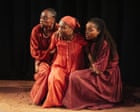
Young Vic, London Recalling Boko Haram’s abduction of schoolgirls in Chibok in 2014, Theresa Ikoko’s fierce and tender play reveals how three teenagers find hope and laughter under the most horrific circumstances Three girls huddle together, playing childish games to allay their fears from whatever terror stalks them. Director Ewa Dina makes this explicit in her programme note when she refers to the Chibok Girls, involving Boko Haram’s mass abduction of schoolgirls in Chibok, Borno State, in 2014.
Young Vic, LondonRecalling Boko Haram’s abduction of schoolgirls in Chibok in 2014, Theresa Ikoko’s fierce and tender play reveals how three teenagers find hope and laughter under the most horrific circumstances
Three girls huddle together, playing childish games to allay their fears from whatever terror stalks them. There are flashes of light and sounds, followed by sudden blackouts. At first, Theresa Ikoko’s play appears post-apocalyptic. Television screens line the back wall with radio frequencies tuning in and out. A strange structure looms overhead. Information about who they are, where they are hiding, who from, is parcelled out gradually.
You learn that they are three Nigerian friends and schoolgirls living in a forest in 2015. Their captors are never named but you can infer they are part of the insurgent Islamist group, Boko Haram, from the breadcrumbs of backstory. Director Ewa Dina makes this explicit in her programme note when she refers to the Chibok Girls, involving Boko Haram’s mass abduction of schoolgirls in Chibok, Borno State, in 2014.
These three girls, we realise, are being held hostage in a camp, forced to convert to Islam with rumours that they might be sent out as suicide bombers or fighters. They speak of not feeling like children any more, of seeing their homes destroyed, watching a woman being trampled to death, the smell of burning human flesh, and of the corpses lying in the well nearby. They tell each other childhood stories of a mythic forest god, yet feel the absence of such a deity in their damned corner of the forest. But they also laugh, play childish games of make-believe, talk about sex and fight, like any group of female friends.
Each character is individuated and responds differently to the terror of the camp: Haleema (Tara Tijani) is belligerent and plans escape, Ruhab (Sewa Zamba) submits to this new reality and finds a version of love among her captors, and Tisana (Hannah Akhalu), flogged daily for refusing to attend Islamic prayers, finds escape in fantasy.
This is certainly a play that reminds us of the fate of the Chibok girls, and violence against women at its most extreme, but it is also a story about female friendship, sometimes tender, other times mean and spiky, rather like Ava Pickett’s trio of friends in her Tudor-era drama, 1536. But it is also fierce and loyal to the last.
There are a few too many breakouts with claps of stagecraft thunder and lighting, and some short scene changes that bring confusion. The final use of screens showing faces (presumably of real-life missing girls) is abrupt and unexplained. But those reservations aside, this play, a winner of the Alfred Fagon award in 2015 and joint winner of the George Devine award in 2016, is without doubt a gut-punch: imaginative, tender, shocking. That around 90 of the Chibok Girls are still believed to be missing makes it all the more haunting, and infuriating.
- boko
- haram
- schoolgirl
- chibok
- girl
- review
- story
- friendship