Spain train crash caused by operator 'inexplicably' telling driver to resume journey despite red signal, transport minister says
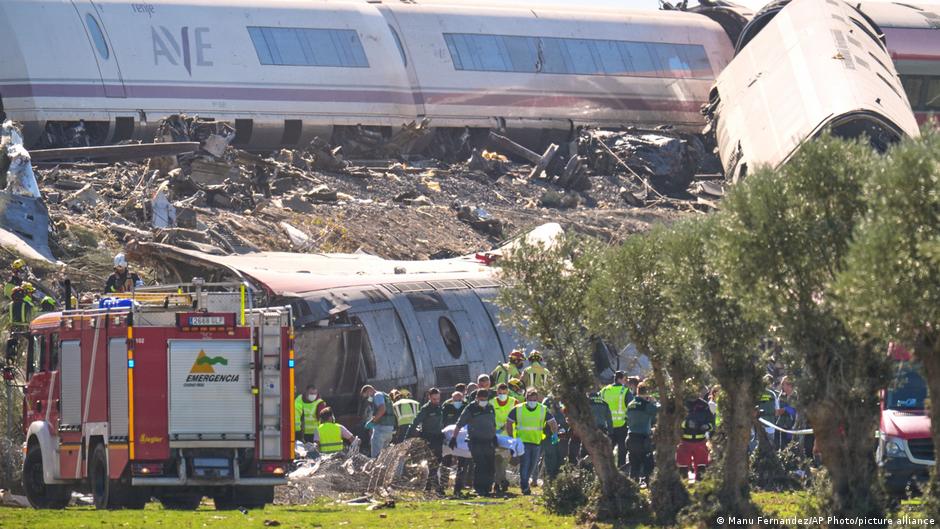
Two high-speed trains carrying hundreds of passengers collided south of Madrid. Spain's transport minister said one of the trains was told to continue its journey despite a "red signal" being in effect.
Here are the latest updates from the high-speed train crash in Spain on Wednesday, October 28:
The Renfe high-speed train that crashed into another stationary train had been told to continue its journey "as normal" despite the fact that all trains on the section of track in Toledo province had been told to stop, Spain's Transport Minister Oscar Puente has said.
Puente told a press conference at the ADIF control center in Madrid that the control system at the train station in Urda had failed due to a computer error.
That failure meant that a 63-kilometer section of track had no control system, which triggered an automatic stop, or "red signal," for all rail traffic on the parts of the track affected.
Operators at the control center ADIF, the company that is responsible for managing and maintaining Spain's railway infrastructure, took over communications.
"At 8:36 a.m. the Renfe train was told to resume its journey 'with normality'," Puente explained, a decision he described as "inexplicable."
He said that between that time and the moment of impact at 8:53, the Renfe train had traveled about 25 kilometers (15.5 miles), likely reaching a speed of over 100 kilometers (60 miles) per hour.
During the press conference, Puente refused to respond to questions about whether he would resign in the wake of the crash, saying his attention was on clarifying the circumstances that led to the crash and supporting the victims.
Senior European Union leaders Ursula von der Leyen and Kaja Kallas have sent their condolences to the victims of the high-speed rail crash and their families.
European Commission President von der Leyen said "Europe mourns with you."
Kaja Kallas, the EU's foreign policy and security chief, said she had spoken to Spain's Foreign Minister Jose Manuel Albares to convey her "profound condolences following the tragic accident."
"Our thoughts are with the families and loved ones of those who lost their lives. I wish a swift recovery to the injured and strength to all those affected," Kallas said.
European Commission spokesperson Paula Pinho, meanwhile, said the bloc was "ready to help Spain if needed."
Spanish Prime Minister Pedro Sanchez is traveling to Urda, where two high-speed trains collided.
At least 64 people have been killed, while more than 80 people have been injured in one of the worst rail accidents in Spain's history.
"The priority is to attend to the victims and ensure the maximum coordination between administrations," it added.
Spain's royal family has issued a statement following the deadly train crash in Toledo.
In a post on X, the royals said they are "deeply saddened and distressed" over the accident.
"We share the grief of the families and loved ones of those who lost their lives, and we send our heartfelt thoughts to the injured and everyone affected."
Spain's King Felipe VI, meanwhile, told reporters in Valencia that he was cutting short his military training exercise at the Jaime I Military Base to return to Madrid to monitor the emergency response to the accident.
Felipe added that he had already been in touch with the regional Castilla-La Mancha president.
A train operated by the private Iryo consortium was reportedly told to stop by rail infrastructure manager ADIF due to a faulty signal, a person briefed on the disaster told the Reuters news agency.
Government officials have not confirmed what caused the train crash, and neither Renfe nor Iryo have commented on the cause.
DW has spoken to Nick Kingsley, the executive editor of the Railway Gazette International, about what might have caused the crash, the second fatal accident to hit Spain's high-speed rail network this year.
Kingsley described it as "a dark day for the Spanish rail industry" and said there would be "profound questions asked" as to how this accident occurred.
While he cautioned that it was still too early to speculate, Kingsley said: "The key point with high-speed railway is you design safety systems and especially signalling and train control systems such that the trains do not crash. This should never happen."
He said investigators would be looking into whether there are any similarities with the fatal accident in January.
"The fact that these two accidents happened in the same year when we had 30+ years without a single fatal accident on a high-speed rail network anywhere in the world, to now have this happen twice in one year in the same country is quite shocking," Kingsley told DW.
"If reports that one crashed into the back of the other are confirmed, that will raise questions about the protection of those sections of track," Kingsley said.
He explained that the "fundamental principle of railway operation is that you have a signalling system that is designed to prevent two trains from occupying the same section of track. This is a fundamental tenet of railway operation."
Kingsley added that it will take a long time, possibly several weeks or even months, "to establish a definitive sequence of events."
The death toll from the accident has risen to at least 64, a spokesperson for Castilla-La Mancha's regional president, Emiliano Garcia-Page, has said.
At least 58 people were injured, many of them seriously, officials have confirmed.
The toll has risen several times during the day, with the possibility remaining that it could still go up.
The president of the regional Castilla-La Mancha government, Emiliano Garcia-Page, has told reporters at the scene of the accident that at least 80 people were lightly or moderately injured as a result of the crash.
"There are also fewer who were seriously injured, so we unfortunately do expect more deaths," Garcia-Page said.
He added that the priority is to treat the injured and move them to hospital.
"We are in the heart of the emergency, so the priority is to attend to the injured, the dead and the victims' families," he said.
Help is arriving from neighboring regions, the president said, as he urged people to remain calm and to allow the emergency services to deal with the accident.
He also refused to speculate on what caused the accident.
"I'm not the one who should comment on the causes, that should come from judicial authorities. The judicial authorities should be the ones to establish the causes of this incident," he said.
The collision in Toledo on Wednesday morning comes just months after another devastating rail disaster near Adamuz in Andalusia in January.
In that accident, a high-speed train derailed and collided with an oncoming train, killing 46 people and injuring more than 150.
The crash was the deadliest in Spain since a 2013 crash that killed 80 people. The January incident shook the confidence the European country has in its extensive high-speed rail network.
Spanish Prime Minister Pedro Sanchez said he was "shocked" by the "serious train accident" near Toledo on Wednesday morning.
He said that emergency services were on the scene to assist those affected in coordination with local administrations.
"My affection, solidarity and support to all the victims and their families," he wrote on social media.
Spanish Health Minister Monica Garcia confirmed that Wednesday's train crash was a "high-speed impact."
She said it was too soon to confirm a final casualty figure but told local broadcaster TVE: "We are expecting this to be a major tragedy."
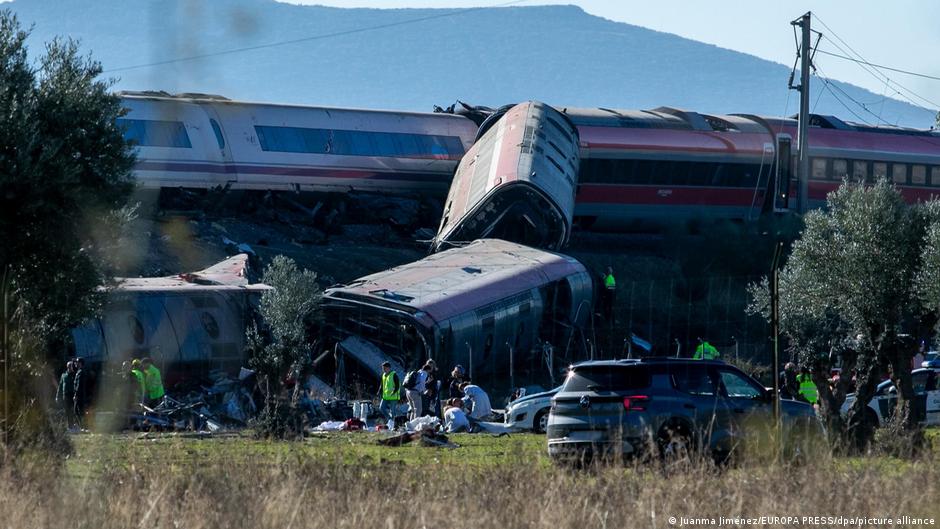
Images from the scene showed at least two severely damaged train carriages flipped over on their side after tumbling down an embankment.
One of the trains, operated by AVE, was reportedly carrying 397 passengers while the other, operated by IRYO, had 146 people on board, according to the Castilla-La Mancha local government spokeswoman.
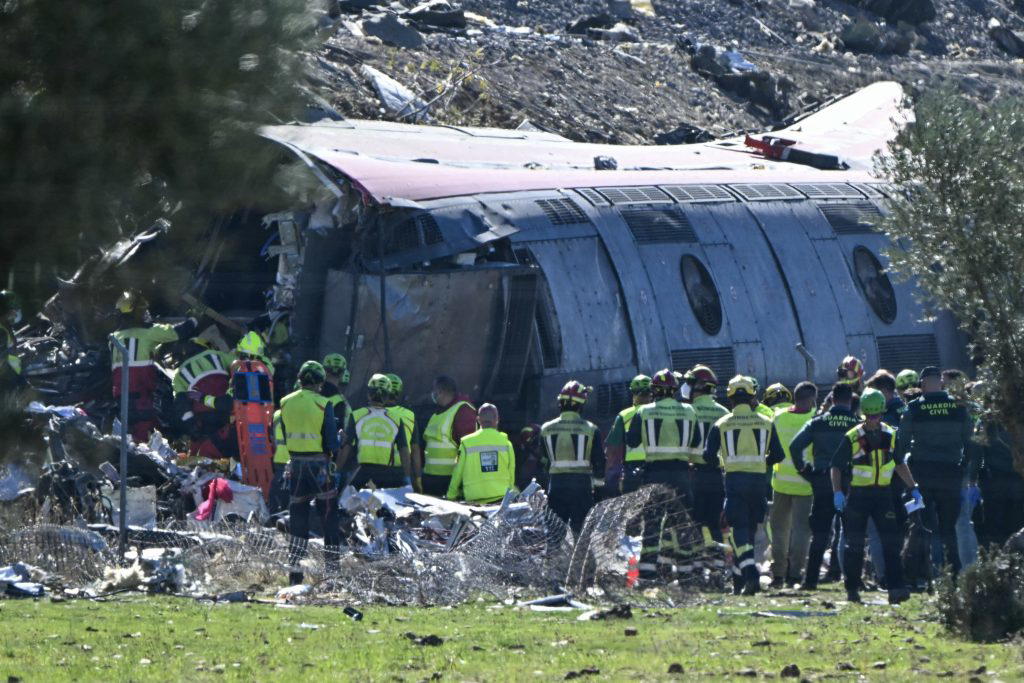
A reporter for local broadcaster TVE described scenes of "absolute chaos" and a constant stream of ambulances and emergency vehicles.
The El Pais newspaper cited witnesses describing numerous injuries and emergency medical teams arriving at the scene.
"All resources are currently being deployed," spokesperson for the Spanish emergency services told the AFP news agency, including "several fire crews, three helicopters, and two mobile intensive care units."
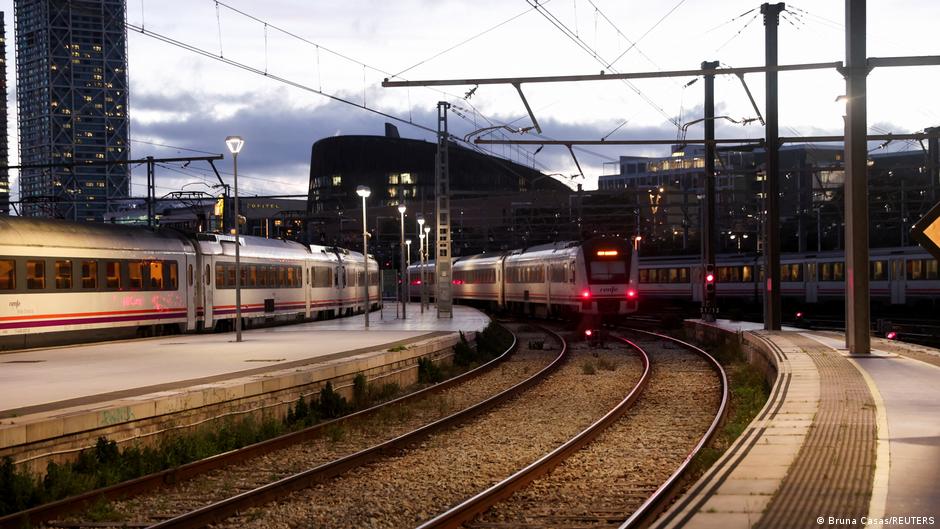
In a post on social media, rail operator Adif confirmed that "traffic on the Madrid-Andalusia high-speed rail line has been suspended following a rear-end collision between two trains."
A passenger on one of the trains involved in Wednesday's deadly crash has described the moment the collision occured.
"We heard a massive roar, a truly enormous thud that went on for 10 seconds as if the train were about to derail," Miguel told local radio station COPE.
"Through the right-hand window, we could see a wrecked train – I imagine it must have been the other one."
At least 30 people were killed in a train crash in central Spain on Wednesday morning, authorities told Spanish national news agency EFE.
"The information we are receiving is not good at all," a spokesperson for the government of the Castilla-La Mancha region said.
"There has been a collision between two trains [and] there are injured people," added Manuel Galans, mayor of the town of Urda in the province of Toledo, close to where the incident took place just after 9 a.m. local time.
The mayor of another nearby village, Jesus Perez of Los Yebenes, told Spanish TV that the accident appeared "serious."
Spanish Health Minister Monica Garcia told national broadcaster TVE that it was a "high impact accident, it will be a major tragedy" but said it was too soon to confirm a final casualty figure.
"We don't just need help from nearby hospitals, we need nearby hospitals that have ICU beds," she added.
There has been a major accident in central Spain, where a high-speed train have collided with another that had stopped.
At least 30 people have been killed and there are "a significant number" of injured, as officials say that toll is very likely to climb.
- train
- spain
- journey
- signal
- transport
- minister
- crash
- operator