Howe, Nagelsmann, Pochettino: can anyone end Manchester United’s doom loop?
Even an elite coach would surely struggle at Old Trafford amid the executive chaos and with an unfit, uneven squad In January 2014 the 13th series of Celebrity Big Brother aired in the UK, the show so popular that its run time was extended by five days before a public vote anointed Jim Davidson the winner. Then, two years later when Brexit happened, people wondered where their tolerant country had gone, lamenting the ephemeral spirit of London 2012 as though the 2011 riots were some kind of fever dream, not a desperate response to decades of structural and institutional racism exacerbated by…
Even an elite coach would surely struggle at Old Trafford amid the executive chaos and with an unfit, uneven squad
In January 2014 the 13th series of Celebrity Big Brother aired in the UK, the show so popular that its run time was extended by five days before a public vote anointed Jim Davidson the winner. Then, two years later when Brexit happened, people wondered where their tolerant country had gone, lamenting the ephemeral spirit of London 2012 as though the 2011 riots were some kind of fever dream, not a desperate response to decades of structural and institutional racism exacerbated by the cruelty of unnecessary austerity.
The truth is that if security is quickly upended, it was built on quicksand to begin with. Which brings us to Manchester United, easing effortlessly from an uplifting third-place finish to some of the worst football in their history.
It is entirely possible that Alex Ferguson made a deal with the devil to the effect that United would be great until he retired and hilariously dreadful thereafter. But assuming not, his l’état, c’est moi mentality was busy setting up the post-him fall even at the height of the success – itself a consequence of what had gone before.
A day after the Munich air disaster, Louis Edwards – later a seller of condemned meat to schools – joined the board, eventually assuming control thanks to a dodgy rights issue. He bequeathed the club to Martin – his substellar son – who floated it for personal gain, turning an institution that sought to win, entertain and unify into a business legally compelled to return value to shareholders.
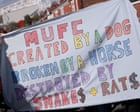
This left United vulnerable to acquisition by anyone and, when Ferguson fell out with two directors – a horse, a horse, his kingdom for a horse’s ejaculate – they sold to the Glazers, who loaded the purchase price and accordant interest obligation on to the club, with government and football authorities waving through a move since outlawed. Ferguson, meanwhile, must have feared exactly what the takeover would entail and known that without his support the banks might not have lent the money, while the chief executive David Gill admitted opposition to it but stayed in his role anyway, and so the pillaging began.
The English game then exploded, with investment in United left available only to those of wealth so extreme it necessarily casts aspersions over their character – such as arch polluter and anti‑immigration zealot, Jim Ratcliffe. Proclaiming inaccurate and divisive rhetoric contrary to the inclusive, cosmopolitan spirit of Manchester and United, jobs were culled and fights picked with fans, Old Trafford’s most desirable seats socially cleansed so the club could sell them to day-trippers for astronomical prices, with longstanding supporters banned after trumped-up charges of touting – a deeply principled stance the club fails to apply to itself.
Not untypically for a billionaire, Ratcliffe seemingly believes that correct opinions reflect exchequer not expertise, giving himself final say on footballing decisions. And rather than the “best in class” executives he promised, his United operate according to what political analysts call the “Boris principle”, no‑marks in thrall to their own self‑image given jobs for which they lack the ability and character, the consequent chaos being effective sabotage.
So the patterns continue: Champions League qualification is missed, insufficient funds are released; a new unsuitable manager spends heavily on players below requisite standard; Champions League qualification is achieved via unsustainably reactive style; the manager is denied necessary funds amounting to less than the bounty of Champions League qualification; the manager imposes a proactive style without the necessary materials; the manager is belatedly fired for a fee far exceeding that saved by cutting jobs; a new unsuitable manager, with entirely different requirements to his predecessor, is appointed; executive accountability is absent.
It is thus no surprise that Michael Carrick remains unfired, despite exuding the vibe of a man who’s mentally fired himself. Perhaps it’s a stay of execution, but more likely there’s bizarre hope of a turnaround, partly to save paying him off, partly because the relevant executives can’t achieve consensus on a replacement, and partly because surely even Omar Berrada and Jason Wilcox accept that, following another catastrophe, after dismissing Carrick they are honour-bound to dismiss themselves.
Except they and United don’t work like that.
So, just as they failed Carrick by not recruiting properly; failing to add experience to his coaching team; failing to replace outgoing fitness and set-piece coaches and failing to interrogate details of his new game-model, they are now failing him by having him continue in a job that is too much for him, destroying a season that remains salvageable. Meantime, the Glazers’ dividends continue unabated.
As such, the question isn’t so much who should be United’s next manager as can anyone manage United? Increasingly, it looks like the answer is – to quote Don Logan in Sexy Beast – “No”.
There are immediate on‑pitch issues: the team are unfit and their collective mentality weak; after years being lied to, the captain has finally broken; and the players hate the suits, the package toxic. Those are the minor problems.
Roughly, football management comprises five aspects: coaching, tactics, talent ID, pastoral care and presence. And, though no manager excels in every department, at this version of United surely they must. Moreover, given this is no job for a novice, track record is also important – and it might be here that Unai Emery’s candidature falls down, his brilliance in transforming mid‑ranking clubs undermined by failures at two high-profile basket cases.
Which brings us to pastoral care and presence. In the postwar era, only Erik ten Hag has won a trophy at United without tangible charisma, the size of the club now demanding it more than ever. This is not a quality associated with Eddie Howe, while Antonio Conte does not scream pastoral care and, brilliant though his career has been, he failed miserably at Spurs, the only environment he has inhabited that is remotely similar to United.
Should United miss Champions League qualification, financial strictures will make an elite coach and tactician essential. But in any event, football has changed such that the alchemic art of combining players and personalities no longer guarantees success.
Which leaves us with talent ID, player quality and intelligence being the best coaching and tactics there are. Of the 78 players purchased post-Ferguson, only Bruno Fernandes and perhaps Zlatan Ibrahimovic could be classed as cast-iron successes, so the next man – assuming United don’t target Emma Hayes, who embodies more of the right stuff than almost anyone else – must have a keen nose. Even Jürgen Klopp, the other manager who fulfils these criteria – and of all the damage Ed Woodward wreaked on United, turning him off was most costly – benefited from a department which delivered the greatest run of transfers ever.
Which leaves Mauricio Pochettino, who built something at Tottenham despite the environment, and Julian Nagelsmann. But had Pochettino not signed a new contract with the USA men’s team, the sense is that, as when Mourinho arrived at Old Trafford after years of speculation, he’s past his magical best, while Nagelsmann may be the free-thinking genius of his own imagination, just as he may be an emperor’s new clothes bluffer.
All of which is to say that failure has many fathers and, once ingrained, is not easily eradicated. Yet just as society has too much going for it to ever move quite beyond the pale, so too does Manchester United. Even the longest journey starts with one step; but does anyone have the nous to ensure it’s taken in the correct direction?
- manchester
- united
- howe
- nagelsmann
- pochettino
- doom
- loop
- coach