Flávio Bolsonaro’s defeat is a major blow to Trump and his orange wave
The far-right candidate was supposed to claim the presidency, but Brazilian voters had other ideas For Donald Trump, Brazil’s presidential election was meant to represent the crest of the “orange wave” – a three-year surge of rightwing triumphs that has reshaped Latin American politics in the US president’s tangerine-hued image. The far-right candidate, Flávio Bolsonaro, was supposed to claim the presidency on Sunday, bringing the region’s biggest democracy and economy into Trump’s orbit, after similar victories in Argentina, Bolivia, Chile, Colombia, Costa Rica, Honduras, Ecuador and Peru – n
The far-right candidate was supposed to claim the presidency, but Brazilian voters had other ideas
For Donald Trump, Brazil’s presidential election was meant to represent the crest of the “orange wave” – a three-year surge of rightwing triumphs that has reshaped Latin American politics in the US president’s tangerine-hued image.
The far-right candidate, Flávio Bolsonaro, was supposed to claim the presidency on Sunday, bringing the region’s biggest democracy and economy into Trump’s orbit, after similar victories in Argentina, Bolivia, Chile, Colombia, Costa Rica, Honduras, Ecuador and Peru – not to mention the capture of Venezuela’s government after the country was invaded in January.
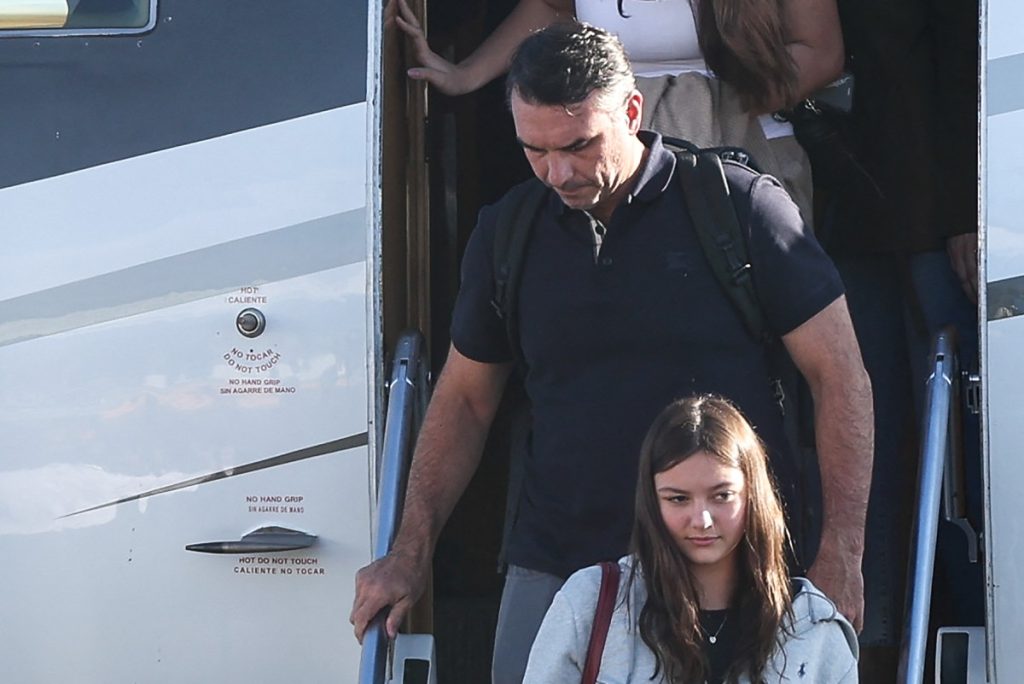
But Brazilian voters had other ideas, turning out in huge numbers to vote against the pro-Trump populist and return the leftwing incumbent, Luiz Inácio Lula da Silva, to power. On Tuesday, as Lula celebrated his 81st birthday to the sound of samba in Brasília, Bolsonaro fled to Miami on a private jet.
“This is a significant blow, indisputably, to Trump’s regional strategy,” Benjamin Gedan, the director of the Stimson Center’s Latin America programme, said of Bolsonaro’s defeat.
“[Trump] was perceived to be steamrolling over South America, having invaded Venezuela and seen close allies win elections in Argentina and Chile, in Bolivia and Colombia. That momentum had given the impression that he could determine political outcomes throughout Latin America – and he clearly enjoyed it,” added Gedan, a former White House South America adviser.
“This is a region where he was really perceived to have a successful foreign policy, and this just flies in the face of that image.”
The US setback was celebrated in China, whose rapidly growing influence in Latin America Trump has been trying to combat with his so-called “Donroe doctrine” of regional domination. “[Lula has] effectively thwarted Trump’s strategy for the region … Trump failed to bring Brazil, the largest nation in South America, under his sway,” Hu Xijin, a prominent Beijing propagandist, enthused on X.
Trump has responded to his ally’s failure by halfheartedly querying the election, which Lula won by 4.3m votes.
“I think the election was really strange … It’s so terrible to see,” he told reporters. “But I wasn’t involved,” Trump added, despite a months-long campaign of economic and diplomatic pressure apparently designed to boost Bolsonaro.
Despite Trump’s decision to offer shelter to Bolsonaro – who is facing several criminal investigations in Brazil – many observers suspect the US president is unlikely to pick a major fight with Lula over his rightwing ally’s plight.
“One of Trump’s good qualities - and I mean this sincerely, even though it sounds ironic – is that he can smell a loser, and he wants to be around winners,” said Michael Paarlberg, a former Latin America adviser to Bernie Sanders.
Paarlberg noted how Trump got along with leftist “winners” including Mexico’s president, Claudia Sheinbaum, New York’s mayor, Zohran Mamdani – and even Lula himself. “I like Lula, I get along with him very well,” Trump said this week.
“He will certainly favour his ideological co-partisans,” Paarlberg said of Trump, “but if the stink of loserdom starts to waft over them, he will drop them.”
The “stink of loserdom” certainly wafted over Bolsonaro as he fled into Argentina on Tuesday and caught a private jet to Florida, where he briefly declared himself Brazil’s “true president-elect” before apparently changing his mind.
Brazilian social networks filled with memes mocking the far-right politician who, only hours earlier, had vowed to stay in Brazil to lead opposition to Lula.
One particularly scathing internet joke featured a photo of Bolsonaro and a parody of his movement’s fascist-inspired slogan, which was: “God, Homeland, and Family.” “Goodbye, Homeland and Family,” it said.
Speaking at his birthday party, Lula said: “This is what the Bolsonaro family is like. Brazil is their second homeland. Their first homeland is licking the boots of the US.”
Lula’s chief foreign policy adviser, Celso Amorim, claimed Bolsonaro’s movement – which was founded by his jailed father, former president Jair Bolsonaro – was dead in the water after Sunday’s defeat, although the losing candidate secured 59.8m votes.
“I think Bolsonarismo was defeated once and for all,” Amorim said, recalling how the movement had lost two successive elections to Lula, in 2022 and 2026.
Amorim predicted a more reasonable conservative movement would replace Bolsonaro’s “extremist” one and called his loss “the last gasp of a radical, irrational, lying right wing”.
Under Lula, Amorim indicated Brazil would not join Trump’s controversial Shield of the Americas “counter-cartel coalition” – as Bolsonaro had planned to do.
But Amorim also signalled Lula would pursue pragmatic ties with Washington. “[Trump] has a certain level of pragmatism. They know Brazil isn’t just any old country. So I think we’ll seek to have proper, balanced relations without failing to defend our interests, but without being needlessly hostile, as we’ve always tried to do,” he said, recalling Lula’s good rapport with George W Bush.
Amorim attributed Trump’s questioning of Brazil’s election to “incorrect things” that “rightwing radicals from the state department” had put on his desk.
On Monday, Trump’s former chief strategist, Steve Bannon, urged Trump and secretary of state Marco Rubio to sever diplomatic and trade relations and “shut down everything with Brazil” as a result of the election supposedly being “stolen up in your face”.
Paarlberg said Trump’s remarks – criticizing the election, but emphasising his fondness of Lula – suggested he would not take Bannon’s advice.
“I read that as: ‘I will give you [Bolsonaro] moral support, but nothing else’,” Paarlberg said. “He certainly wasn’t saying: ‘I’m going to call for further tariffs, or further visa sanctions or any further actual measures to try to punish the Lula government.”
Gedan was unsure about Trump’s next move. “Anything’s possible, and I’m certain he has no idea how he’s going to approach it either,” he said.
But Gedan believed Trump and Lula could patch things up – perhaps striking a deal involving Brazil’s massive critical mineral reserves - despite Trump’s hopes of a “glorious return” for the Bolsonaros being dashed.
“There’s actually quite a bit of space for a positive relationship, if Trump does not decide to explode US-Brazil relations,” he said. “I think you absolutely could see Trump finding a way to admire Lula’s political skills.”
- trump
- bolsonaro
- wave
- flávio
- defeat
- blow
- candidate
- presidency