Can EU and India work together to secure Indo-Pacific?
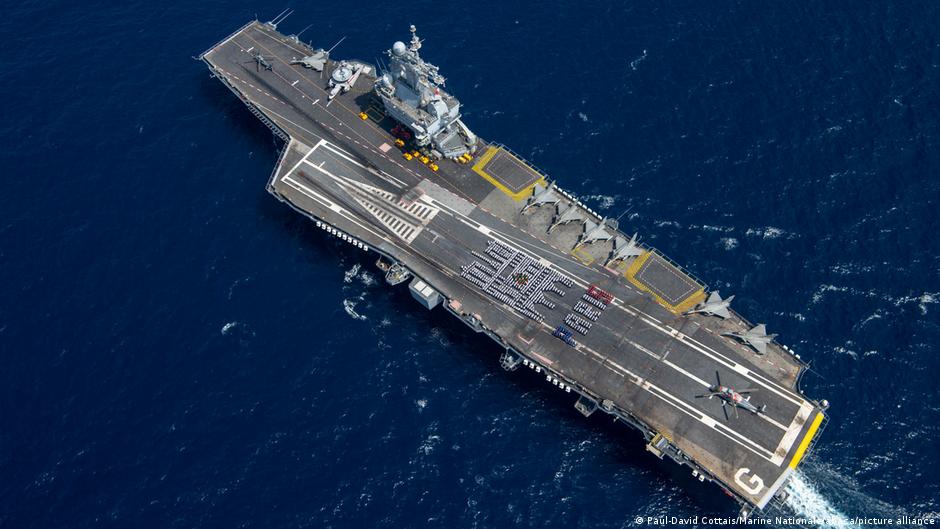
India and Europe are deepening defense ties, but their clashing perspectives on Russia and differing priorities on China are hampering their joint ambitions on maritime security.
The European Union is vying for a larger role in Indo-Pacific security with the US on the back foot in the Eastern Hemisphere.
Meanwhile, India is looking for new allies. Its rising economy and increasingly global ambitions have pushed it into new forums and partnerships, including ever closer defense ties with the European bloc.
In January this year, India and the EU signed a Security and Defense Partnership, followed by their first formal Security and Defense Dialogue in March. More meetings followed throughout the year, including the fifth Maritime Security Dialogue in Brussels last month.
However, while both sides want to boost cooperation on maritime security, working together in the Indo-Pacific remains a challenge — India and European countries simply have different defense priorities.
"Europe can be a credible defense partner of India, especially in the maritime theater in general and Indo-Pacific in particular," Mohan Kumar, a former Indian ambassador to France, told DW.
But Europe's capacity to expand its role is constrained by other security crises.
"European distractions such as the conflict in Ukraine, which is of existential importance for it, do detract from this objective and can be a limiting factor," he added.
France is a notable exception, given its established military presence in the Indian Ocean.
"France, with its presence in Reunion Island and Mayotte, is already cooperating with India in the Indian Ocean theater and this cooperation can be intensified," added Kumar.
Javed Ashraf, another Indian diplomat, said that France has been "a strong, trusted and consistent security partner across the full spectrum of defense cooperation."
"What makes the partnership easier is the acceptance that the two may not always agree or be in a position to cooperate," said Ashraf.
"France also stands out for India because [France] has currently no defense cooperation with Pakistan or with China," he told DW.
While France remains the EU's only nuclear power and maintains its strongest military force, a cooperation between Paris and New Delhi does not automatically translate into a coherent European security role across the Indo-Pacific.
"Europe as an entity has very little role in the Indo-Pacific security despite the announcement of a strategy in 2025," said Tara Kartha, a former member of India's National Security Council Secretariat.
She pointed to political differences among EU members as an obstacle to a coherent security outlook.
Those differences were on display during the EU's October 15–16 summit in Brussels, when leaders reaffirmed support for Ukraine, but also signaled disagreements over funding and national priorities.
This could also explain why, as India's defense ties with Europe keep expanding, much of that cooperation still takes place between New Delhi and individual European nations.
Germany, Spain, Italy and Poland have all emerged as important partners.
Ashraf said Brussels could signal broader support for its member states' partnerships with India and provide access to EU-funded programs, boosting cooperation in areas such as maritime security, space, critical minerals, chips and defense technologies.
"India is also becoming an important source of defense supplies for a re-arming Europe," the diplomat said.
There may also be opportunities to share experience in emerging areas of warfare.
"India could also access drone technology in light of valuable experience gained by Europeans in Ukraine," Kumar said.
Germany, the EU's largest economy, is another important part of this relationship. Alongside France, it has become a defense partner for India, including through major equipment purchases. India could push for its relationship with Berlin to include industrial partnerships and technology development.
But experts warn that closer defense ties should not be confused with a shared strategic outlook, as European countries have their own priorities.
The differences between Brussels and New Delhi are particularly clear when it comes to Russia and China.
India still relies heavily on Russian equipment and technology, even as it seeks to diversify its defense supplies. European governments, meanwhile, have been engaged in a tense standoff with Russia since its 2022 invasion of Ukraine.
That creates a problem for those seeking to deepen defense industry ties.
"Buying a few big-ticket defense items, such as Rafale fighter jets from France or submarines from Germany, is one thing," said Gulshan Sachdeva, a professor of European Studies at Jawaharlal Nehru University in New Delhi.
"However, integrating India's defense industry into the expanding European defense value chain is more challenging as long as Russia remains Europe's principal security concern," he said.
China presents a different but equally important challenge. For India, China is a rival and source of major security issues, including an ongoing border dispute. While the EU also sees China as a "systemic rival," its members differ in how they balance security concerns with their economic relationships with China.
These differences complicate attempts to develop a shared assessment of Indo-Pacific threats.
On a geopolitical level, India wants partnerships that strengthen its capabilities without requiring it to align fully with another power's strategic priorities. European governments are also weighing their regional ambitions against security demands closer to home.
The new India-EU partnership creates a framework for closer engagement, but it does not amount to a joint security commitment.
Ashraf said the two sides could strengthen their mutual capabilities but were unlikely to exercise a visible influence on the global security order.
For now, maritime domain awareness, information-sharing, defense technology and selective industrial cooperation offer more realistic prospects than a common security role of the EU and India across the Indo-Pacific.
- india
- indo
- pacific
- europe
- defense
- tie
- perspective
- russia