Human trafficking victims stranded in Guinea-Bissau
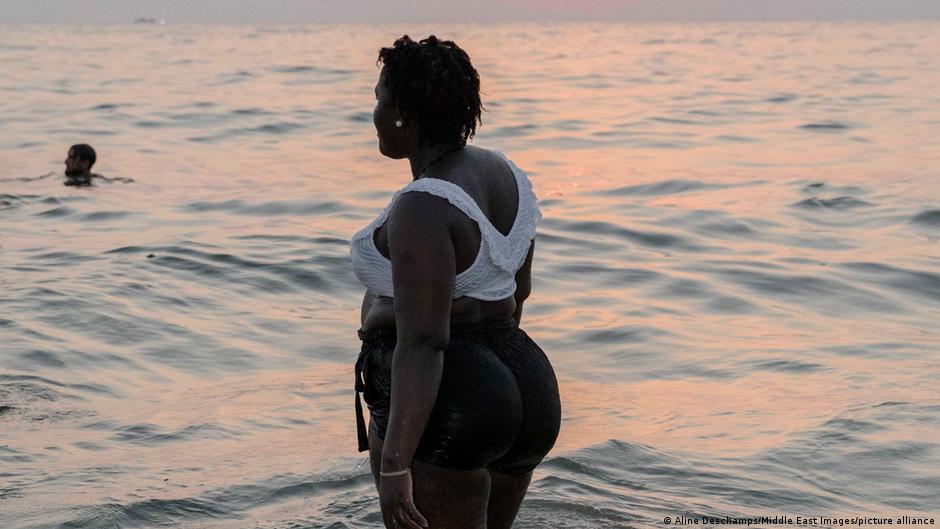
Dozens of West Africans lured to Guinea-Bissau with promises of jobs and migration to Europe say they were exploited by a suspected trafficking network. Now many cannot afford to return home.
This article contains descriptions of rape, exploitation and sexual assault. Reader discretion is advised.
Sadio Konimba had hoped for a better future. The 26-year-old had lost her husband and was left alone with her child in Bamako, the capital of Mali.
When an acquaintance told her about the possibility of reaching Europe via the West African nation of Guinea-Bissau, she decided to make the journey. She left her 6-year-old daughter behind with relatives for the time being.
Konimba says she was invited to the country's capital, Bissau, with the promise of work and better chances of eventually continuing on to Europe.
She was told the journey from Bamako to Bissau would cost between 100,000–125,000 CFA francs (roughly €150-€190, or $170-$210), which she paid. She had only intended to stay temporarily in Guinea-Bissau, but when she wanted to return to Mali, her money was not refunded.
"I had to pay a large sum of money," Sadio told DW, adding that instead of the prospects she had been promised, she was confronted with a very different reality.
According to Konimba's account, men from Senegal offered to repay the money she had paid if she "worked" for them. When she realized what that meant, she refused and demanded her money back. To this day, she has received nothing.
Jane, a 21-year-old woman from Sierra Leone, recounted how she was subjected to an attempted rape and other abuses at the hands of a criminal network. She told French news agency Agence France-Presse they even tried to force her into prostitution.
Sadio and Jane are among dozens of victims of a suspected human trafficking ring that was dismantled by police following an operation in Guinea-Bissau on October 21. The intervention followed complaints from victims who had reported abductions and fraud.
In a written statement to DW, the criminal investigation police said that more than five suspects had been arrested.
According to police, the network used a front company to lure people with promises of jobs and assistance with migration to Europe.
Around 70 people are believed to have fallen victim to the scheme. Most came from abroad, including Guinea, Mali, Cote d'Ivoire and Senegal. The suspected perpetrators allegedly charged victims between 400,000 and 700,000 CFA francs for each journey to Guinea-Bissau.
According to preliminary findings, the victims were held against their will in Bissau, subjected to pressure and forced to take part in fraudulent pyramid schemes. They were expected to recruit additional participants into the schemes through social media.
To make their operations appear legitimate, those responsible allegedly used false contact details for supposed offices in Canada, the United States and Portugal. Information from Interpol, the international police agency, helped investigators uncover the network, according to police.
Issa, a 23-year-old from Guinea, says he paid a smuggler 10 million Guinean francs (around €1,000). When he refused to recruit more people, he was allegedly threatened with death.
For Bubacar Ture, head of Guinea-Bissau's Human Rights League, the case is an alarming sign.
"As a human rights organization, we are extremely concerned about this phenomenon, which has now reached deeply troubling proportions," he told DW. In May, authorities rescued 60 foreign nationals during a similar operation.
Ture sees a link between the human trafficking problem and Guinea-Bissau's weak institutions. Criminal networks exploit these conditions to continue their activities, he said, noting that women are particularly vulnerable to human rights abuses.
The small Portuguese-speaking West African country has been plagued by political instability since independence in 1975 and is also known as a transit hub for cocaine bound for Europe.
A week after their rescue, the victims face a new problem: many lack the funds needed to travel back to Mali, Sierra Leone or elsewhere in West Africa.
Sadio Konimba is temporarily staying with an acquaintance in Bissau. Her friend told DW that Konimba had been deeply traumatized by what she had experienced. She had never imagined she could fall into the hands of a human trafficking network that might force her into prostitution.
Konimba herself does not want to discuss in detail what kind of work she was asked to do. Police confirm that women in such cases are often sexually exploited.
Konimba says she has managed to borrow around 75,000 CFA francs from acquaintances in recent days. But that falls short of the cost of her journey back to Bamako.
According to available information, Guinea-Bissau's migration and border authority, the Direcao-Geral de Migracao e Fronteiras (DGMF), also lacks the funds needed to finance the victims' return journeys.
Contacts have been established with the diplomatic missions of the countries concerned. But progress appears slow, and no concrete arrangements for their return have yet been announced.
Bubacar Ture criticizes the lack of protection available to victims.
"There are no public shelters for cases like these," he told DW, noting that private facilities have limited capacity, and psychological support and funding for temporary accommodation are also lacking.
The human rights advocate commends the criminal investigation police for taking action against the networks despite limited resources. At the same time, he calls for greater support.
"We make an urgent appeal to the government and international partners to provide adequate support to the judiciary, the police and the other institutions," he told DW.
For Konimba, one thing matters above all else now: returning to Bamako.
"Now I definitely want to go back to my mother and my daughter," she told DW. "Every day she asks me, 'Mom, are you coming home?' I tell her, 'I will come, I will come. Just wait a little longer.'"
But Konimba still does not have enough money for the journey. She is free, but for her, the struggle to rebuild a life with dignity has only just begun.
- trafficking
- guinea
- bissau
- victim
- dozen
- west
- africans
- promise


