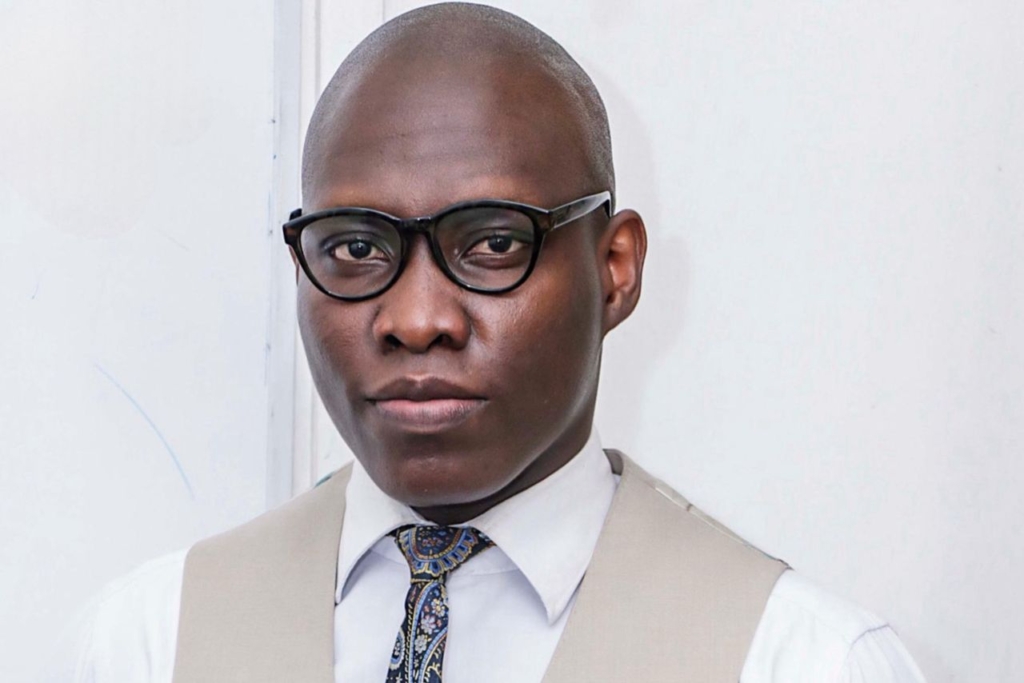
Abu Jinapor and the rare political virtue of loyalty

Yes, I am talking about the same Abu Jinapor whose voice has been a familiar feature of Ghana’s political discourse for as long as I can remember. When the NPP won power in 2016, Abu was appointed Deputy Chief of Staff in charge of Operations at the Presidency.
From the airwaves of my childhood to the corridors of power, a story of steadfast allegiance to a political cause.
By Gideon Kwasi Annor, a writer and political thinker
The Bible gives us Ittai the Gittite, who declared to David, “...in what place my lord the king shall be, whether in death or life, even there also will thy servant be” (2 Samuel 15:21). Greek mythology gives us Argos, the faithful dog of Odysseus, whose loyalty endured twenty years of separation. Different stories, different worlds, but one enduring principle: true loyalty is not measured by the convenience of the moment, but by the consistency of one's commitment.
That is precisely how I feel whenever I see or hear Samuel Abu Jinapor.
Shocked? Yes, I am talking about the same Abu Jinapor whose voice has been a familiar feature of Ghana's political discourse for as long as I can remember.
Anytime I hear him, I am transported to my days preparing for the BECE at St Francis Junior High School in Nungua, some 20 years ago. I would ask my father, Opanin Yaw Annor of Kyebi Amanfrom, who these political figures were, and he would explain which belonged to the NDC, which belonged to the NPP, and how we were lucky to have the brightest of the brothers in our fold.
Even then, Abu was making his case on the airwaves. His advocacy was so prominent that I remember hearing about his involvement in President John Agyekum Kufuor's 2007 State Visit to the United Kingdom. I would later learn that, at just 23, he had already become a political aide to Nana Akufo-Addo, supporting his presidential ambition through the 2007 primaries, the 2008 elections, the 2012 elections and, eventually, the defining contest of 2016.
I remember the stories of a young man travelling across the country with candidate Akufo-Addo, speaking through a megaphone connected to a loudspeaker before the candidate himself addressed the crowd. It was the work of a young activist who understood that political success required energy, conviction and a willingness to do the groundwork long before the privileges of office arrived.
I also remember the walks through the principal streets of Osu with him and Mrs Rebecca Akufo-Addo, culminating in engagements with party faithful at the party headquarters. When the NPP won power in 2016, Abu was appointed Deputy Chief of Staff in charge of Operations at the Presidency. He had moved from campaigning in opposition to helping coordinate the machinery of government. Yet his story did not end at the Presidency.
In 2020, he took on the formidable challenge of contesting Damongo, a constituency the NPP had never won under the Fourth Republic. He succeeded, defeating the incumbent NDC MP in the constituency associated with President Mahama's maternal roots. His victory was historic, and he subsequently became Minister for Lands and Natural Resources.
What strikes me most is not simply the progression from Party Activist to Presidential Aide, Minister and Parliamentarian. It is the continuity of his relationship with the party and its people throughout that journey.
In Government, Abu demonstrated that one could occupy a consequential office without completely disconnecting from the political base that helped make the journey possible. From what I observed, he was among the Ministers who made room for party people across the country, engaging them and creating opportunities for interaction. Such accessibility matters in a political tradition where grassroots activists sometimes feel forgotten once their leaders ascend to office.
There is another leadership trait worth acknowledging: his willingness to allow others to shine. His deputies, including Duker during his ministerial tenure, had opportunities to demonstrate their abilities. Today, we see a similar quality in the space afforded to Asafo-Adjei in Parliament. He has found his voice relatively early, and that is partly what good leadership should accomplish. A leader should not be so consumed by personal visibility that those working under him are denied the opportunity to grow. For that, Abu deserves our appreciation.
Even after the NPP's bruising defeat in the 2024 general elections, he retained the Damongo seat. He now serves as Ranking Member on Parliament's Foreign Affairs Committee, continuing to contribute to national discourse from the opposition benches.
I am particularly interested in his work on foreign affairs. At a time when concerns have been raised over the treatment of Ghanaians abroad and the country's response to recent xenophobic attacks, I understand that Abu played a significant role in efforts to strengthen the Minority's response, including facilitating legal support for the Minority in connection with the Foreign Affairs Committee's work.
It is therefore rather telling that some would criticise Abu Jinapor for not giving us the Abu we have known for years at a recent show. Given the standards he has set for himself, I understand why some may have expected more. On Eko Sii Sen the following week, his own Deputy Ranking Member, Asafo-Adjei, spoke about the support he had received from his boss to thrive and to provide the monitoring eye needed to examine the entire exposé concerning the Okudzeto Ablakwa South African evacuation scandal. That account is significant. It speaks to a side of Abu that is sometimes overlooked: a man who, even when he occupies a position of influence, can create room for others to find their feet and make their voices heard.
That is precisely why I was taken aback when I came across a post suggesting that Abu may have been compromised by Okudzeto Ablakwa through his brother. What absolute balderdash! Abu Jinapor compromised? I dare say that, given the political journey of the Abu we know today, not even Elon Musk could buy his conviction.
Think back to the years of sacrifice, the political battles, the long road to public office and the constituency he fought to represent. Consider the journey for yourself and draw your own conclusions.
Another allegation suggested that Abu was responsible for the difficulties facing Wontumi. I decided to seek clarification from Wontumi's lawyer, Hon. Samuel Atta Akyea, who told me that Wontumi had, on several occasions, spoken to him about how Abu was always willing to engage him and about the countless forms of support he had received from Abu. In his account, Abu never turned him away over any legally grounded proposal he had made.
I also sought to establish the facts surrounding claims about Abu's dealings with Ibrahim Mahama over concessions. The information available to me did not substantiate the allegation as it had been presented. More importantly, the account I received did not support the suggestion that Abu had used his office to favour Ibrahim Mahama. The relevant facts indicate that Ibrahim Mahama obtained access to the Damang Mines during the tenure of his brother, John Mahama, as President. That access arose from arrangements and circumstances attributable to that period and could not, on the information available to me, be legally or factually imputed to Abu Jinapor. There is therefore no proper basis for suggesting that Abu used his public office to confer an improper advantage on Ibrahim Mahama.
Let me be clear: I understand why some party faithful may be disappointed if Abu has not on an occasion performed at the level they have come to expect of him. His reputation was built on a formidable command of political communication, and people will naturally measure him against that standard. But disappointment over a particular performance should not automatically become a verdict on a man's integrity or decades of service.
Abu has many years ahead of him to demonstrate, once again, the conviction and political sharpness for which he became known. The 2028 elections will present another important test as he seeks to retain the Damongo seat for the NPP. I wish him well, and I hope he recognises that many of us still appreciate his contribution, believe in his capacity to rise to the occasion and want to see him stronger.
Loyalty, after all, should not mean shielding a person from criticism. It should mean being fair enough to acknowledge the criticism, honest enough to demand answers where necessary, and discerning enough not to discard a long record of service because of a single disappointing moment.
Abu Jinapor has earned the right to be assessed on the totality of his political journey, not on rumours alone. And for those of us who remember the young man with the megaphone long before the ministerial office and parliamentary ranking, that journey is not one we are prepared to dismiss lightly.
- abu
- jinapor
- loyalty
- party
- story
- npp
- akufo
- addo