Middlemarch review – World’s Greatest Novel hurtles from costume drama to jolting marital tragedy
Swan theatre, Stratford-Upon-Avon This RSC staging of the sprawling middle England masterpiece has humour, compassion – and even George Eliot herself as a character Is there a literary achievement greater than George Eliot’s stonking masterpiece? Andrew Davies had a go at it with his watchable enough 1994 television costume drama, retelling Eliot’s story about provincial life, in six parts.
Swan theatre, Stratford-Upon-AvonThis RSC staging of the sprawling middle England masterpiece has humour, compassion – and even George Eliot herself as a character
Is there a literary achievement greater than George Eliot’s stonking masterpiece? Not according to a Guardian poll, topped by this sprawling, contemplative and profound book about marriage, moral goodness, debt, death, God and everything in between. So how do you adapt its nonpareil greatness for the stage without flattening the moral, philosophical and psychological complexities?
Andrew Davies had a go at it with his watchable enough 1994 television costume drama, retelling Eliot’s story about provincial life, in six parts. A mere six-parts, you might say, for a novel that is about 900 pages. While its timeline only spans three years in the life of a fictional Midlands town, it juggles multiple storylines and perspectives, weaves the local with the big socio-political backdrops of its age and follows the trajectories of characters with such detail that it becomes hard to replicate in another form.
Now the Royal Shakespeare Company has had a go at a stage adaptation, divided into two parts and totalling almost six hours of viewing (including the intervals). Again, you might say, a mere six hours, particularly in relation to the compressions of Part One. Jeremy Herrin’s production at first seems to sacrifice character study and emotional connection for plot and pace, although it hits all the beats of a pleasing costume drama, is easy on the eye, full of incident and with an understated visual beauty that suits the town of Middlemarch perfectly. Grace Smart’s supple set design contains ecclesiastical touches in the vaulted ceiling and back window, alluding to Eliot’s exploration of divinity. The stage is often lit by candles, perhaps to gesture at Eliot’s famed passage about the candle and pier-glass, which is quoted at the outset of the show. But there is so much incident to get through that you do not get much more than momentary philosophical reflection or inner outpourings before the next flick of the proverbial page.
Like the book, the beginning focuses on the marriage of the young, devout Dorothea (Nia Towle), who sees wedlock as a means of higher learning, but does not quite make you feel enough. Her failed suitor, Sir James Chettam (Gunnar Cauthery), remains featureless, as does her sister, Celia (Lizzie Annis; why is she dressed in the same shockingly unfashionable frock throughout?). Outsider-artist Will Ladislaw (Rory Alexander), meanwhile, is barely there, appearing in brief spotlight as little more than a motif. Beyond the parish of Lowick, the drama of the Vincy family ticks over: Fred’s (Ebenezer Gyau) feckless ways with money, his tenderness for Mary Garth (also Annis), along with the budding romance between Rosamond (Emma McDonald) and the town’s ambitious new doctor, Tertius Lydgate (Andrew Richardson). It is Dorothea’s scholarly and sour husband, Casaubon (Ian Drysdale), who serves as the highlight in Part One, happy to marry a much younger woman but disdainful in the face of marital intimacy.
Eliot’s book has sometimes been seen as a satire of middle England, and Nina Raine’s script leans into humour, tipping into a bumptious broadness, which verges on pantomime entertainment in scenes featuring Peter Featherstone (Peter Forbes) on his deathbed, his hands gripped around his money box. He is played like a provincial Scrooge, his greedy family comprising a tableaux of other Dickensian types around him in the inheritance wrangles.
Raine treads a fine line between faithfulness and invention, keeping many of Eliot’s lines but turning the omniscient narrator into a character (Amanda Root). It becomes clear that this is Eliot herself, not only watching over her story but listening to characters divulge anxieties or yearning, and sometimes interrupting them, mid-scene. It is a very inventive way to get around delivering a backstory without clumsy exposition, but it feels too much like a device.
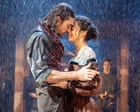
The author Tom McCarthy recently argued that Middlemarch has been middlebrowed and “heritage-industried to death,” in a podcast for London Review of Books, and this production runs the risk of doing the same by the end of this first half. But then the heavens open and it seems, for a book so preoccupied with divinity, that Eliot herself has descended to touch it with her greatness. Part Two finds its footing and doesn’t take one wrong step: the humour working brilliantly in occasional flecks, the drama leading with emotion, thought and the everyday tragedy of marital disappointment. The piano music, by Nathan Feeney, which sounded so mannered, now seems emotionally integrated. Characters come fiercely, painfully, to life. Dorothea, now a widow, carries great depths. The marriage between debt-worn Lydgate and his starkly withdrawn wife, Rosamond, is heartbreaking. Take away the 19th-century costumes and their marital friction would feel utterly contemporary. Each scene shakes you, each performer excels.
The interaction between these characters and the narrator takes on a lovely, tender texture, too. She challenges or soothes them in their worst moments, like a mother would. Eliot’s narration excels in its sustained compassion for the most fallen of characters and Raine’s script does the same. You feel for Casaubon with his writerly paralysis over his unwritten magnum opus, The Key to All Mythologies (the narrator, Eliot, voices her own sympathies), and you even feel for the rapacious Nicholas Bulstrode (John Hodgkinson), for his inability to do good.
Marriage is a “noose,” warns Dorothea’s uncle at the start, but there is a return to the “marriage plot” in Eliot’s work, however much she is said to have upturned it. The romance between Ladislaw and Dorothea is heady, intense and also – to invoke the words of Virginia Woolf – very “grownup”. You want happiness for them, for her. You believe in this second go at it.
- novel
- drama
- eliot
- review
- world
- greatest
- tragedy
- masterpiece