Sinkholes, scarred land and scapegoats: the scourge of illegal gold mining in Johannesburg
There is no end in sight for the drivers of illegal mining, while police action appears ineffective Cora Bailey has been encountering illegal miners ever since she first started treating injured animals in the townships around Roodepoort, west of Johannesburg, in 1991. In late September, dozens of zama zamas – the name given to illegal miners in South Africa, meaning roughly “to take a chance” in Zulu – arrived to dig for gold across the dirt road from her charity, Claw (Community Led Animal Welfare).
There is no end in sight for the drivers of illegal mining, while police action appears ineffective
Cora Bailey has been encountering illegal miners ever since she first started treating injured animals in the townships around Roodepoort, west of Johannesburg, in 1991. But as the price of gold has soared, so too has activity in the abandoned mine shafts that mark the area.
In late September, dozens of zama zamas – the name given to illegal miners in South Africa, meaning roughly “to take a chance” in Zulu – arrived to dig for gold across the dirt road from her charity, Claw (Community Led Animal Welfare).
Soon, they were taking water for their panning and processing from the organisation’s two 25,000-litre water tanks, which are filled irregularly by the city government for the 100 or so rescued and injured animals on site.
“We’ve asked them really nicely and haven’t ever refused them water to drink … But, for the first time ever, we closed the gate at 12 [midday], because we literally had about two buckets of water left,” Bailey said in mid-October.
Police told her that the scale of the illegal mining was too big for them to do anything about, she said at the time. About a week later, officers sheared away the grass that had partly hidden the zama zamas. But within a few days a smaller group had returned, although Bailey said they were now taking Claw’s water only for drinking.
South Africa’s police regularly trumpet their success in tackling illegal mining. On 19 October, they said they had arrested 71 suspected zama zamas across the country in the previous week.
However, researchers put the number of illegal miners in the tens of thousands. In 2019, Marcena Hunter, a researcher at the Global Initiative against Transnational Organised Crime, estimated that a tenth of South Africa’s gold production, worth about $1bn, was being exported illegally.
Police operations have also led to tragedy. In 2025, 93 bodies were pulled from a mine shaft in Stilfontein, after officers blocked food and water from being delivered underground.
Meanwhile, there is no end in sight to the dynamics driving illegal mining, including the high price of gold, poverty, unemployment, corrupt politicians and police profiting, and the failure of mining companies to fulfil their legal obligation to seal mining shafts when they cease operating.
South Africa’s modern history is tied to mining. In 1884, gold was found on a farm, sparking a gold rush that led to the creation of Johannesburg. Gold production peaked in the 1970s, but South Africa was the world’s largest producer, a title it held for more than a century, until 2007.
In 2009, Morris Viljoen, a geology professor at the University of the Witwatersrand, estimated that the reef that gave the university its name had produced more than a third of the gold ever mined globally. Claw is housed in the old offices of the Durban Deep mine, which shut at the turn of the century, having once lent its name to an Elton John song.
The city government claims there is still 40,000 tonnes of gold underground in the region. But, with the remainder lying ever deeper, the costs of recovering it have risen.
Mining companies are supposed to seal up old mine shafts and rehabilitate the environment around them. However, in 2025 there were “6,100 derelict and ownerless mines and 1,170 unsafe mine openings”, the mining minister, Gwede Mantashe, said in response to a parliamentary question.
Zama zamas have stepped into those voids left in the earth. While there is no comprehensive data on them, experts agree that a majority are from neighbouring countries, principally Lesotho, Mozambique and Zimbabwe.
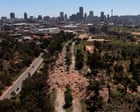
The skyline south of Johannesburg is punctuated by the pale yellow ridges of mine dumps. Increasingly, the ground is also caving open.
For politicians seeking votes in local elections on 4 November, the culprit is clear: illegal miners. In May, Kenny Kunene, the Johannesburg council member responsible for transport, took journalists on a tour of sinkholes that he claimed were the fault of zama zamas, including a section of Wemmer Pan Road that had completely collapsed.
The road was once the main artery linking the city’s central business district to the south-eastern suburbs. In one section it has completely disappeared, now raw earth pitted with the holes where illegal miners have been digging.
However, when it comes to sinkholes, experts say zama zamas are being scapegoated.
Rosalind Morris, an anthropology professor at Columbia University, who has worked extensively with illegal miners, noted that the porous dolomitic rock to Johannesburg’s south and west becomes unstable when water is removed.
“The biggest culprit of sinkholes in South Africa is formal industrial mining, which dewaters at a scale of hundreds of millions of gallons of water removed from underground every day,” she said.
“There are areas where there is a lot of residual gold, which are being very intensely mined by zama zamas, and some of that definitely causes structural collapse, there’s no doubt about it. But the idea that this was invented or caused for the first time by zama zamas is completely fallacious.”
Zama zamas are also frequently blamed for violence in mining areas, including a September mass shooting in Wedela township, west of Johannesburg. However, David van Wyk, the lead researcher at Bench Marks Foundation, said culpability laid with the often-feuding gangs that controlled access to the shafts.
“The guys working in the mine are actually super-exploited cheap labour … The guys with the guns are the guys who take the gold,” he said. “They don’t go underground.”
In Khutsong, about 50 miles (80km) west of Johannesburg, illegal miners, local and foreign, kept the township afloat, said Vusi Cele, the youth secretary for the local branch of Mining Affected Communities United in Action, a campaign group that advocates for “artisanal miners” to be granted mining licences. “Without those rents, it’s a ghost town,” he said.
While Cele, 33, currently hustles above ground selling mobile phone covers and screen protectors, he said he too would mine if he could get a licence. “On the surface there’s peanuts,” he said. “Underground there’s money.”
- gold
- mining
- johannesburg
- land
- scourge
- miner
- animal
- sinkhole