Gen Z protests sweep cities across Germany
Young people in Germany have taken to the streets in some 34 cities, calling for greater political say and a more hopeful future. The protests come amid a wave of youth demonstrations across Europe.
This is a round-up of events at the youth protests across Germany on October 31, 2026:
In Germany's second-biggest city, Hamburg, police estimated 6,700 people taking part in the demonstration.
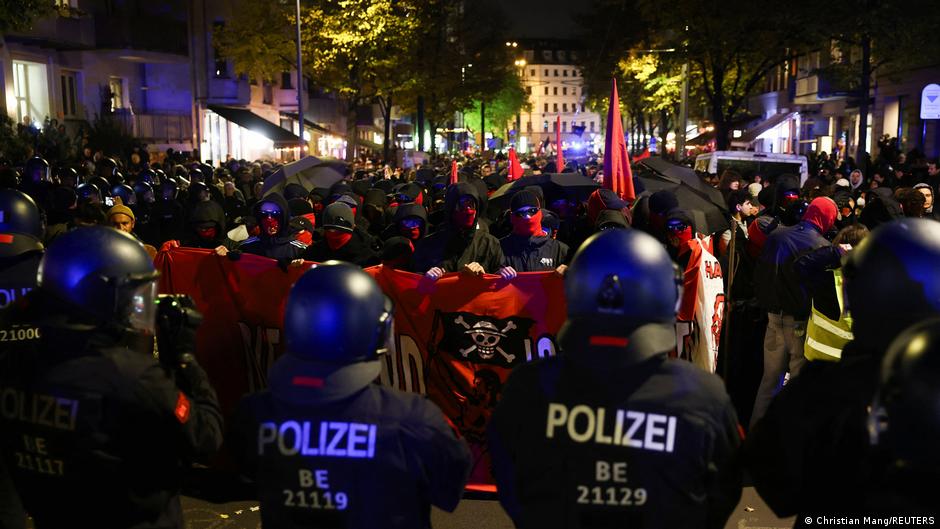
They reported some groups of black-clad protesters, some of whom also wore face masks, pulling apart construction site barriers and throwing them on the street. Some of the barriers were later set on fire.
Police said they pushed the crowd back and used pepper spray to break them apart. The fire was eventually put out.
Following an initial estimate of several hundred people attending the rally in central Berlin, police said that some 5,000 people were now gathered at the Brandenburg Gate. The organizers, "Gen Z regelt" (Gen Z sorts it) gave a much higher number, saying 10,000 people were in attendance.
One of the speakers in Berlin, Kaja Schwab, decried false promises made by politicians.
The youth is being told that "we will do well if we work hard enough." In reality, the life is getting unaffordable and the young are "forced into military service," she said, in reference to Germany's renewed recruitment drive.
Thousands of young people have joined the demonstrations in over 30 German cities, with police reporting largely peaceful protests.
Hundreds also gathered in Hamburg, Erfurt, Magdeburg, Dresden, Leipzig, Nuremberg, and elsehwere.
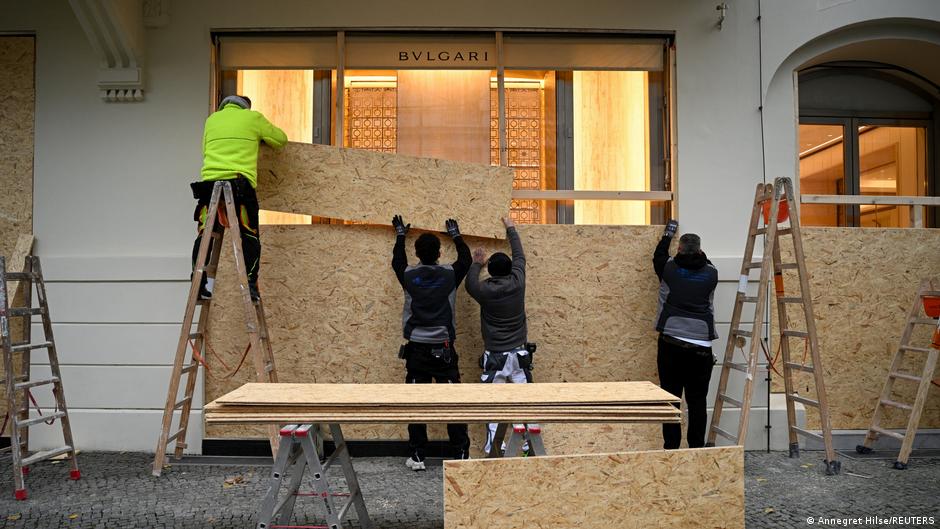
Retailers in several city centers had boarded up shop windows, particularly along luxury shopping streets, fearing unrest. Some shops were already closed for the Reformation Day public holiday.
No nationwide turnout figure was immediately available. More than 182,100 people had expressed interest in attending the events online.
Police in Cologne called off the planned "Gen Z regelt" procession after some participants covered their faces and used pyrotechnics.
"The demonstration will continue as a stationary rally," a police spokeswoman told the DPA news agency. Participants would remain on the Rhine riverbank, she said, appealing for restraint.
Attendance remained below the 15,000 people registered for the demonstration. Based on advance registrations, Cologne's protest was expected to be the largest in North Rhine-Westphalia.
Police repeatedly stopped a youth protest march in Stuttgart, citing participants covering their faces and leaving the agreed route.
Officers also reported smoke devices and firecrackers before the procession began. "Be loud, but remain peaceful," a police spokeswoman urged in a video.
In other German cities, police reported a largely peaceful start to demonstrations. Authorities estimated included 2,500 participants in Freiburg, more than 1,500 in Frankfurt, 1,200 in Mainz, 1,000 in Munich and 650 in Berlin.
No nationwide turnout figure was immediately available.
Politicians must involve young people in decision-making or risk the youth turning away from political institutions, education researcher Nina Kolleck warned.
Their exclusion "creates the impression that there is a policy for the old, but not for the young," the University of Potsdam professor told Germany's RBB Inforadio.
Kolleck pointed to decades of underinvestment in schools and the disproportionate impact of climate change on younger generations.
She warned that populist parties could exploit the resulting political vacuum if young people's frustrations continued to go unanswered.
Organizers of Germany's nationwide youth protests have accused the media of stoking fears of violence and distracting from their demands.
A "narrative of violence" was being used "to divert attention from our core demands," spokeswoman Veronika Dinter told the German broadcaster Deutschlandfunk.
She stressed that "GenZ regelt" — roughly meaning "Gen Z takes charge" — called for peaceful demonstrations, pointing to its published principles. Anyone who shared those principles was welcome, she said.
Dinter also regretted the decision by Germany's national school student representative body to distance itself from the protests. It had cited concerns including unclear organizational structures.
The initiative is holding rallies in Berlin, Cologne, Frankfurt and Munich, with local groups organizing protests in another 30 cities. Nearly 180,000 people had pledged online to attend, although actual turnout remained unclear.
Security authorities had warned that extremist groups could try to infiltrate the demonstrations.
People in Germany have the fundamental right, enshrined in the constitution or Basic Law, to assemble in public provided they remains peaceful and are unarmed.
However, several states have adopted their own assembly acts, which means some of them have additional restrictions, such as a ban on protesting on highways in the state of North Rhine-Westphalia.
Federal law itself imposes the obligation on organizers of protests to notify the local authority entrusted with approving public assemblies at least 48 hours before they invite people publicly to take part.
This aims to allow authorities to put in place security measures and to lessen the impact of any assembly on others by, for example, instigating traffic control measures.
Spontaneous assemblies are, however, also allowed in cases where a topical issue of urgent importance is at stake, and there is no notification requirement for indoor assemblies.
Protests or other assemblies can be banned beforehand or dispersed while they are underway, but this is considered a means of last resort.
Some locations are also subject to restrictions on protests, such as the area around the Reichstag building in Berlin where the German parliament sits, and around the Federal Constitutional Court in Karlsruhe.
Demonstrations around the Reichstag are, for example, permitted only when the parliament is not in session.
Post-war Germany has seen several massive demonstrations, including one in 1983, when 250,000 people — according to police estimates — gathered in the then West German capital, Bonn, to protest against the decision by NATO to station American nuclear missiles on German territory.
That was, however, surpassed in size by a protest in Berlin in 2003 against the invasion of Iraq by US-led forces, which drew a crowd of around half a million people.
There is some more detail on the law regarding the right of assembly in this DW article.
Young people are to take part in demonstrations across Germany on Saturday, following the example of their peers in France and other countries who have been calling for better educational prospects and future opportunities.
In Germany, organizers said there is also to be a focus on rejecting military conscription and on demanding more protection for the climate as the Earth warms, with potentially catastrophic effects.
Saturday's protests are being called for by the youth initiative "Gen Z regelt" ("Gen Z sorts it") through a social media campaign
The group itself will directly organize four of the protests — in Berlin, Cologne, Frankfurt and Munich —, with associated demonstrations to take place in some 30 other cities.
It has explicitly called for peaceful protests without the violence that marred recent demonstrations in France.
This has not stopped several conservative politicians, notably from Chancellor Friedrich Merz's Christian Democrats (CDU), from warning that similar scenes could occur.
"Gen Z regelt" has, however, criticized what it sees as a wrong focus on the possibility of violence at the protests.
"It shows that our point about not being taken seriously or being heard is right. No one wants to work with us on the issues at stake but instead always put the topic of violence on the agenda," an organizer of the Munich protest told a press conference in Cologne.
However, other lawmakers have come out in support of the protests.
The leader of the parliamentary party of the Greens, Katharina Dröge, told the DPA news agency: "Young people are rightly furious because the federal government does not take their wishes seriously enough."
The Left Party leader, Luigi Pantisano, also said it was the right time for protests as the government mulls reforms of the nursing care and pensions systems, calling them "social cruelties."
"Gen Z" broadly refers to the generation born between 1997 and 2012.
As Germany gears up for a day of mass youth protests, authorities in neighboring France are also bracing for new demonstrations on Saturday amid fears that the violence seen at October 17 rallies could repeat itself.
Some 70,000 police officers have been deployed to monitor around 150 protests across the country.
In recent weeks, protests by school pupils complaining about poor school conditions morphed into wider demonstrations on multiple issues, including the rising cost of living and social inequality.
On October 17 in particular, considerable violence occurred on the sidelines of mostly peaceful protests as extremists took the opportunity to plunder, riot and damage public property.
Young people in Germany are taking their lead from student protests in neighboring France to call for their opinions to be heard amid multiple challenges facing society.
As seen recently in France, organizers said they will be airing grievances about a perceived neglect of education but also calling for more social equality, less surveillance and measures to curb global warming.
Some politicians, in particular far-right leader Alice Weidel from the Alternative for Germany (AfD), have warned that the protests could attract violent extremists, but the organizers themselves have rejected any form of the violence that was seen occasionally in France.
Follow the protests as they unfold in some 34 cities across Germany.
- germany
- gen
- protest
- city
- people
- street
- future
- wave