Kenya eyes regional maritime security hub as Red Sea threats widen
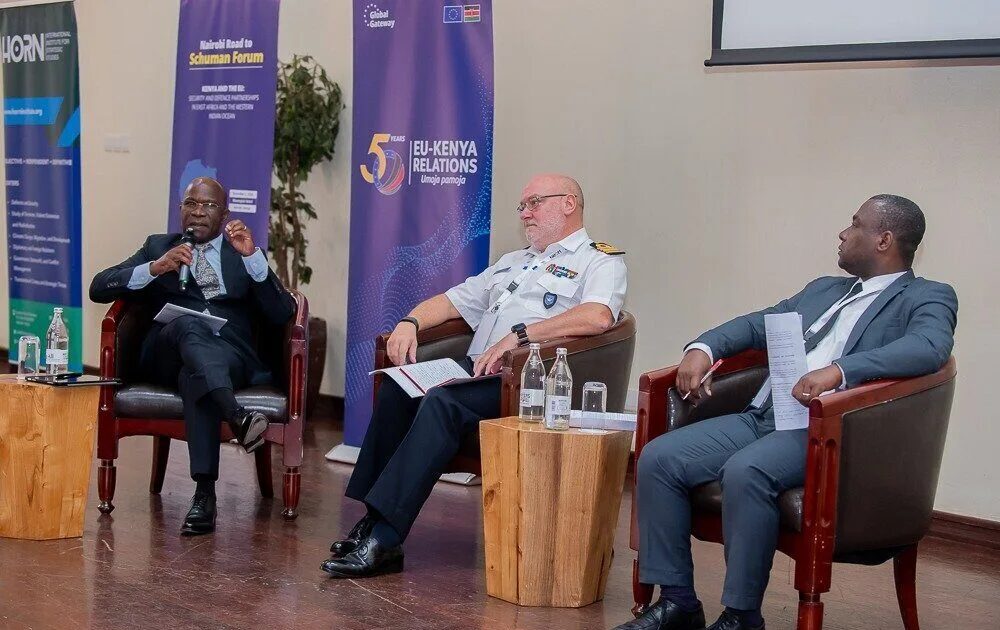
At a Kenya-European Union security forum in Nairobi, regional security officials and European maritime experts called for stronger cooperation, intelligence sharing and investment in local capabilities to address threats extending beyond piracy to include geopolitical competition, interstate tensions and asymmetric warfare. European Union maritime security expert Captain Hans Huyghens said Kenya was well placed to become a regional centre for maritime training, operational coordination and inter-agency cooperation, building on its existing role in multinational maritime security initiatives.
NAIROBI, Kenya, Nov 2 — Kenya is being positioned to play a bigger role in coordinating maritime security across the Western Indian Ocean, as growing geopolitical tensions and emerging threats expose the vulnerability of key shipping routes linking Africa to global markets.
At a Kenya-European Union security forum in Nairobi, regional security officials and European maritime experts called for stronger cooperation, intelligence sharing and investment in local capabilities to address threats extending beyond piracy to include geopolitical competition, interstate tensions and asymmetric warfare.
European Union maritime security expert Captain Hans Huyghens said Kenya was well placed to become a regional centre for maritime training, operational coordination and inter-agency cooperation, building on its existing role in multinational maritime security initiatives.
“Maritime security cannot be treated as a purely military matter,” he said.
He pointed out that the EU’s support should focus on strengthening regional leadership and connecting existing security initiatives rather than creating fragmented structures.
Huyghens cited the Djibouti Code of Conduct as an important framework for regional cooperation, while identifying the EU-supported CRIMARIO initiative and its IORIS maritime information-sharing platform as practical tools for coordinating operations and exchanging information.
He said Kenya could help promote the use of these platforms among regional partners while strengthening cooperation between maritime security agencies.
Captain Said Lavani, Deputy Director of the Regional Maritime Information Fusion Centre (RMIFC), described Kenya as an important regional security actor, saying it was an anchor of stability and leadership in the Western Indian Ocean.
The discussions come amid growing concerns over insecurity in the Red Sea, Gulf of Aden and Western Indian Ocean, where disruptions to strategic shipping routes have implications for international trade, energy supplies and African economies.
IGAD Special Envoy Amb. Mohamed Ali Guyo said maritime insecurity could not be separated from conflicts and instability on land, warning that the threats facing the region had evolved beyond traditional piracy.
He pointed to the growing strategic importance of the Strait of Hormuz and Bab el-Mandeb, whose interconnected disruptions could affect shipping, energy stability, supply chains and inflation, with wider humanitarian consequences for African countries.
Guyo said insecurity at sea was often a reflection of instability on land, requiring governments to address the underlying political and security challenges alongside maritime operations.
Kenya Navy Commander Major General Paul Otieno similarly called for a coordinated approach involving different security institutions, arguing that no single agency could independently address the threats facing the maritime domain.
“No one institution is capable of undertaking maritime security. We all have to work together and bring into play the complementary capabilities that we have,” Otieno said.
He warned that insecurity on land and at sea reinforced each other, citing illegal fishing as a threat to coastal livelihoods that could create conditions exploited by terrorist recruiters.
Beyond military operations, Huyghens said maritime security needed to incorporate the protection of coastal economies, sustainable fisheries, port modernisation, environmental conservation and tourism.
He cited disruptions in the Strait of Hormuz, which have slowed fertiliser exports, as an example of how insecurity along distant shipping routes can affect agricultural production and food security in countries such as Kenya.
Kenya’s strategic importance is also reflected in the scale of maritime trade passing through its ports.
Defence Cabinet Secretary Soipan Tuya said the Port of Mombasa handled close to 50 million tonnes of cargo in 2025, with transit cargo increasing by almost 20 per cent, underscoring the importance of protecting sea lanes that support regional commerce.
Kenya Ports Authority figures put the port’s 2025 cargo throughput at a record 45.45 million metric tonnes, while transit cargo rose by 19.5 per cent to 15.88 million tonnes.
Tuya said Kenya viewed itself not merely as a beneficiary of international security cooperation but as an active contributor to regional peace and stability.
She also called for predictable financing for African-led peace operations, citing an estimated annual funding gap of about 76 million US dollars facing the African Union Support and Stabilization Mission in Somalia (AUSSOM), while acknowledging continued EU support.
“Lasting security cannot be achieved by any one nation alone. It demands trust, shared responsibility and partnership grounded in mutual respect and common interests,” she said.
The forum, organised by the EU Delegation to Kenya in partnership with the HORN International Institute for Strategic Studies, brought together defence officials, diplomats, regional organisations and security experts to examine Kenya-EU cooperation on peace, security and defence.
EU Ambassador to Kenya Andreas Peschke said the discussions were intended to identify existing cooperation gaps and determine how partners could improve their collective response to regional security challenges.
“Maritime security concerns livelihoods as well as freedom of navigation,” he said.
The Nairobi meeting is part of the EU’s Road to Schuman Forum engagements ahead of the third Schuman Security and Defence Forum scheduled for November 17-18 in Brussels, where regional perspectives will feed into broader discussions on international security partnerships.
Bruhan Makong is a Senior News Reporter for Capital FM in Nairobi, covering diplomacy, foreign policy, national security, climate, and human rights across East Africa and the wider region.
- security
- kenya
- sea
- threat
- insecurity
- red
- shipping
- cooperation