Constantinople to Istanbul review – you won’t want to leave this lavish celebration of double imperial splendour
V&A, London Treasures from the two world-defining cultures that somehow coexisted in one mighty city keep on dazzling in this gorgeous, unmissable show Two empires compete to bewitch you in this exhibition that offers a double bubble of beauty. It collides the Byzantine empire, whose capital Constantinople was officially inaugurated on 11 May AD330, with the Ottoman Turks who conquered this great city in 1453 and turned it into Istanbul.
V&A, London Treasures from the two world-defining cultures that somehow coexisted in one mighty city keep on dazzling in this gorgeous, unmissable show
Two empires compete to bewitch you in this exhibition that offers a double bubble of beauty. It collides the Byzantine empire, whose capital Constantinople was officially inaugurated on 11 May AD330, with the Ottoman Turks who conquered this great city in 1453 and turned it into Istanbul. The combined glories of two lost worlds – the Ottoman empire was dissolved in 1922 – beget an utterly enrapturing blockbuster. I lost all track of time in this dream city of gold and ivory.
Even the human form is magically transfigured here into mineral and metal. The martyred abbess St Eudokia becomes a Byzantine icon of marble inlaid with coloured glass, wearing a crown of precious stones and an exquisite dress patterned with diamonds and decorated with pearls and emeralds. It is a masterpiece of abstract splendour that looks like a Klimt painting, but this icon can’t have influenced him because it wasn’t excavated until 1929.
Beat that for splendour – but the Ottoman empire could. A 16th-century kaftan, probably worn by Sultan Selim II, irradiates you with light-giving yellow and geometric white designs, part flower, part solar disc: it is made of zerbaft, a fabric said to be “woven from gold”, and looks it.
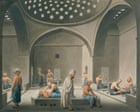
Staggering. But it’s not all precious metals. There are blue and white glazed tiles from a hamam that conjure images of steaming bathhouse comfort, along with a bath wrap of red silk. Wooden foot supports from a women’s hamam are inlaid with mother of pearl. As a wall text points out, if you have a nice bathroom you are living under the influence of Ottoman Istanbul.
The story all begins with Constantine, the emperor who accepted Christianity. He created New Rome, or Constantinople, at a strategic point between Europe and Asia to deal with the unmanageably vast Roman empire. You can see here sublime relics of this eastern capital including a mosaic from Constantine’s palace of a huge moustached face of weird godlike mystery.
That luxury was seen in public places too. Constantine brought the Roman policy of “bread and circuses” here and adorned the chariot racing hub, the Hippodrome, with artistic masterpieces pillaged from ancient Greece and Egypt. Here you can see the bronze head of a snake that was part of the celebrated Serpent Column and a less scary goose. Ivory reliefs portray consuls at the Hippodrome, holding a mappa, the piece of cloth they let fall to start the games. These men are ancient Romans, with names such as Flavius Taurus Clementinus but by their time, the sixth century AD, the Roman empire in western Europe and north Africa was finished.
Yet it lived on in the east. Byzantine schoolchildren studied Homer and monasteries preserved Plato’s writings. Facing the final Turkish attack in 1453, the last Byzantine emperor urged his people to throw their javelins and spears to let the enemy know they were fighting “the descendants of the Greeks and Romans”. However, the Ottomans had cannon.
By the end, the Byzantine empire was reduced almost entirely to Constantinople with its massive walls and secret weapon, “Greek fire”. The survival of this final fortress of ancient civilisation for so long was such a historical freak that it gets politely passed over in history books as a kind of wondrous but irrelevant exception to the laws of progress: the golden, mystical Byzantium where nothing changed or was invented. This exhibition takes you to the unreal city WB Yeats evokes in his poem Sailing to Byzantium.
Then you cross a gap between galleries that feels like a rupture in time, and find yourself looking at Gentile Bellini’s portrait of Sultan Mehmed II, painted from life in 1480. Mehmed poses in a white turban and fur-lined red robe, and the Venetian artist shows the sensitive profile of this ruler whose Muslim empire terrified European Christians. The Ottomans were culturally curious, as this experiment in importing Renaissance art reveals. Was there in fact an Ottoman Renaissance, to mirror and match the western one?
A wooden chest made to hold a copy of the Qu’ran in the late 16th century may look like yet another luxury but it is also a document of that Istanbul Renaissance, for it takes the shape of a magnificent dome. The conquerors of Constantinople were fascinated by one of its wonders above all others: the church of Hagia Sophia, consecrated in 537 AD, with its colossal, dreamlike cavern of an interior beneath a majestic dome.
The Ottomans made it a mosque but with minimal changes to its fabric. Just as Brunelleschi, Michelangelo and Wren were inspired by antiquity to build domes, Istanbul’s Blue Mosque and Süleymaniye Mosque are inspired by Hagia Sophia. Watercolours by early European visitors show how the mystery of Hagia Sophia became globally known. From 1935 to 2020 it was a museum. Now it is a mosque again by edict of populist president Recep Tayyip Erdoğan, who described the change as “Hagia Sophia breaking away from its chains of captivity” – a strange way to characterise a building that is 90% ancient Roman and was built as a church.
This is a sumptuous voyage to Byzantium via Istanbul. Linger in the baths, in your tall wooden shoes and silk towel, and enjoy the artifice of eternity. I spent two hours here, but I wanted to do the whole thing again immediately, in reverse.
- constantinople
- istanbul
- splendour
- city
- empire
- review
- celebration
- world