Alexander: God, King, Man by Edmund Richardson review – a dazzling, dizzying adventure
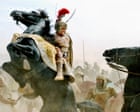
The winner of the 2026 Baillie Gifford prize is a riveting work of ancient history that feels startlingly present • ‘Blockbuster’ history of Alexander the Great wins £50,000 Baillie Gifford prize Desperate to prove his worth, Alexander led an army into the Persian empire to confront Darius III, a man who ruled more than 50 million people.
The winner of the 2026 Baillie Gifford prize is a riveting work of ancient history that feels startlingly present ‘Blockbuster’ history of Alexander the Great wins £50,000 Baillie Gifford prize
In 336BC, Alexander was not great. He was a wiry 20-year-old “no one had thought much about” who found himself king of Macedon after the assassination of his father, Philip. He seemed uniquely unfit for the position. Desperate to prove his worth, Alexander led an army into the Persian empire to confront Darius III, a man who ruled more than 50 million people. Darius was so confident of victory that he brought his family along for the show.
Alexander was outnumbered, and apparently out of his depth. He had suffered a fever that left him “shaking and helpless”, and dissent rattled through his ranks. A vast military force was bearing down on him, with Darius at the helm. “He did not know it yet,” Edmund Richardson writes, “but Alexander was about to become a legend.”
Alexander: God, King, Man is the story of that legend, told in dazzling and dizzying prose. It is the story of ruthless ambition, of restlessness leading to recklessness, of identity crises and messianic ideation, of a man who unleashed “violence on a scale never before seen”, conquering vast tracts of the world only to find himself paranoid and afraid. It is a story that, as Richardson shows, has been told by Roman politicians and Jewish scholars, by Icelandic bards and Persian courtiers. Which raises the question: do we really need another telling? In this case, yes. Partly because Richardson, professor of classics at Durham University, uses material from 12 languages, mining hieroglyphics, cuneiform and computer simulations, in a tremendous work of synthesis. And partly because his book is brilliant – and that is reason enough.
It is by necessity a violent read, tracking one conquest after the next, each battle characterised by some new brutality. But Richardson manages it with a light touch. The book frequently made me laugh amid the mayhem, and the author has a talent for selecting eye-catching details. At the battle of Issus, Alexander’s first confrontation with Darius, he introduces the phalanx: a 16-man-deep war machine, spiked with 19ft spears. We see the siege of Tyre through the lens of an engineer: it is a tale of catapults, boring machines, tridents and giant nests that “snatched up men” and “dashed them against rocks”. And we learn how Darius might have won the battle of Gaugamela, had he known horses could not stomach the stench of elephants.
It’s not all battles. On the march to Siwa, we observe the process of self-creation, as Alexander allows the Egyptians to designate him the son of their god, Amun. He may have let their adulation get the better of him, as he wrote in a letter: “King Alexander, the son of Zeus Amun, greets his mother, Olympias.” She responds, as only a mother could: “My dearest boy, don’t ever call yourself that again.” In Susa, we watch a drunk Alexander promising to pay off the debts of his soldiers, as well as dowries, a mistake Richardson calls “the most expensive hangover in history”. We follow him around Babylonia and witness a burgeoning existential crisis: is he king of Babylon or lord of the two lands? Is he son of Philip or Amun? Is he actually a god?
Richardson doesn’t mind diversions – flashing forward, flashing back, shifting through time and space. The book is all the better for it. The chapter on Alexandria and its library – a topic also covered in Richardson’s 2021 book, Alexandria: The Quest for the Lost City – is especially fascinating. The intellectual world centred on the library produced designs for the first ever steam engine, an early and close calculation of the world’s circumference, a flock of pneumatic singing mechanical birds and the first “universal” editions of Homer, achievements Richardson deems more wonderful than the literal wonders of the world. “Of all the ripples set in motion by Alexander’s life,” the author explains, “none have been as far reaching, and none continue to shape the world today, as much as the legacy of the Library.”
This is not the staid history of chalkboards but living, breathing history. It is a rush, and frequently hilarious. Speaking of the Greek contempt for their one-time enemies, Richardson says: “Persians were meant to be weak and uncivilised. Some of them even wore trousers.” The comic and the curious are often confined to brackets, interrupting the text but always welcome. “Amid vigorous linguistic competition … Greek’s fascination with the penis remains unrivalled.” Or better still: “Some survivors of the Trojan War were left behind … because, it was said, their buttocks had begun to rot. They settled in a new town called Pygela, which translates as ‘Ass City’.” Not all of the curiosities are as prurient, but they are always memorable.
Alexander’s life ends with a whimper, after so many spectacular bangs. He dies aged 32, battle-weary and fearing mortality, mourning the loss of his best friend, consumed by paranoia and consuming enough wine to drown an army. After so many near-deaths, he succumbs to a banal one, his killer salmonella typhi, likely contracted from river water. “The boy had become a king,” Richardson writes. “The king had become a hero. The hero had become a living god. Now … the god was dying, slobbering and broken-hearted, in Babylon.”
Despite its subject’s fate, Alexander: God, King, Man somehow sustains its sense of pace right up until the last word. It is a riot from start to finish, driven by exquisite prose and captivating stories, full of horror and violence, but laced with wonder and comedy.
Richardson shows us that you don’t have to sacrifice academic rigour at the altar of accessibility, and this exhaustively researched work will charm even the most general of general readers. It is a story about a long-disappeared empire, told with enormous verve and immediacy, and the biography of a man who forged a new world through force of will. “From the stars in the sky to the words on this page,” Richardson tells us, “Alexander reshaped reality more profoundly than almost anyone else in history.”
- alexander
- king
- man
- edmund
- richardson
- darius
- god
- review