New Zealand heads for election cliffhanger with minor party cast as kingmaker
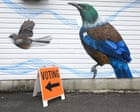
Polls show neither major party will have enough seats to form government, meaning the fate could fall on centrist minor party, The final polls ahead of New Zealand’s election show a knife-edge path to power, with neither the ruling right-wing coalition or opposition left bloc able to form a government without the support of a newcomer centrist party.
Polls show neither major party will have enough seats to form government, meaning the fate could fall on centrist minor party, Opportunity
The final polls ahead of New Zealand’s election show a knife-edge path to power, with neither the ruling right-wing coalition or opposition left bloc able to form a government without the support of a newcomer centrist party.
New Zealanders will vote on 7 November, concluding a six-week campaign defined by the high costs of living, a wobbling healthcare system, political tit-for-tats over gangs, personal attacks, and complex vote-splitting strategies.
“A lot of [the campaign] has been quite negative in the last few weeks and I think … most people are kind of sick of it and ready for it to be over,” said Lara Greaves, a political scientist at Victoria University of Wellington.
A final push from National – the major party in the ruling right bloc – and the opposition Labour party has done little to budge their cratering popularity, with both parties sitting below 30% in polls released this week.
The 1News-Verian poll, released Tuesday, has prime minister Christopher Luxon’s National on 30%, with Chris Hipkins-led Labour on 29%. A Taxpayers’ Union/Curia poll had National on 28.9% and Labour on 28.4%.
New Zealand’s mixed-member proportional (MMP) system requires two votes – one for a party and one for a local electorate candidate. Small parties often hold the balance of power. In 2023, National got 38% of the vote and needed the New Zealand First and Act parties to form a government.
Minor parties are continuing to scoop up votes from National and Labour.
Across both polls left-wing Greens are polling between 14 and 16%, the libertarian Act party 10%, the populist New Zealand First party between 8 and 9% and Te Pāti Māori (the Māori party) about 1%.
The numbers indicate that neither left or right bloc will have enough seats to form a government, so their fate could fall to the centrist minor party, Opportunity, which polls show could clear the 5% threshold to become kingmaker.
The Opportunity party, led by businesswoman Qiulae Wong, 38, has said it will negotiate first with the party that secures the highest number of votes. However, Luxon has ruled out working with Opportunity numerous times, saying its proposed land tax runs contrary to National’s “no new taxes” pledge.
Should he keep his promise, National faces the possibility of being the first one-term National-led government since the party was founded in 1936.
In another late blow to Luxon’s hopes, unemployment unexpectedly rose to a fresh 11-year high, hitting 5.7% in the September quarter, according to data released Tuesday. And according to the most recent Ipsos issues monitor, released on Monday, most people think Labour is the best party to deal with nine out of the 10 most pressing everyday concerns of voters.
Polls are also indicating the potential of several overhang seats, where a party wins more electorates than its share of the party vote. If that occurs, more seats will be added to parliament and could dictate which coalition can form a government.
More than one million New Zealanders have voted early this year – already up about 30% compared to the 2023 election, which Greaves suspects could be down to the closeness of the race.
But it could take weeks for New Zealand to know the shape of its government, Greaves says.
“There’s two possibilities here: one is that there’s a clear winner at the end of the night, and then they set about negotiating,” she says.
But if there is no clear winner, parties must wait for the final count, due 27 November. If special votes, which includes overseas votes, add seats to a party, or an overhang is created, that could “change the whole map of the house”.
Either way, the future government is going to have a “tough ride” ahead, Greaves says.
“Generally, it does seem like it will be a really challenging time for whoever ends up having to govern.”
- party
- zealand
- election
- cliffhanger
- kingmaker
- poll
- government
- head