‘Mind-blowing’: dark-sky fans gather on Exmoor to see what light pollution hides
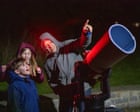
The UK is 14th most light-polluted country, but in south-west England the veil is lifted at the dark skies festival “It’s just mind-blowing,” says the astronomer and teacher Jo Richardson. She is standing in Exmoor national park talking about Saturn, the first planet she ever saw through a telescope.
The UK is 14th most light-polluted country, but in south-west England the veil is lifted at the dark skies festival
“It’s just mind-blowing,” says the astronomer and teacher Jo Richardson. She is standing in Exmoor national park talking about Saturn, the first planet she ever saw through a telescope.
But it is not the cosmic colour of the planet that Richardson is drawn to, nor its mysteries – it is the vastness. “Saturn, on average, is 800m miles away,” she says, the equivalent to travelling the circumference of the Earth 32,000 times. “You can see it through a telescope here. That’s just nuts.”
Richardson is on Exmoor to spread the word. She is here for the 10th dark skies festival, celebrating the park as Europe’s first designated international dark skies reserve. Throughout October, people travelled from across England’s south-west to see the wonder of the night sky and learn about space, guided by astronomers and ecologists from the national park.
Bringing people to the darkness of Exmoor encourages them to consider the light pollution that prevents them seeing the cosmic show at home, Richardson says. “It’s not about shutting all the lights off all the time, it’s about just using them wisely,” she says, the faint glow of Tiverton, the nearest town, emerging on the horizon as the sun sets. “It’s all about education, making people think about their environment and how to protect it.”
Throughout the evening, families are taught about the cosmos via fireside question and answers, peeks through the telescope and bioluminescence walks through the woods. “Sometimes it just generates that spark,” says Richardson’s husband, Peter, also an astronomer. Together, the pair run Space Detectives, which delivers space science workshops, presentations and courses for adults and children. “We’ve had youngsters go through our clubs that are now working as professional astronomers,” he adds.
Research has shown that the night sky becomes 10% brighter every year because of growing light pollution. According to the Light Pollution Map, the UK is the 14th most light-polluted country in Europe, with microstates such as Vatican City and Monaco making up the top five.
Light pollution is measured by the Bortle scale, the nine-level numeric chart that measures brightness. A nine is lit up like central London, while a one is the remotest locations on Earth such as the Atacama desert in Chile. The darkest zone of Exmoor is a two. “[A] one sky is proper jaw-dropping,” says Peter Richardson. “You can see the Milky Way and you can see dust lanes and everything with your naked eye. It’s quite incredible.”
The darkness is also important for the local wildlife, says Kate Lacey, an ecologist at Exmoor National Park Authority. Her work focuses on protecting the park’s nocturnal environment, including the rare bechstein’s and barbastelle bats that live on Exmoor. They rely on darkness for hunting, navigation and migration.
Protecting salmon populations is also on her to-do list. “Salmon migrate upstream and Exmoor is quite an important spawning ground for salmon,” Lacey says. “They get disrupted by artificial light. It confuses them, and then they’re less likely to survive.”
As the night goes on, clouds blanket Exmoor’s sky, obscuring the stars and bringing the event to a close. But the organisers hope the experience will stay with visitors long after they leave. They want people to continue to look up at the sky and think about how light pollution threatens what they can see.
“The night sky is a sense of wonder for people that not everyone gets to experience,” says Lacey. “It’s inspired science, it’s inspired art, it’s inspired religion. It’s just so important.”
- exmoor
- mind
- sky
- pollution
- richardson
- saturn
- planet
- telescope