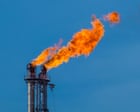
NNPC, Oando join global push to end gas flaring as Nigeria’s emissions rise

Nigeria’s participation in a global oil and gas decarbonisation initiative comes as independent data show that gas flaring in the country increased for the third consecutive year in 2025.
The Nigerian National Petroleum Company (NNPC) Limited and Oando are among oil and gas companies committed to ending routine gas flaring by 2030 under a global decarbonisation initiative, even as Nigeria continues to record rising gas-flaring volumes.
The companies are signatories to the Oil and Gas Decarbonisation Charter (OGDC), which on Tuesday released its 2026 Status Report at the ongoing United Nations Climate Change Conference (COP31) in Antalya, Türkiye.
The report, released three years after the initiative was launched at COP28 in Dubai, shows that 41 signatory companies now have action plans to eliminate routine gas flaring, representing a 78 per cent increase from the 2024 baseline.
The initiative is particularly noteworthy for Nigeria, one of the world’s largest gas-flaring countries, where regulatory weaknesses and inadequate infrastructure have continued to undermine efforts to reduce emissions from oil and gas operations.
According to the World Bank’s Global Gas Flaring Tracker, Nigeria flared 6.6 billion cubic metres of gas in 2025, compared with 6.1 billion cubic metres in 2024 and 5.1 billion cubic metres in 2023.
The figures indicate that gas flaring in Nigeria has increased for three consecutive years, despite the country’s commitments to eliminate routine flaring by 2030.
The OGDC brings together 57 oil and gas companies operating in more than 100 countries and representing one-third of global oil and gas production.
Its signatories have committed to achieving net-zero operational emissions by or before 2050, near-zero upstream methane emissions and zero routine flaring by 2030.
Beyond NNPC and Oando, other companies with Nigerian operations identified among the charter’s signatories include ExxonMobil, which has its subsidiaries in Nigeria as Esso Exploration and Production Nigeria Limited and Esso Exploration and Production Nigeria (Deepwater) Limited; Shell, through its subsidiary Shell Nigeria Exploration and Production Company (SNEPCo), and TotalEnergies.
Shell also holds a 25.6 per cent interest in Nigeria LNG Limited.
The 2026 report indicates increasing participation by companies in emissions monitoring, planning and investment, although progress remains mostly measured through corporate disclosures and commitments.
Of the 56 companies that were members during the reporting period, 52 submitted emissions data, covering 97 per cent of the charter’s operated production.
Four companies reported their operational emissions for the first time, while another national oil company established its emissions baseline and shared data with the initiative for the first time.
The number of companies that have set interim 2030 targets to reduce Scope 1 and Scope 2 emissions also rose to 46, up from 42 in the previous reporting year.
Of these, 42 have developed action plans to achieve their emissions-reduction ambitions, representing a 40 per cent increase from the 2024 baseline.
Scope 1 emissions are those generated directly by a company’s operations, including emissions from burning fuel and gas flaring, while Scope 2 emissions arise indirectly from purchased electricity, heating and cooling.
The report also found that 39 companies had developed methane action plans, representing a 63 per cent increase from the 2024 baseline.
Methane is the principal component of natural gas and a potent greenhouse gas. It escapes into the atmosphere through leaks, venting and incomplete combustion during gas flaring.
The report also highlighted growing financial commitments to reducing operational emissions.
Thirty-five signatory companies, accounting for 84 per cent of the initiative’s operated production, have allocated capital towards achieving their interim emissions-reduction targets.
Half of these companies said their allocated budgets now cover their entire decarbonisation roadmaps.
In addition, 34 companies reported $28 billion in lower-carbon investments and acquisitions in 2025.
The report also identified improvements in emissions verification, with 39 companies, representing 92 per cent of the initiative’s operated production, having individual third-party verification procedures for their emissions data.
Twenty-one companies now use direct measurement technologies for most of their reported methane emissions, while another 18 use the technologies for some of their reported emissions.
The report said 30 companies also provided the OGDC secretariat with information not currently publicly disclosed, allowing the initiative to assess progress and identify areas needing further support.
The commitments come against the backdrop of Nigeria’s persistent difficulties in enforcing regulations intended to curb gas flaring and methane emissions.
A PREMIUM TIMES report published on 24 September, titled Inside Nigeria’s methane problem, found that Nigeria’s gas-flaring volumes increased from 5.1 billion cubic metres in 2023 to 6.6 billion cubic metres in 2025.
The investigation attributed the persistent problem to weak regulatory enforcement, inadequate infrastructure and the transfer of environmental liabilities following the divestment of assets by international oil companies to indigenous operators.
It also found that only 15 of the 62 companies covered by the Nigeria Extractive Industries Transparency Initiative‘s (NEITI) first upstream greenhouse gas audit submitted emissions data, while 47 companies did not.
NEITI warned that the poor disclosure rate posed a significant risk to Nigeria’s ability to meet its climate commitments.
A separate PREMIUM TIMES investigation published on 1 September found that oil companies continued to violate gas-flaring regulations without facing corresponding sanctions.
Another investigation published on 12 October examined TotalEnergies’ declaration that it had ended routine gas flaring in Nigeria. PREMIUM TIMES’ analysis of satellite data and observations around the company’s assets identified persistent flare activity despite the company’s claims.
The investigation also showed that TotalEnergies failed to report its methane emissions in Nigeria.
Nigeria’s Petroleum Industry Act and subsequent regulations have established obligations for oil and gas operators to reduce flaring, monitor methane emissions and implement measures to eliminate routine flaring.
However, flaring persists, raising questions about the effectiveness of regulatory enforcement and how well companies are translating climate commitments into measurable reductions.
Bjørn Otto Sverdrup, head of the OGDC secretariat and chair of the Executive Committee of the Oil and Gas Climate Initiative, said the report showed increasing participation in emissions reporting, the development of action plans and the allocation of capital towards decarbonisation.
“Our focus now is to build on that momentum towards delivery,” he said.
He said improved data, practical support, collaboration and technology were helping companies identify emissions sources, prioritise interventions and accelerate decarbonisation.
“With four years to go until 2030, the priority is to get more complete data, scale proven solutions and turn plans into more projects,” he added.
The OGDC said more than 4,000 professionals from signatory companies had participated in its technical workshops and training programmes since the initiative began.
- gas
- flaring
- nigeria
- nnpc
- oando
- push
- emission
- participation