State police, resource control top Makinde’s ‘Reset Agenda’
The presidential candidate of the Allied Peoples Movement (APM) in the 2027 general elections and Governor of Oyo State, Seyi Makinde, has unveiled an ambitious plan to restructure Nigeria’s governance and economy, promising to dismantle institutional bottlenecks, devolve more powers to states, strengthen security and redirect public resources towards productive sectors if elected president. Under his proposed Reset Agenda, entitled: ‘Reset Nigeria: A governing programme for a productive, secure, capable and accountable federation’ Makinde is offering Nigerians a governing programme built…
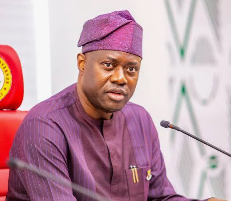
By Dapo Akinrefon The presidential candidate of the Allied Peoples Movement (APM) in the 2027 general elections and Governor of Oyo State, Seyi Makinde, has unveiled an ambitious plan to restructure Nigeria’s governance and economy, promising to dismantle institutional bottlenecks, devolve more powers to states, strengthen security and redirect public resources towards productive sectors if elected president.
Under his proposed Reset Agenda, entitled: ‘Reset Nigeria: A governing programme for a productive, secure, capable and accountable federation’ Makinde is offering Nigerians a governing programme built around what he describes as the need to rebuild the relationship between government and citizens, restore the country’s federal balance and establish an economic system capable of translating Nigeria’s human and natural resources into better living standards.
The governor argues that Nigeria’s development challenges are rooted not simply in a shortage of resources or the absence of economic policies, but in institutional failures, excessive concentration of authority at the centre, poor coordination among government agencies and the inability of successive administrations to translate policy announcements into tangible improvements in people’s lives.
His proposal, therefore, goes beyond promising new infrastructure, social interventions and economic programmes. It seeks to alter the structure through which the government makes decisions, allocates resources and delivers public services. Makinde’s argument is that Nigeria cannot achieve sustainable economic growth under a system in which the Federal Government retains excessive control over critical responsibilities while state governments and communities bear much of the consequences of policy failures.
He traces some of the country’s present difficulties to the centralisation of authority during military rule, arguing that the return to democracy did not sufficiently restore the federal balance envisaged by Nigeria’s founding fathers. According to him, the country must return to a system in which different levels of government have the authority, resources and institutional capacity to address problems within their jurisdictions, while remaining accountable for their performance.
“Reset Nigeria means correcting that course and building a federation capable of making our unity work,” he declared in presenting the programme. The proposal comes against the background of widespread public dissatisfaction over the cost of living, insecurity, unemployment, unreliable electricity, poor infrastructure and the declining purchasing power of households.
Makinde acknowledges that Nigerians are experiencing the consequences of rising food, transportation, energy and housing costs, arguing that the government must move beyond explaining why economic reforms require time and demonstrate how those reforms improve the lives of citizens. He maintains that although rebuilding institutions cannot happen overnight, the time required for reform should not become an excuse for inaction or institutional failure.
Economic restructuring and productivity At the centre of the Economic Reset is a promise to reorganise the country’s economic priorities around productivity, domestic production, employment and the reduction of avoidable costs. The APM candidate opines that Nigeria’s economic difficulties are compounded by the failure to connect agriculture, transportation, energy, manufacturing, finance and security into a coordinated production system.
He cites the difficulties farmers encounter in moving produce to markets, the high cost of electricity for manufacturers, the recurring expenditure on government-owned refineries and the delays businesses experience in dealing with public institutions as examples of a system that increases production costs and transfers the burden to consumers. Rather than introduce a new policy for every problem, he proposes an integrated economic framework that would identify the country’s most important productive sectors and remove the obstacles preventing them from expanding.
His approach will be guided by five principles: establishing the true cost of government interventions, assigning responsibility for results, connecting related policies, setting measurable delivery deadlines and discontinuing arrangements that repeatedly consume public funds without delivering value. One of his major proposals is to prioritise federal road construction around economically important corridors connecting farms, industrial clusters, ports, markets and border communities.
He holds the view that road construction should not be measured simply by the number of kilometres awarded or the amount of money released, but by the economic opportunities created through improved transportation. Under the proposed Federal-State Road Compact, states undertaking projects on federal roads would have clearly defined agreements with the Federal Government on financing, reimburseme
- resource
- makinde
- reset
- state
- nigeria
- government
- system
- cost