Sanusi, Ladoja warn against politicising traditional institutions
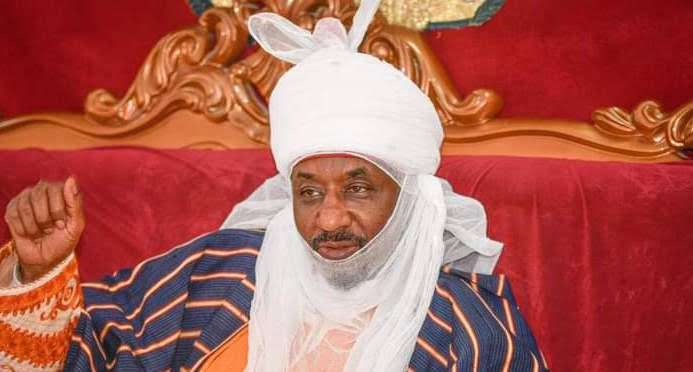
By Adeola Badru The Emir of Kano, Muhammadu Sanusi II, and the Olubadan of Ibadanland, Oba Rashidi Ladoja, have called for national healing, peaceful coexistence and stronger bonds among Nigeria’s diverse ethnic and religious groups, warning against the politicisation of traditional institutions. Sanusi, who was in Ibadan to honour an invitation from the League of Imams and Alfas in South-West Nigeria, said his visit reflected his belief in a country where ethnic, religious and political differences would not determine relationships among citizens.
By Adeola Badru The Emir of Kano, Muhammadu Sanusi II, and the Olubadan of Ibadanland, Oba Rashidi Ladoja, have called for national healing, peaceful coexistence and stronger bonds among Nigeria’s diverse ethnic and religious groups, warning against the politicisation of traditional institutions. The two traditional rulers spoke on Sunday in Ibadan when Sanusi paid a courtesy visit to Ladoja at his palace in Oke-Aremo, where they stressed the need for traditional institutions to remain above partisan interests and serve as instruments of reconciliation, mutual understanding and national unity.
Sanusi, who was in Ibadan to honour an invitation from the League of Imams and Alfas in South-West Nigeria, said his visit reflected his belief in a country where ethnic, religious and political differences would not determine relationships among citizens. He described the engagement as one of the positive developments needed to bridge Nigeria’s regional and cultural divides, stressing that national unity, progress and prosperity could only be achieved when people from different backgrounds deliberately reached out to one another.
The Emir said although other engagements had emerged, he considered it important to honour his earlier commitment to attend the conference, even if his participation would be brief. “We fixed this date a long time ago, and even though other events came, we considered it important to honour our promise to appear at the conference, even if it is for a brief period, because they have been expecting me to come.
“This invitation is part of the positive developments we have been yearning for to build a bridge where Nigerians from different parts of the country reach out to each other and come together in the interest of the unity, the progress and the prosperity of our dear nation,” he said. Sanusi also apologised for the delay in visiting Ladoja following his appointment and coronation, explaining that certain circumstances had prevented him from attending earlier.
He congratulated Ladoja on his ascension to the throne of his forebears and prayed for divine protection, a long and peaceful reign, as well as prosperity for Ibadanland and Nigeria. The Emir described the courtesy visit as necessary, given the longstanding relationship between the two traditional institutions and their respective communities. Reflecting on his relationship with Ibadan, Sanusi recalled his longstanding connections with the ancient city dating back to his days at First Bank, his association with the late Aare Musulumi of Yorubaland, Alhaji Abdulazeez Arisekola Alao, and his subsequent tenure as Governor of the Central Bank of Nigeria.
He said Ibadan had remained a familiar destination over the years, adding that he had maintained close relationships with several indigenes of the city. Sanusi also expressed his readiness to host the Olubadan in Kano, saying reciprocal visits would further strengthen the longstanding bonds between the two communities and promote understanding among Nigerians from different regions.
Responding, Ladoja identified political interference in traditional institutions as a major concern, calling for deliberate measures to insulate traditional rulers from partisan politics and arbitrary decisions capable of destabilising established traditional structures. He warned that political actors who interfere in traditional institutions often take decisions without fully appreciating their historical significance and the far-reaching consequences for affected communities.
Specifically, the Olubadan expressed concern over developments surrounding the Kano Emirate, arguing that an institution with more than 1,000 years of history should not be subjected to arbitrary fragmentation. He urged those involved in the controversy to allow reason to prevail, expressing hope that peace and the historical integrity of the Kano Emirate would be restored.
“We have a lot in common. And we have to find a way of insulating the position of the traditional rulers from partisan politics, failure of which they continue to take decisions whose consequences they don’t even understand. “From history, we know that Kano has been there for more than 1,000 years. And for somebody to wake up and say he is going to break it doesn’t seem to be reasonable.
We pray that reason will prevail in the Kano Emirate to restore what we used to know Kano for,” Ladoja said. Recalling the Maitatsine crisis, which originated in Kano, the Olubadan stressed the need to sustain peace in the ancient city, describing it as a major commercial centre whose stability has implications for the wider northern region and Nigeria.
He noted that Kano and Ibadan were widely regarded as two of the country’s most accommodating cities, adding that Kano remained a major convergence point for Hausa- and Fulani-speaking communities. According to him, Kano’s importance as a commercial hub extended beyond Nigeria, making peace and stability in the city a matter of nation
- sanusi
- ladoja
- institution
- nigeria
- kano
- ibadan
- visit
- relationship


