‘In the end, nothing happened’: how Reform’s Doge-style crackdown fell flat
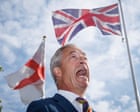
Party promised a Musk-inspired blitz at councils in England, but research shows it has failed to cut harder or faster than comparable local authorities When Reform UK secured a historic breakthrough in the May local elections last year, it was – according to the party leader, Nigel Farage – time for the UK to emulate Donald Trump and make sweeping local government cuts. At the time, the US president had enlisted the world’s richest man, Elon Musk, to run his “department of government efficiency” (Doge).
Party promised a Musk-inspired blitz at councils in England, but research shows it has failed to cut harder or faster than comparable local authorities
When Reform UK secured a historic breakthrough in the May local elections last year, it was – according to the party leader, Nigel Farage – time for the UK to emulate Donald Trump and make sweeping local government cuts.
At the time, the US president had enlisted the world’s richest man, Elon Musk, to run his “department of government efficiency” (Doge). During a 16-week blitz at the heart of the US government, Musk caused chaos, fired tens of thousands of workers and gutted USAID.
Farage promised voters that his new councillors would take a similar approach to local government.
Responsible for implementing this at Worcestershire county council was David Taylor, who was elected deputy leader of the minority Reform administration in May last year.
Yet nine months later, he quit the party live on the BBC, criticising the 9% council tax hike proposed by Reform. He told the Guardian his decision to leave was due to the lack of progress on the Doge-style overhauls. There was, he said, a “lack of conviction and ambition to make cuts and to look at waste in detail … In the end, it just fell flat and nothing happened.”
This is not an isolated instance: research by the thinktank Public First Global, seen by the Guardian, confirms that Reform-majority councils across England failed to cut harder or faster than comparable local authorities. They did not make the savings they promised in cuts to net zero or diversity, equity and inclusion (DEI) either.
The research looked at the spending intentions of six Reform-majority counties – Derbyshire, Kent, Lancashire, Lincolnshire, Nottinghamshire and Staffordshire – and compared them with several non-Reform-majority counties.
Of the £254m stated savings in the latest budgets of the Reform-majority councils, £30m to £44m represented genuine discretionary cuts – once savings inherited from previous administrations, changes in statutory demand and income generation were stripped out, the research found.
This constituted 12-17% of the headline figure and was “much the same proportion as the new discretionary savings we find in comparable non-Reform councils”, the analysis found.
Despite repeated pledges by Reform to scrap DEI and net zero initiatives in local government, their councils did not declare savings in these areas, according to PF Global. Instead, the savings referred to “corporate efficiency work”, such as £1.6m off consultancy fees in Lancashire, similar to county councils not run by Reform, the analysis found.
Damayanti Chatterjee, a director at PF Global, said the findings showed “Reform-majority councils don’t look very different on spending”, though they had been raising council tax more slowly.
She added that a definitive account of Reform-led spending could not be written before late 2027, when outturn figures for the financial year would be published.
Taylor said the outlook had initially appeared promising. When he met Zia Yusuf, Reform’s former head of Doge, at Worcester county council in June 2025 to discuss cuts and efficiencies, he was left feeling that the party’s intentions “did seem genuine”.
But he added: “Maybe they thought it was going to be too easy to walk into councils and set this up – that could have been a bit of an oversight at the beginning,” the now independent councillor said.
He said the initiative “hit choppy waters” owing to legal obstacles, such as GDPR legislation, which prevented the team from accessing sensitive data.
“I don’t blame the failure purely at the feet of anybody in particular, I think the idea was probably right, the premise was probably right, but maybe it was just unrealistic,” he added.
For opposition councillors at Worcester, the failure of Doge was inevitable, not least because local authorities are facing ballooning costs and demand for the statutory services such as adult and children’s social care that account for most of their spending.
Adam Kent, who was suspended from the Conservative party earlier this year for forming a coalition with the Green party to oust the minority Reform administration at the council, said the party made “wild promises” to the electorate “that didn’t seem to understand how the council actually worked”.
“They were making all these wild assumptions that they were going to find loads of waste as soon as they walked through the door and they didn’t realise that the council had been run really tight,” the now deputy leader at Worcester county council said.
Kent said the issues became apparent at the first council meeting after the May local elections, which he said lasted about 20 minutes and where the previous administration’s budget was left unchanged.
In the end, the Reform administration delivered the “polar opposite” to what it had promised voters – a 9% council tax hike, Kent said.
In response to PF Global’s analysis, Jack Shaw, the director of the thinktank Groundwork Research, said the Doge-style approach was “flawed from the outset”.
“Focusing on services that account for a small fraction of council spending, bringing in people with no experience of local government and expecting councils to hand over their data was not a credible approach,” Shaw said.
Rob Whiteman, a former local government chief executive and head of the Chartered Institute of Public Finance and Accountancy (Cipfa), said the figures were unsurprising as there were no “quick wins” that could bring down costs for councils.
“There isn’t widespread corruption and there isn’t widespread inefficiency,” he said. “It’s not a bad thing for politicians to feel that the state can be more efficient … but there is no quick easy win here.”
Reform’s head of local government, Ben Bradley, denied the party had overpromised and underdelivered on Doge and said it was still a “fundamental part of everything we do”.
Bradley, a former Conservative MP and Nottinghamshire county council leader, emphasised the “difficult financial situation” facing councils and said the past year had been a “huge learning curve” for many of the party’s councillors.
Bradley said the PF Global findings were like “comparing apples and pears”.
His view was echoed by the leader of Reform-controlled Lancashire county council, Stephen Atkinson, who said Doge-style overhauls and efficiencies had enabled the council to increase council tax by 3.8%, lower than the maximum.
Bradley added: “The powers to [implement Doge-style changes] in this country don’t exist,” he said. “What we’re trying to do here is to come into this sector that is broken, it’s fundamentally insolvent and unsustainable, and to try and find ways to get the best possible value for taxpayers’ money.”
- reform
- musk
- government
- end
- crackdown
- party
- blitz
- time