UK and France believed to have vetoed UAE choice for UN secretary general
Costa Rican diplomat remains frontrunner but needs to win over two more permanent members of security council The UK and France are believed to have effectively vetoed a controversial United Arab Emirates diplomat in a vote for the next UN secretary general, ostensibly over the UAE’s alleged links to atrocities in Sudan. The search for a new chief diplomat for the world remained deadlocked on Friday after the UN security council’s ninth straw poll once again did not settle on a candidate.
Costa Rican diplomat remains frontrunner but needs to win over two more permanent members of security council
The UK and France are believed to have effectively vetoed a controversial United Arab Emirates diplomat in a vote for the next UN secretary general, ostensibly over the UAE’s alleged links to atrocities in Sudan.
The search for a new chief diplomat for the world remained deadlocked on Friday after the UN security council’s ninth straw poll once again did not settle on a candidate.
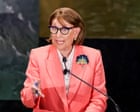
The Costa Rican diplomat Rebeca Grynspan remains the frontrunner. In Friday’s poll she collected enough votes (10) to win the position, but the winner must also have no votes against from any of the security council’s “P5” permanent members – the US, UK, France, Russia and China – of which she collected two.
At more than 100 days, the vote to replace the current secretary general, António Guterres, is already the longest in UN history. His second term ends on 31 December. Another vote is scheduled for next week.
Should she overcome the two security council countries who oppose her – believed to be the US and Russia – then Grynspan would become the first woman to lead the UN.
Second on the latest ballot was Argentina’s Rafael Grossi, with eight “encourage” but three “discourage” votes from among the P5.
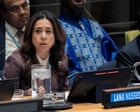
The Emirati diplomat Lana Nusseibeh, who had been a late entry into the race, received seven votes for but three against from the permanent members, a potentially insurmountable hurdle. Given her public support from the US and Russia and, according to multiple sources, it appeared likely she was effectively vetoed by the UK, France and China.
There has been widespread criticism over her candidacy due to the UAE’s ongoing links to the brutal conflict in Sudan. Nearly 70 MPs wrote to the UK foreign secretary, Ed Miliband, arguing Nusseibeh was not a “credible candidate” because she had “repeatedly denied and dismissed” reports by a UN panel of experts linking the UAE to atrocities in Sudan.
Consistent reporting from the UN panel and rights groups says the UAE has hired mercenaries for, and provided weapons to, the Rapid Support Forces (RSF), the Sudanese paramilitary group the UN and US have determined has committed genocide in Darfur. The UAE denies involvement.
Nusseibeh has taken a leave of absence from her ministerial post in the UAE government, “mindful of the obligations of independence” the UN role would require, adding that “the horrific conflict in Sudan will be the litmus test of the success of an incoming secretary general”.
China’s opposition to Nusseibeh is grounded in its commitment to an unwritten convention that the secretary general’s position observes a geographic rotation, so all parts of the globe are ultimately represented: while the rotation principle has been ignored before, it is now the “turn” of Latin America or the Caribbean to hold the post.
The process of electing the world’s chief diplomat is an arcane one, controlled by the security council, and dominated by the council’s five permanent members who wield an effective veto. Candidates need nine “encourage” votes from the 15 nations on the council: five permanent members (P5) and 10 elected members (E10). But the P5 carry an effective veto as a winning candidate must have the support of all five permanent members.
Elected members vote with white ballots, permanent members vote with red ballots. Voting is never disclosed but tallies are distributed through unofficial channels.
Daniel Safran-Hon, a senior adviser at the International Peace Institute who formerly worked in the UN secretary general’s executive office, said Grynspan was the “undisputed frontrunner”.
He said the Costa Rican, who is the head of the UN conference on trade and development (UNCTAD), needed to win over the remaining two P5 members resisting her candidacy.
“It is all speculation at this stage, but I would speculate that it’s not impossible. It’s not easy because the fact is that she’s been trying for a while to peel off American opposition, but she is the undisputed frontrunner: other candidates face a steeper hill.”
Grynspan has invoked her Jewish heritage to argue for the importance of ending conflict; her agency, UNCTAD, has exhaustively documented the economic damage wrought by Israel’s long-term occupation of the Palestinian territories. If elected, she would be the UN’s first Jewish secretary general.
She told the UN general assembly: “Peace is what made it possible for my parents, two refugees from the second world war, to find respect and dignity in a small country, Costa Rica. I am the daughter of this peace, a demonstration of what peace makes possible.”
- france
- uae
- secretary
- general
- diplomat
- choice
- security
- council