Cop31 failed but in ‘the real world’ the transition away from fossil fuels is inevitable
The summit’s failure was due to a refusal to admit we cannot confront the climate crisis without shifting to renewables The failure of Cop31 will be measured not in inches of negotiating text, or bland promises made by ministers and officials, but in lives and livelihoods, in hopes dashed and hardship endured, community leaders from around the world have warned. “Cop31 failed because it refused to name the issue at the core of climate change: fossil fuels,” said Edson Krenak, an Indigenous leader from Brazil and member of the Cultural Survival network.
The summit’s failure was due to a refusal to admit we cannot confront the climate crisis without shifting to renewables
The failure of Cop31 will be measured not in inches of negotiating text, or bland promises made by ministers and officials, but in lives and livelihoods, in hopes dashed and hardship endured, community leaders from around the world have warned.
“Cop31 failed because it refused to name the issue at the core of climate change: fossil fuels,” said Edson Krenak, an Indigenous leader from Brazil and member of the Cultural Survival network. “This presidency chose to ignore the urgency the world is already living through, turning a blind eye to the people who have died, been displaced and suffered this year alone, because of rising temperatures.”
The Australian president of negotiations, Chris Bowen, did not quite apologise for the failure. “Unfortunately we’re unable to reach agreement on a climate decision,” he told journalists outside the hall. “And that’s disappointing, very disappointing.”
For two weeks, ministers and high-level officials from 190 countries laboured over a few pages of convoluted text, only to produce, at the end, almost nothing. What was proposed as the main outcome, the prematurely named “Antalya pact”, inviting countries to electrify their economies and address the “overshoot” of global temperatures beyond 1.5C above preindustrial levels, was abandoned after a lengthening roll call of countries rejected it, during the final dramatic meeting on Sunday afternoon.
The collapse was almost unprecedented in the long history of Cops, because it was so clearcut. Other conferences have produced mediocre outcomes, but usually tried to salvage some face-saving semblance of unity at the end. But after a marathon final negotiating session that carried on more than 40 hours beyond its scheduled end, a small group of countries led by Saudi Arabia refused to accept an outcome that mentioned the need to “transition away from fossil fuels”.
Normally, as Cops proceed by consensus and even a few holdouts can change the outcome, that refusal would have been enough to force through a weakened final compromise that excised such commitments in favour of the presidencies’ preferred wording, referring only to an “irreversible transition towards lower greenhouse gas emissions”.
Instead, a large group of other countries led by the EU, the UK, small islands and least developed countries, decided they would not accept such a weak deal. When it came their turn to take the microphone, each in turn declared their objections – close to 40 countries registered objections or refusals.
Irene Vélez Torres, a former Colombian environment minister who earlier this year chaired a conference of 57 countries on the phaseout of fossil fuels, said this was the right outcome. “This Cop has failed, not because there are no pathways to advance climate action, but because there has been an attempt to erase from the final decision a reality that science has demonstrated and a growing number of countries already recognise: there is no way to confront the climate crisis without ending our dependence on fossil fuels,” she said.
Yet the developed countries that led the charge are riven with contradictions over the issue, as Mohamed Adow, the director of the Power Shift Africa thinktank, pointed out. “Europe’s hypocrisy is staggering. Its governments demand fossil fuel roadmaps from others while expanding fossil fuels themselves and blocking the finance poorer countries need to make the transition. Without money and credible action at home, those demands are hollow.”
In place of the cover decision, there was agreement on some side issues, including a “just transition mechanism” to help workers in high-carbon industries shift to the low-carbon economy, which was decried as toothless by campaigners. Commitments on finance to help the poor and vulnerable cope with the impacts of the climate crisis were sidelined.
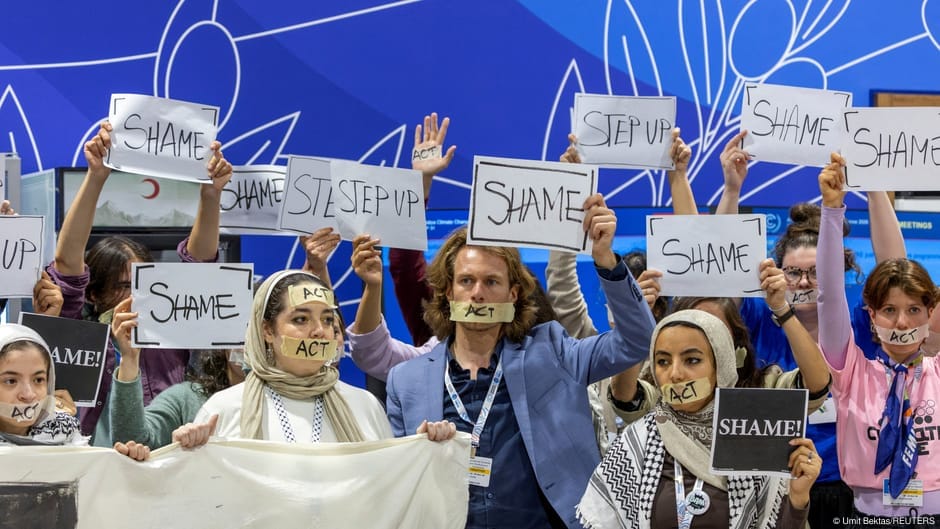
Tasneem Essop, the executive director of Climate Action Network, cried foul. “This was the worst Cop ever,” she said. “We are witnessing human suffering on an unimaginable scale, and we had hoped this Cop would take steps to protect people from the worsening climate crisis. Instead, rich nations gutted the very measures that could have made a difference. Negotiating room after negotiating room, developed countries systematically blocked measures that would require them to provide finance to protect people’s lives and address the climate crisis.”
The result also threatens the “multilateralism” on which Cops depend, which is crucial for many of the smallest nations and disadvantaged groups. For them, Cops are the only forum in which they can confront the authors of the fossil fuel crisis – the rich nations and petro states which have benefited from coal, oil and gas up to now.
“Despite the discouragement we feel today, we will keep betting on multilateralism,” said Juan Carlos Jintiach Arcos, the executive secretary of the Global Alliance of Territorial Communities. “We start from a clear premise: multilateralism is not built by political leaders alone. We remain hopeful that the world’s governments will find the courage to join us in this fight.”
The question now is how the world can put this right. For that, what is happening outside the windowless air-conditioned conference halls of Cop may be far more important than any Cop decision, or lack of one.
Renewable power has overtaken coal in China, reaching 60% of generation capacity, investment in clean energy around the world is twice that into fossil fuels, and electric vehicles have taken off, making up a third of new car sales in Europe and a majority in many other countries around the world, from China to Vietnam, Singapore and Iceland.
As Bowen said, in his final address: “The transition away from fossil fuels in the real world is inevitable. It’s happening, it’s happening at speed, and it’s irreversible.”
- world
- transition
- fuel
- failure
- climate
- leader
- summit
- refusal