The good news out of Cop31? That most of the world’s governments said no to an agreement stripped of meaning
The good news out of Cop31? Co-chairing global climate talks is clearly not something to be repeated, certainly not by Australia, which is exporting climate pain The failure of Cop31 in Antalya was a line in the sand moment, a victory for multiculturalism as countries stood up to the big fossil fuel producers and said no.
Co-chairing global climate talks is clearly not something to be repeated, certainly not by Australia, which is exporting climate pain
The failure of Cop31 in Antalya was a line in the sand moment, a victory for multiculturalism as countries stood up to the big fossil fuel producers and said no. The text they rejected barely recognised the catastrophic climate emergency we’re facing, let alone signalled a definitive move away from fossil fuels.
The good news is that most of the world’s governments rejected an agreement stripped of meaning. And the power of one particular fossil fuel producer, Saudi Arabia, needs particular scrutiny. What we also know is that co-chairing global climate talks is clearly not something to be repeated, certainly not by Australia. It didn’t work.
Governments have spent the past 35 years negotiating the global response to preventing “dangerous interference” with the climate system. Over that same period global warming has increased to close to 1.4C, with observed warming now accelerating above 0.3C per decade. Now, we’re facing an imminent breach of the Paris agreement’s critical 1.5C warming limit.
Successive Australian governments have either actively denied the problem exists – or have talked loud and long about how they are playing their role.
And what a role it has been! Australia’s coal exports have tripled since 1991; LNG exports have increased 20-fold. Australia now contributes about 4.3% of global fossil carbon emissions through both its domestic activities, and as the third-largest exporter of fossil fuels of all time.
Now that Australia’s efforts to host successful climate talks have failed so badly to deliver at a global level, we must turn to the urgent question: what will the government deliver for Australians at home?
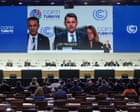
The prime minister, Anthony Albanese, has called the current decade “critical” for combating climate change. He told leaders at Cop31 they had a “solemn responsibility” to act – and he’s said that every fraction of a degree of warming prevented matters.
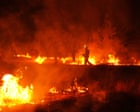
If anyone needed confirmation of that during the past year, they only needed to turn on the TV news or, in some cases, to walk out of their house. From Adelaide to Sydney, the south-east broiled in January. Bush burned, homes ignited, lungs filled with smoke. Can you guess what made the heat so brutal? And the floods so powerful?
Further afield, in countries that gave the Australian colony many of its people, things were equally desperate. Italy, Greece, Britain, Spain … all of Europe crackled through its summer, leaving an estimated 50,000 people dead before their time.
South and east Asia (many of them our LNG markets) shared the pain, with temperatures hitting a close-to-unliveable 52C in Pakistan. All of it driven by climate change; all of it driven by burning fossil fuels.
So that’s the logical framing when you hear government ministers from the prime minister down celebrating new fossil fuel finds, talking about how the country benefits from extracting and exporting coal, oil and gas.
The government clearly didn’t turn on the TV news nor leave its house this year: it was too busy planning for coal and gas exports staying close to present levels over the next decade, at exactly the time emissions globally should be halving.
In Australia’s approvals pipeline are four “carbon bombs”, defined by scientists as projects that could emit a billion or more tonnes of fossil CO2. Off the coast of Western Australia there’s the Browse gas development at the pristine Scott Reef, the Valhalla fracking project in WA’s Kimberley further north, the Beetaloo basin fracking project in the Northern Territory, and the massive Hunter Valley Operations coalmine in New South Wales.
Albanese’s ministers have shown little other than full-blooded support for these projects going ahead. Is it no wonder then that we left Antalya with no agreement?
Rather than a decision to build on the transition away from fossil fuels (TAFF) roadmap initiated by Brazil, the only reference to fossil fuels remaining in the final text offered by Turkey was the industry’s favoured get-out-of jail-free technology – carbon capture utilisation and storage (CCUS).
The Australian government has already thrown its weight behind CCS, including special legislation to allow for offshore CO2 disposal, with virtually no evidence of its effectiveness. It is an open secret that the world’s biggest CCS project at Chevron’s Gorgon project has spectacularly failed to deliver but this has not stopped the government backing this failed technology.
We couldn’t even see the call for 35% electrification by 2035 be “clean” even with science clearly showing that if it’s not clean it will increase fossil gas use – adding a tenth of a degree of warming by mid-century.
Indeed, while the prime minister says every tenth of a degree of warming matters, his problem is that lowering every tenth of a degree of warming means his beloved gas industry loses more market share.
This week the WA premier, Roger Cook, jets off to Japan with gas giant Woodside – to talk up LNG markets.
It’s unlikely he’s going there to tell the LNG industry what’s needed to limit warming to 1.5C.
It’s also unlikely he’ll mention the International Energy Agency’s report last week showing that to limit warming to 1.5C, fossil gas demand falls by about 40% from 2025 levels by 2035, driven by rapid electrification of end-uses, efficiency improvements, and the displacement of gas-fired power generation by renewables.
Australians are looking to their federal and state governments to protect them from the terrifying ravages of climate change, yet those governments’ actions appear hyper-focused on fuelling more of it. And co-hosting the climate talks clearly didn’t help.
The government says it’s serious about climate action. By their fruits ye shall know them.
Bill Hare, a physicist and climate scientist, is the chief executive of Climate Analytics
- news
- world
- agreement
- meaning
- climate
- fuel
- government
- talk