What happens if a nuclear weapon explodes in space?
Earth's atmosphere offers protection from a nuclear blast in space, but satellites are more exposed. We explain how radiation could damage them, why the effects can linger and what protection is possible.
A nuclear explosion in space would be unlikely to cause widespread injuries on Earth. But it could disable satellites that provide services we depend on every day, including some that save lives.
In the United States, satellite failures could make it harder for emergency crews to communicate in remote areas. If GPS were also disrupted, drivers and pilots could lose navigation guidance, and financial networks could lose a source of precise time.
We have some idea of what would happen because it's already been done.
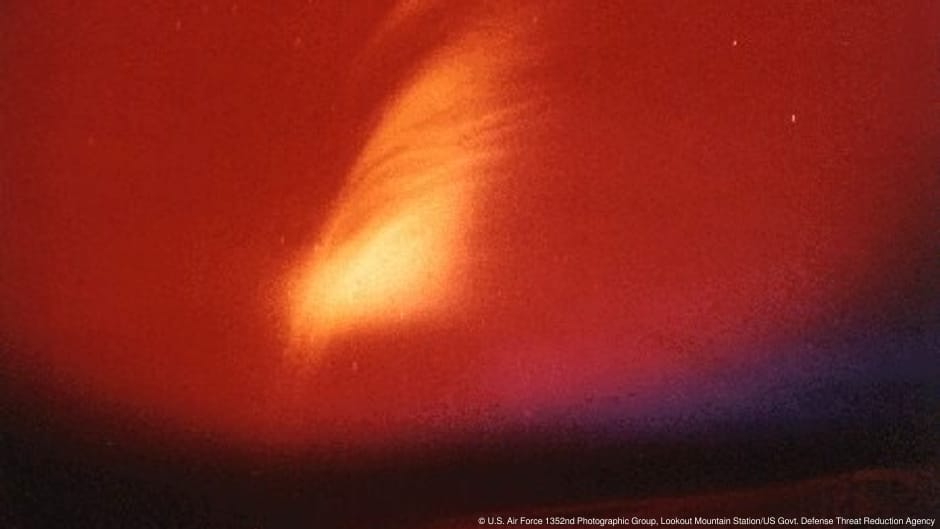
On the evening of July 8, 1962, people in Hawaii held "watch-the-bomb parties" and followed the countdown on shortwave radio. Then the night sky lit up. The United States had detonated a nuclear weapon about 400 kilometers (250 miles) above the Pacific. The test was called Starfish Prime.
An electromagnetic pulse knocked out some streetlights in Hawaii, and some Pacific radio links briefly went down. The glow faded within minutes, but some satellites failed months later.
The air was too thin for a conventional fireball to form or for a destructive shock wave to reach the ground. Charged particles made denser air below glow, creating an artificial aurora. The atmosphere also absorbed much of the initial radiation.
Satellites are especially vulnerable because they orbit above most of the atmosphere that shields people on the ground from the initial radiation.
In orbit, the initial burst of X-rays can damage spacecraft right away. But Earth's magnetic field can also trap electrons released after the blast, as it did after Starfish Prime. Satellites receive another dose each time they cross the resulting radiation belt. Over time, that exposure can damage electronics and solar panels.
That would depend on where the explosion happened and which satellites crossed the radiation belt. GPS satellites send signals that help phones, planes and ships work out where they are. They orbit about 20,200 kilometers above Earth and could keep working even if satellites closer to Earth failed.
But satellites do different jobs. A ship's emergency beacon can use GPS to work out its location, then send it to rescuers through a separate satellite network. If part of that network failed, the alert could take longer to get through.
The 1967 Outer Space Treaty bars its parties from placing nuclear weapons in orbit. The 1963 Limited Test Ban Treaty prohibits its parties from carrying out nuclear explosions in space.
The Outer Space Treaty has no dedicated system for checking what spacecraft carry. A detonation is easier to detect because US satellite sensors are designed to pick up the signals it gives off.
Shielding could help protect satellite electronics, and backups could keep some services running. During a GPS outage, pilots over the contiguous US can use ground-based navigation aids. Operators could launch replacements, but those satellites could still face lingering radiation or debris.
Radiation could leave many satellites intact but unable to steer. If two objects collided, fragments from the crash could hit other satellites, creating more debris and triggering further collisions. If enough debris built up for the chain reaction to keep going on its own, it could continue even if no new satellites were launched. This is known as Kessler syndrome.
Whether an explosion would trigger such a cascade is uncertain. If it did, the debris could endanger replacement satellites for years.
Some radioactive particles could enter the atmosphere and eventually settle on the ground. But a blast in space is too far away to sweep up the soil and water that carry fallout from a surface explosion.
As the particles disperse, their radioactivity decreases over time. The concentrated local fallout that can expose people near a ground-level blast to high doses would be unlikely.
- space
- weapon
- protection
- earth
- atmosphere
- blast
- satellite
- radiation