Aberfan: From Darkness to Light review – Mealor’s requiem offers hope amid the tears
Hoddinott Hall, Cardiff A thoughtful and moving concert – with Paul Mealor’s new choral work its centrepiece – commemorated the 60th anniversary of the Aberfan disaster A concert requiem of hope is how composer Paul Mealor describes his new choral work Aberfan: From Darkness to Light, commemorating the 60th anniversary of the disaster that killed 116 children and 28 adults. Heard first in the Aberfan Community Centre with the voices of children from today’s junior schools – Ynysowen Primary School and Ysgol Gymraeg Rhyd y Grug – joining the Ynysowen Male Voice Choir, the BBC National Chorus…
Hoddinott Hall, CardiffA thoughtful and moving concert – with Paul Mealor’s new choral work its centrepiece – commemorated the 60th anniversary of the Aberfan disaster
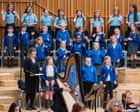
A concert requiem of hope is how composer Paul Mealor describes his new choral work Aberfan: From Darkness to Light, commemorating the 60th anniversary of the disaster that killed 116 children and 28 adults. Heard first in the Aberfan Community Centre with the voices of children from today’s junior schools – Ynysowen Primary School and Ysgol Gymraeg Rhyd y Grug – joining the Ynysowen Male Voice Choir, the BBC National Chorus of Wales and an instrumental ensemble, this second performance, again conducted by Timothy Redmond, had the full weight of the BBC National Orchestra of Wales. While the focus on hope coloured the whole, it was – not surprisingly – the bright, shining voices of the children, their every syllable crystal-clear, which made one well up.
Setting words by Grahame Davies, whose poetic sequence of narrative and verse balanced remembrance with reflection, the piece was, at its heart, a celebration of life and the culture of the valley. Both librettist and composer were guided by Aberfan people themselves who asked that the spirit of hope and renewal be invoked, and that present and future be implicit alongside recognition of the tragic past.
With Mark Lewis Jones narrating, this then was a story simply told, neither shying away from the horror, nor from pointing a finger at those who might have prevented the disaster, and remembering the heroic bravery of the rescuers and of those who perished. A lyrical melancholy – especially from cor anglais and oboe – was present in the orchestral transitions yet, overall, Mealor’s achievement was in finding musical language, often vibrantly rhythmic and percussive, to carry the different facets over a span of 40 minutes without sounding sentimental or maudlin, and making the children’s playful singing feel the most natural thing in the world. At the end, a member of the audience was heard to say that they could not have imagined the piece would have such joy.
By way of preface, Anna Clyne’s This Moment – inspired by the calligraphy of the Buddhist monk, Thich Nhat Hanh – had meditated on death and life, on rain and tears. Together with movements from symphonies by Haydn and Mozart and a stirring performance of Vaughan Williams’s Toward the Unknown Region, setting Walt Whitman’s poem on spiritual death and rebirth, a concert which might only have represented grieving also invited a deeper kind of contemplation.
- aberfan
- hope
- mealor
- darkness
- light
- requiem
- child
- voice