World reacts to Trump’s new tariffs as US stocks tumble

The new levies come after an eight-month investigation launched by the United States Trade Representative.
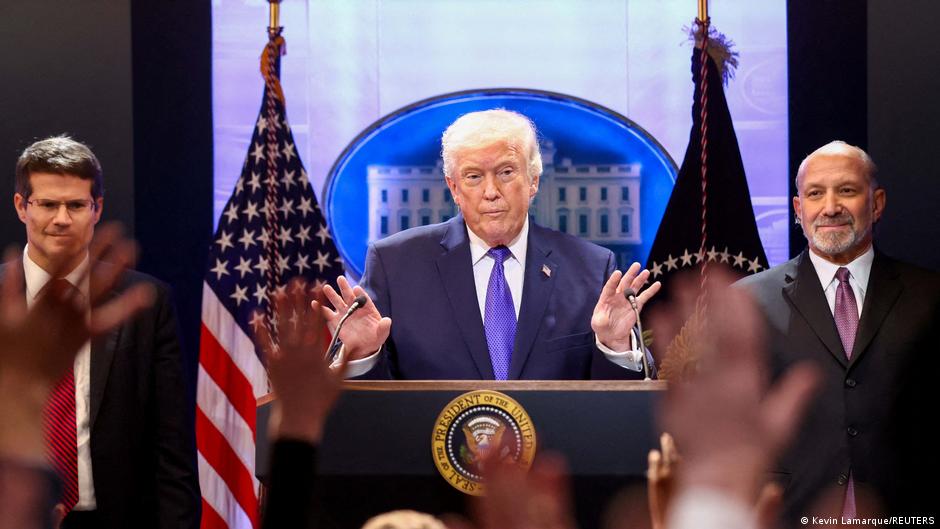
The Trump administration has announced new tariffs on 14 major trading partners, including China and the European Union, claiming that excess production has given them an unfair advantage.
The proposed levies come after a months-long investigation into the trade practices of 12 countries, the 27-member EU and the self-governing island of Taiwan, launched after the Supreme Court struck down United States President Donald Trump’s sweeping global tariffs in February.
The highest tariff rate announced on Wednesday would hit China the hardest, at 20 percent, adding to the roughly 25 percent duties that Trump imposed on China during his first term.
The proposed tariffs would not apply to about $30bn of Chinese imports under consideration for tariff reductions through a bilateral mechanism known as the Board of Trade.
Washington has long accused China of subsidising its industries and flooding global markets with low-cost exports ranging from steel to electric vehicles and solar products, allegations that Beijing has once again denied.
“The so-called ‘overcapacity’ is a false issue, and China opposes using it as an excuse for political manipulation,” Foreign Ministry spokesman Guo Jiakun said, urging the world’s two top economies to maintain stable relations.
Other US trading partners facing proposed new tariffs include India, Japan, South Korea, Indonesia, Bangladesh, Cambodia, Malaysia, Singapore, Switzerland, Taiwan, Thailand and Vietnam.
Mexico and Norway were also part of the probe but were excluded from the new round of tariffs because investigations into their trade practices are still ongoing.
The tariff announcement follows an eight-month investigation initiated by US Trade Representative Jamieson Greer, under Section 301 of the US Trade Act of 1974, which permits the president to impose import taxes and other sanctions against countries found to engage in unreasonable or discriminatory trade practices.
“The administration’s use of Section 301 is cynical,” Gregory Shaffer, professor of international law at the Georgetown University Law Center, told Al Jazeera. “It launched these investigations in order to support the president’s aim to set tariffs globally and to modify them at any time at the president’s will, and thus strip Congress of the authority to set tariff rates under the taxing power set forth in the Constitution.”
In a separate announcement, the White House also announced a proposed 10 percent tariff on finished aircraft made by Brazilian planemaker Embraer, whose jets are widely used by US regional carriers operating under brands including United Express, Delta Connection and American Eagle. Finished aircraft are Brazil’s fourth-biggest export to the US.
The US also plans to raise duties on imports of Brazilian sugar that exceed quotas as part of an effort to push Brasilia to rectify alleged unfair trade practices, according to a senior US official.
Several governments have reacted to the new tariff announcement, as has the European Union.
“The EU takes note of the publication by the US of preliminary findings pursuant to its Section 301 investigation concerning structural excess capacity in manufacturing sectors,” European Commission spokesperson Olof Gill told Al Jazeera.
“We will study the findings. At the same time we strongly reject the premise that Europe is a source of structural overcapacity. To the contrary, Europe is among those most exposed to overcapacity,” Gill added.
The Swiss government has also reacted, saying that it rejects the allegations stemming from the investigations.
“The timing right before the G20 [in mid-December] sets up those meetings as an opportunity for negotiation and increases risk of both inflationary pressures and macro volatility in 2027, reducing some of the benefit from easing gas prices,” Rachel Ziemba, adjunct senior fellow at the Center for a New American Security, told Al Jazeera.
“We have been clear throughout the process that Norway does not have policies that contribute to overcapacity. Norwegian companies produce in response to market demand,” Foreign Minister Espen Barth Eide said.
US markets are trending down on news of the new tariffs. The tech-heavy Nasdaq tumbled 3.9 percent in early trading on Wednesday. The S&P 500 is down 2.8 percent, and the Dow Jones Industrial Average slumped by 1.4 percent.
The price of gold – which is considered a safe investment in times of economic uncertainty – fell by more than 3 percent to its lowest level in more than a year. However, in addition to tariffs, the price was influenced by inflation data released on Wednesday which showed a 0.3 percent rise in one of the US Federal Reserve’s key metrics for assessing the rate of inflation. Higher inflation increases the chances of a rise in interest rates, which in turn weighs on the metal.
Bond yields in both the US and Europe dropped on Wednesday.
Germany’s 10-year bond yield, which is the benchmark for the eurozone, slid by 4.5 basis points to 3.2 percent, while the US 10-year Treasury note yield stumbled by 6.8 basis points to 4.834 percent, putting it on pace for its seventh daily drop over the past eight sessions.
- world
- trump
- tumble
- react
- tariff
- stock
- levy
- month