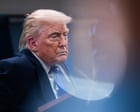
Live: ASX to open higher after US tariff announcement
The Australian share market is set to open higher as the US president announces more tariffs on 14 trading partners. Follow the day's events and insights from our business reporters on the ABC News live markets blog.
The Australian share market is set to open higher in morning trade after losses on Wall Street.
US stocks fell overnight after US President Donald Trump announced sweeping tariffs that will to impact more than a dozen trading partners.
Follow the day's financial news and insights from our specialist business reporters on our live blog.
Disclaimer: this blog is not intended as investment advice.
Choose what information you see below by using filters
The tariffs may well not take effect until next year.
The measure must go through a public comment period and a hearing, meaning its implementation could be delayed until January.
The tariff follows a months-long investigation by the White House into alleged "excessive industrial production."
The investigation also examined Chinese investments in Southeast Asia (Vietnam, Indonesia, and Cambodia), which the United States claims are used to produce goods for the U.S. market in order to evade tariffs.
The investigation began on March 11 under Section 301 of the Trade Act of 1974, which empowers the USTR to respond to foreign practices that harm U.S. trade.
At that time, Trade Representative Jamieson Greer stated that the US "will no longer sacrifice its industrial base" to nations that may be "exporting their problems."
The initiative is ultimately an effort to rebuild Trump's global tariffs, which the Supreme Court struck down in February.
A senior official indicated that Washington "seeks stability with the Chinese," does not foresee retaliation from Beijing, and believes the tariffs are meant to facilitate new trade agreements, possibly during the G-20 meeting in December in Miami.
China denied the allegations, arguing that its exports reflect competitive advantages.
The European Commission denied that the EU exports excess capacity. Olof Gill , its deputy spokesperson, stated that the origin of the issue "does not lie in Europe" and that Brussels would react "firmly and proportionately" if Washington violated the trade agreement established in the summer of 2025, which set a limit of 15 per cent.
In all, fourteen economies are affected.
They will apply to goods from China, Bangladesh, Cambodia, the European Union, India, Indonesia, Japan, South Korea, Malaysia, Singapore, Switzerland, Taiwan, Thailand and Vietnam.
Mexico and Norway are not included as their cases are still under review with no deadline.
They follow a months-long investigation by the White House into alleged "excessive industrial production".
Washington officials stated that the economies affected by the new tariffs "promote production and capacity that are disconnected from the realities of demand and market principles".
The new duties will stack on top of some previous tariffs already imposed during Mr Trump's second term.
However, many of those rates will be capped at lower rates because of deals already struck between the Trump administration and individual countries.
The highest surcharge of 20 per cent would be imposed on China, adding to the nearly 25 per cent tariffs Trump had already established in the past.
In other cases, the rates would not exceed those agreed upon in previous trade agreements, which are set at 15 per cent for the EU, Japan, South Korea, and Taiwan, and 19 per cent for Malaysia. Negotiations with India and Vietnam have not yet concluded.
The 20 per cent limit for China is explained by a trade truce that ends on January 10.
The new tariffs would not be added to the 10 per cent or 12.5 per cent tariffs that the United States imposed in July on 60 partners due to forced labor regulations, nor would they cover roughly $30 billion of Chinese imports included in a bilateral trade mechanism.
The Trump administration considers China the largest source of excess capacity in sectors such as steel, aluminium, electric vehicles, appliances, and solar products.
US President Donald Trump has announced a new round of sweeping tariffs on 14 major trading partners.
As it stands, Australia is not one of them.
The rates could be anywhere between 20% and 40%.
We will break down the announcement this morning, but to start with, here is an overview from Elissa Fitzgerald:
Good morning everyone and happy Thursday,
Business reporter Adelaide Miller here to guide you through the morning on the markets blog, where we cover the latest business, finance and economics stories from across the globe.
To begin with, the ASX 200 is set to open higher later this morning, with Futures pointing up +0.7% to 8,729 points.
That's as much of Wall Street fell, as US President Donald Trump announced a new round of sweeping tariffs.
For now, grab yourself a coffee and see you back here soon!
- tariff
- asx
- announcement
- market
- share
- president
- trading
- partner